Foundations and Nonprofits Do Little to Include People With Disabilities, New Study Says

By Jim Rendon
Executive Editor
April 25, 2019 | Read Time: 5 minutes
Nonprofits and foundations do a poor job of hiring, accommodating, and including people with disabilities, according to a report released today by the disability-rights group RespectAbility. The organization surveyed 969 people who work at charities and foundations. It found the majority of organizations have policies that prohibit discrimination against people with disabilities but that those policies often fail to promote real inclusion.
“Philanthropy and the nonprofit community are at the heart of what drives progress in the world,” says Jennifer Laszlo Mizrahi, president of RespectAbility. “We want to be at the table to help set the agenda and help solve problems for all people, and we are being excluded.”
The study comes out just weeks after the leaders of the Ford Foundation, the Robert Wood Johnson Foundation, and 13 other large grant makers announced the creation of the Presidents’ Council on Disability Inclusion in Philanthropy.
‘A Whole Lot Less Attention’
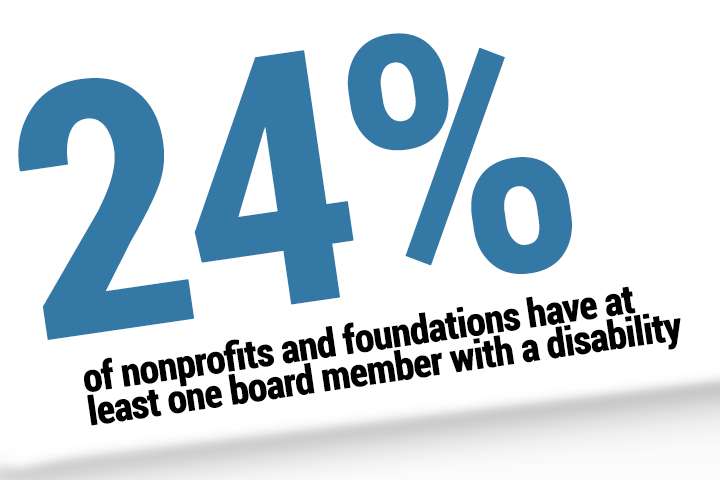
According to the Centers for Disease Control, one in four adults has some form of disability. But only 24 percent of the organizations surveyed had a single board member with a disability.
John Feather, chief executive of Grantmakers in Aging, a national association of foundations and corporations that fund nonprofits serving older people, responded to the survey. His organization does not have any board members or employees with a disability, to his knowledge, he said in an interview. He says that his group and many of those in his association have focused on racial diversity, equity, and inclusion but not disability, even though their focus is aging, a time of life when an even larger percentage of people have disabilities. “Disability has received a whole lot less attention,” he says.
Many foundations don’t track how many staff or board members have disabilities, says Stephanie Powers, vice president for policy and partnership at the Council on Foundations. These organizations commonly track their racial composition, but Powers says that the question about the number of people with disabilities in her organization’s annual survey generally goes unanswered. “It is not anything malicious or malevolent,” she says. “It just doesn’t occur to them to ask.”
Inaccessible Web Content
Few organizations take even simple steps to make their online content more broadly accessible. The survey found that only 14 percent of organizations included captions in their online video content for hard-of-hearing viewers, despite the fact that YouTube provides this service free.
“Why wouldn’t you want 38 million Americans to view your content?” says Mizrahi. “These organizations don’t know how many people are impacted and had no idea the service was free.”
Additionally, only 30 percent of those surveyed said that they allow participants at public events to request sign-language interpreters or food-allergy alternatives.
Mizrahi has not surveyed for-profit companies, but she says they are likely far ahead of the nonprofit and foundation world when it comes to hiring people with disabilities. Some large corporations like Ernst & Young, for example, are known for recruiting employees with disabilities. Federal contractors are required to seek out disabled individuals and retain them and have a goal of hiring people with disabilities for 7 percent of their staff.
Henry Berman, CEO of Exponent Philanthropy, an association that serves small foundations, says the conversation about disability is just beginning among his members. “Over the last few years, the major push around diversity, equity, and inclusion has been focused to a great extent around race,” he says. “I believe that disability issues need to be woven into that as well.” Exponent Philanthropy doesn’t have any board members with a disability, as far as Berman knows.
His member foundations are interested in the issue. Nearly half of them make some grants to disability organizations.
“It is almost a bit like you hit yourself on the forehead — ’Oh my gosh, I never thought about it. I need to understand this,’ ” he says. “It is a positive indicator for me that they are open and willing to learn.”
Failing Grades
In the survey, the most common reason — cited by 36 percent of respondents — that organizations failed to reach out to or hire people with disabilities was bias. When asked to rate their organization’s diversity when it comes to disability, 55 percent of survey participants who work at nonprofits gave their organizations the two lowest ratings. The foundations surveyed fared even worse — 69 percent of the grant makers surveyed chose the two lowest ratings.
But the survey found that small steps such as having one or more employees or board members with a disability makes a difference. According to the survey, 38 percent of those organizations made efforts to recruit disabled candidates for job openings compared with just 23 percent of groups who didn’t have any staff or board members with disabilities.
Policies matter, too. Organizations that had a diversity policy that included people with disabilities were more than twice as likely to have disabled staff members than those groups that lacked a diversity policy.
The Ford Foundation’s announcement in 2018 of its effort on diversity inclusion caused a number of other foundations and nonprofits to take notice, says Powers. Ford pledged to review its hiring practices and make sure its grant-making process and events are accessible to all. It also set up the Disability Philanthropy Forum, which has 200 members, to provide an online community for discussion about inclusion.
Stronger Organizations
When groups are inclusive, the results are well worth the effort, says Mizrahi. She brought this issue to the attention of the Jewish Federation of Greater Washington and helped the organization become more inclusive in its work. Due in part to the effort, the organization has benefitted in many ways, she says. It has 200 more volunteers than it did before, and its fundraising has increased by $1 million.
“Organizations can be stronger by including people with disabilities in solving whatever problem they already are trying to solve. They should not think of this as a distraction,” says Mizrahi. “It’s about making sure people with disabilities can contribute their time and talent and treasure to advancing the missions that these foundations and nonprofits already are focused on.”