
Goodwill in Your Lobby? Giving Made Easy for City Dwellers

By NICOLE WALLACE
Features Editor
March 29, 2015 | Read Time: 2 minutes
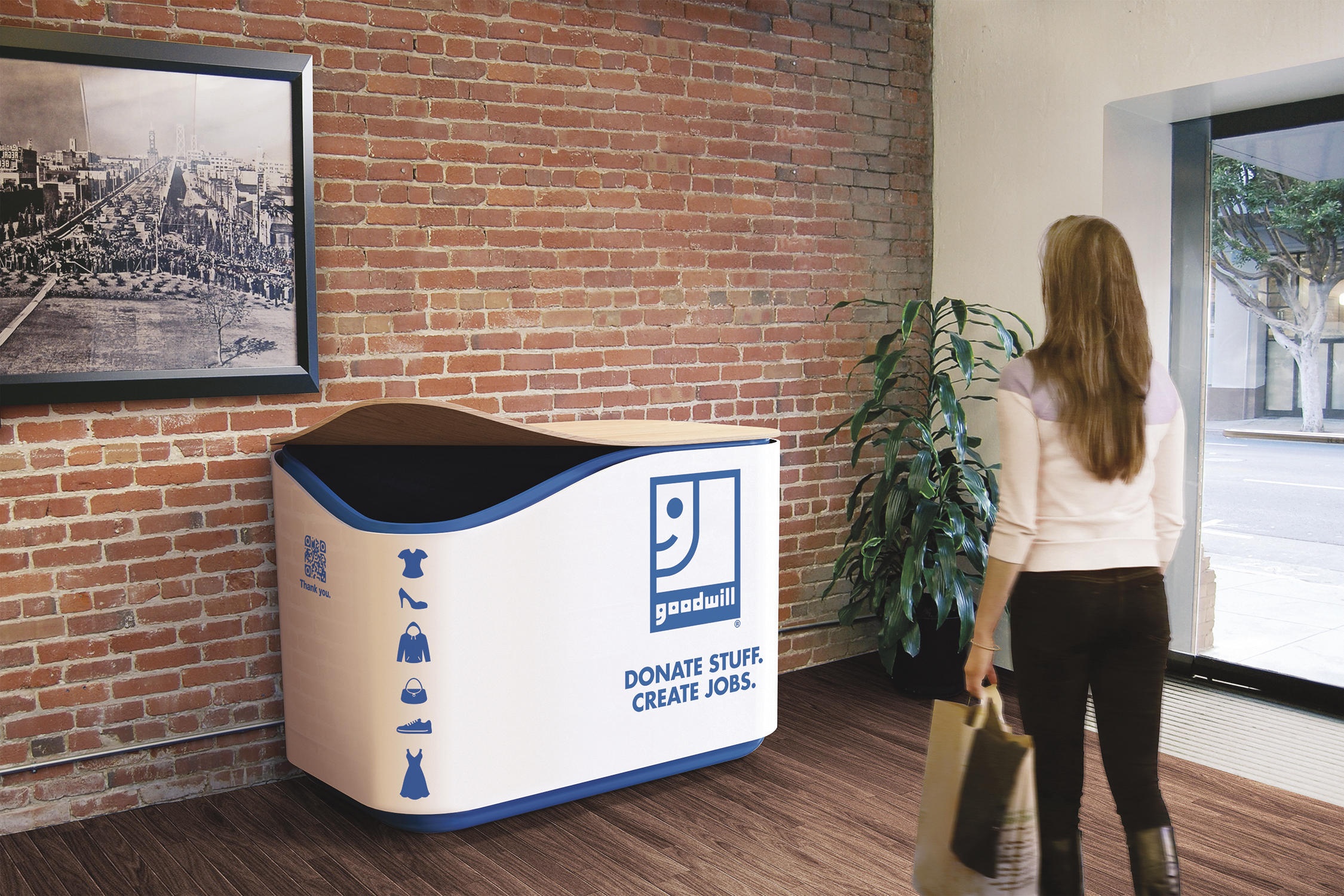
When most people think about giving clothing to Goodwill, they picture pulling up to a donation dumpster in a parking lot and unloading the car trunk. But a growing number of people in San Francisco and other big cities don’t drive. That’s why Goodwill of San Francisco, San Mateo, and Marin created goBINs, sleek new donation receptacles designed for the lobbies of large apartment and office buildings.
The nonprofit hopes to attract clothing donations that would otherwise end up in the landfill, and maybe change the way Goodwills across the country collect goods from city residents.
The bins include a smart sensor that measures how full the container is and alerts the nonprofit when a pickup is needed. The sensors are connected to software that plots the most efficient route for drivers to make the day’s pickups.
Overflowing bins would quickly sour the nonprofit’s relationship with building managers, so Goodwill knew it needed a way to get alerts about the level of donations, says Maureen Sedonaen, chief executive of the San Francisco Goodwill. “Without the technology, it’s just a box,” she says.
People who donate items can use their smartphones to scan a QR code — a bar code that links to online information — on the bin to learn how their contributions will help Goodwill. They can also enter an email address and a list of the items they donated to get a gift receipt for tax purposes.
After working through several prototypes with Frog Design, a product-development firm, the charity will place the first five goBINs in lobbies this spring. The plan is to start with four apartment buildings and one office building.
The new bins are part of the organization’s strategy to attract more donations of clothing and accessories. Part of the reason is environmental: Textiles make up more than 5 percent of landfill volume in San Francisco — more than 39 million pounds each year. And part of the reason is practical: Textiles are easy to transport, and clothing that is too worn-out for the nonprofit to resell in its stores can be recycled as insulation or sold for use overseas.
“We know with textiles that nothing’s going to go to waste,” says Tim Murray, a vice president at the organization.
The San Francisco charity is selling goBINs to other Goodwills. The price starts at $899 per bin, with a minimum order of five, and orders are already starting to come in.
Ms. Sedonaen thinks the bins have the potential to change the way people donate clothing in urban areas.
“It’s not just about having some whiz-bang gadget,” she says. “It really is about responding to communities and to a population of people who are using technology in their everyday lives. This is a tool for us to slide right in there and help them do the right thing.”





