Savvy Use of Social Media Helps Propel Rapid Growth for Giving Tuesday

By TOM HELD
Contributor

October 19, 2014 | Read Time: 6 minutes
On November 20, Hallie Tamez plans to lug a yellow five-gallon jerry can the length of Manhattan.
Her 10-mile urban trek will mimic the one that millions of women and children make daily to provide water for their families—and will provide a feet-on-the ground promotion for Giving Tuesday, a philanthropic effort added to the post-Thanksgiving shopping season of Black Friday and Cyber Monday.
A fundraiser at WaterAid America, Ms. Tamez plans to ask people she encounters on the walk to take pictures of her and post them on social networks to draw attention to how they can help her charity during this year’s Giving Tuesday, on December 2.
Ms. Tamez’s approach is in line with what the organizers of Giving Tuesday hope to achieve: a movement, fueled by social media and in-person events, to spark volunteerism and donations while expanding the base of donors from which charities can solicit gifts long after the holidays.
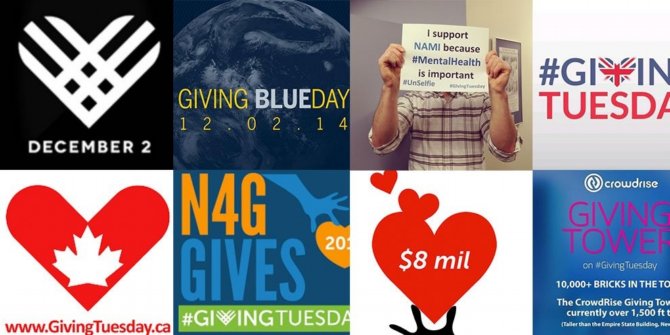
Last year, Giving Tuesday generated $19-million in online donations, as tracked by Blackbaud. That amount was 90 percent more than in 2012, the first year the event was held. Network for Good, which also helped process online donations, tallied another $2-million. Meanwhile, the hashtag #Giving Tuesday appeared 270,000 times on Twitter and reached nearly two billion followers, an increase of 338 percent over 2012.
WaterAid, which helps build water and sanitation systems in developing countries, is among more than 10,000 U.S. and international charities, corporations, schools, and business organizations that plan to participate this year.
Varied Approaches
Many of those participants are now doing the same as WaterAid: developing creative ways to get attention on or before Giving Tuesday.
“It’s a mob mentality, but in a good way,” Ms. Tamez says.
Among the approaches groups will employ on December 2:
- The Arkansas Nonprofit Alliance will host press conferences around the state and promote Unselfie Booths on college campuses, encouraging students to post photos of themselves donating or volunteering, in a push to raise $250,000.
- The Lothian Autistic Society, in Edinburgh, Scotland, plans a treasure hunt that will feature, in the windows of participating businesses, posters containing clues and information on donating.
- Projects for All, which develops digital schools around the world, is encouraging children to post photos from outdoor computer kiosks.
- Microsoft will match gifts donated through YouthSpark on Global Giving, an approach that helped raise nearly $1-million on Giving Tuesday in 2013.
Already, nonprofits have announced goals exceeding what they raised on Giving Tuesday last year, and which could well top the sums raised in each of the past two years.
The United Methodist Church, for example, has a Giving Tuesday goal of $8-million, a big jump from the $6.5-million raised in 2013.
The Donors Forum in Illinois set its goal at $12-million statewide, in its first #ILGiveBig campaign, a combined appeal through social media to direct donations to participating nonprofits. Nonprofits registered for #ILGiveBig will report their totals to the Donors Forum.
Similarly, the Maryland Association of Nonprofit Organization set its goal at $12.2-million through #MDGivesMore. The association is taking over and expanding the #BMoreGivesMore campaign that last year raised roughly $5.7-million for charities in and around Baltimore. Organizers hope that 3,000 charities will use the #MDGivesMore name and hashtag to raise money on Giving Tuesday.
Beyond the dollars raised online on Giving Tuesday, charities say they get added benefits by sharing stories about their work on social networks during the day. That, in turn, can promote continued donations after Giving Tuesday wraps up.
“We never wanted it to be a telethon,” says Henry Timms, executive director of the 92nd Street Y, who was the driving force behind the first Giving Tuesday in 2012, along with Kathy Calvin, chief executive of the United Nations Foundation.
“What Giving Tuesday did was provide a context for really creative and entrepreneurial leaders in nonprofits around the country to tell stories and engage people,” says Mr. Timms.
WaterAid America, for example, brought in nearly $200,000 on Giving Tuesday last year and believes another $300,000 it received in the months that followed was spurred by attracting new donors that day.
For 2014, WaterAid America has a $150,000 matching grant it will use to encourage donations on Giving Tuesday.
Expanding Outreach
Nonprofits also credit Giving Tuesday with sparking volunteer projects and attracting new supporters.
Clicks on the website of the Family Dinner Project, in Cambridge, Mass., nearly doubled during last year’s campaign, and the nonprofit received hundreds of new subscribers for its newsletter promoting the benefits of family discussions about values and healthy meals.
“The numbers weren’t huge, but they were significant,” says Shelly London, a founder of the Family Dinner Project. “For us, just the way we work, that was a big deal for us. It was our first marketing effort, our first foray into spreading the word in a bigger way.”
That was one of the goals that appealed to the UN Foundation’s Ms. Calvin.
“Lots of nonprofits and charities that hadn’t learned to use social media valued this as an opportunity for them to do this for the first time,” Ms. Calvin says.
“The big driver was to create something of a different conversation around philanthropy and answer a different question: How do you engage a younger generation,” she says. “The whole focus on social media and the way we’re communicating was about creating a change in the face of philanthropy.”
Mr. Timms says Giving Tuesday has gone “well beyond any expectations we originally had.”
He and others involved in Giving Tuesday say the success has come in part from a desire among donors to be part of a big movement focused on doing good.
“We all get up in the morning and we want to make the world better,” says Wendi Copeland, senior vice president of strategy and advancement at Goodwill. “We look around our communities, or you walk past someone homeless on the street, or you take the metro with someone struggling with their kids, or read about domestic violence, and wonder, ‘What can I do about this.’ ”
Goodwill chapters will participate in the 2014 Giving Tuesday effort, using templates and social-media pitches that can be customized for each location around the country.
The approach proved successful in 2013, particularly for Goodwill of Greater Washington, D.C., which had a modest goal of $2,500 and brought in five times that amount.
But Ms. Copeland and others involved in Giving Tuesday say joining the movement will not replace the year-round fundamentals of success for nonprofits.
“We should be telling the story all of the time,” Ms. Copeland says. “Our opportunity as a sector and community is to see how we parlay Giving Tuesday into an awareness that there are 364 other days of need in our community.”
For some nonprofits, the success of Giving Tuesday will create a new challenge: devoting the time and resources to keeping donors and volunteers excited and involved.
Ms. Tamez, while preparing for her hike, is also getting ready to step up the personalized thank-you messages and phone calls to the new donors she hopes to add to WaterAid’s rolls on December 2.
“The people who make that first gift have come to the game, but they’re not fans yet,” she says. “The next job, and the bigger job, is to make them fans. That needs to start fairly immediately after that first gift.”