

February 11, 2014 | Read Time: 5 minutes
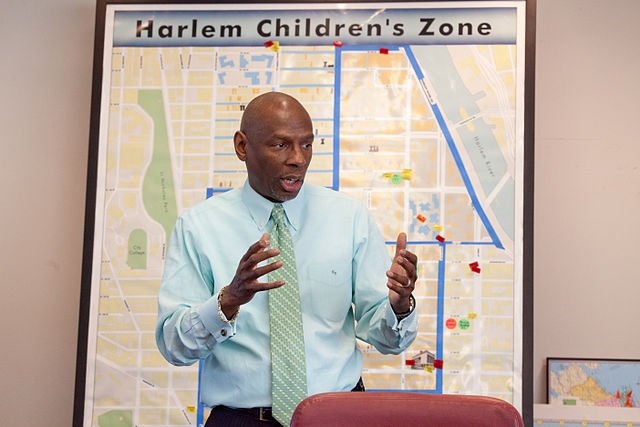
Geoffrey Canada, one of the nation’s most prominent nonprofit leaders, announced today he plans to step down as chief executive of Harlem Children’s Zone after more than 20 years at the helm.
Mr. Canada, 62, will keep his position as president of the antipoverty group but will hand over day-to-day responsibilities on July 1 to Anne Williams-Isom, the group’s chief operating officer since 2009.
He says he and the board had been planning such a move for several years and that Ms. Williams-Isom became the obvious candidate to succeed him about two and a half years ago.
“I have been concerned that one of the major strategic errors that not-for-profit leaders make is they don’t take succession planning seriously,” Mr. Canada said in an interview.
Staying On as Adviser
Under Mr. Canada’s leadership, Harlem Children’s Zone pioneered a poverty-fighting approach that has been widely imitated across the country, one that aims to help children from “cradle to college” by providing a comprehensive network of educational, medical, and social services within specific neighborhoods.
Soon after he took office, President Obama persuaded Congress to create the Promise Neighborhoods program to provide money for communities across the country to set up projects modeled on Mr. Canada’s work in a 100-block area of Harlem.
Mr. Canada, who has close ties to Wall Street donors, says he has no other immediate job plans and will come in to the office once a week to serve as an adviser to Ms. Williams-Isom. He says he is not withdrawing completely from the organization because his “for-profit advisers” warned that an abrupt departure could shake confidence in the organization. ”They felt people would be comforted to know I’m around in the background somewhere.”
Mark Lipton, a leadership-transition expert at the New School for Public Engagement, says that kind of arrangement could be problematic, however, especially since the nonprofit is so closely identified with Mr. Canada, which means his management style is “thoroughly baked into the culture of the place.” Given his continuing role with the organization, Mr. Lipton says, a key question is: “What kind of runway does the new ‘leader’ have to really lead?”
Mr. Canada says he is well aware of the danger of undermining his successor and says he plans to make it clear that she is in charge. “My main job is not to get in the way of Anne’s leadership,” he says.
Debate About Results
Mr. Canada joined the organization, then called Rheedlen Foundation, in 1983 and became chief executive in 1990. He has been the subject of countless news-media profiles and a book, Whatever It Takes, by Paul Tough. Community leaders from across the country attend the charity’s Practitioners Institute workshops, which explain the group’s approach.
Mr. Canada was also a key figure in “Waiting for ‘Superman,’” a 2010 documentary that won praise for its tough critique of the U.S. public education system but also drew complaints that it promoted charter schools as a panacea and unfairly demonized public-school teachers. Harlem Children’s Zone operates two Promise Academy charter schools with 1,400 students, some in a sleek new building, although it also offers services to more than 10,000 public-school students and their parents.
Stanley Druckenmiller, a former hedge-fund investor who is a major donor to Harlem Children’s Zone and chairs its board, cited several statistics to demonstrate the program’s success. For example, he said, 78 percent of college students who attended Promise Academy or got after-school help are on track to graduate within six years—compared with a national average of 62 percent for whites and 40 percent for blacks.
Speaking at an event to announce Mr. Canada’s move, he said studies have also shown the Promise Academy middle school has closed the black-white achievement gap in math and cut it in half for English, while pregnancy and incarceration rates are down sharply among academy students.
Charity officials say 95 percent of seniors participating in Harlem Children’s Zone programs are accepted to college.
Some questions have been raised over the years, however, about how extensive the successes are. Diane Ravitch, an education historian who is a sharp critic of the charter-school movement, in August highlighted Promise Academy scores on New York’s recent “common core” educational standards tests. They were “all over the map,” she wrote on her blog, with some dramatically higher and some dramatically lower than the city average.
Mr. Canada says he wants his schools to score higher on those tests but that Ms. Ravitch would find more impressive results if she compared the Promise Academy schools to others in Harlem rather than to the city average.
Using More Data
Mr. Canada said in a statement that he and Ms. Williams-Isom were “kindred spirits” and that she had the skill to take the charity’s work “to the next level.”
Ms. Williams-Isom served for 13 years in New York’s Administration for Children’s Services, including as deputy commissioner for community and governmental affairs.
She said in an interview she wants the organization to pay more attention to data about whether individual students are making progress in areas like academics and health and deepen the use of a tool she helped create, “HCZ Stat,” which brings together staff members to draw up specific strategies for helping the organization’s toughest cases.
Mr. Canada says Harlem Children’s Zone, which has a $100-million budget, will wrap up a campaign to increase its endowment from $160-million to $400-million before he leaves.
Note: This article has been changed to reflect updated information from Harlem Children’s Zone. Ninety-five percent of all seniors participating in Harlem Children’s Zone programs are accepted to college, not just those attending Promise Academy. The article also said Harlem Children’s Zone operates three charter schools. The correct number is two.
Send an email to Suzanne Perry.




