October 6, 2013 | Read Time: 4 minutes
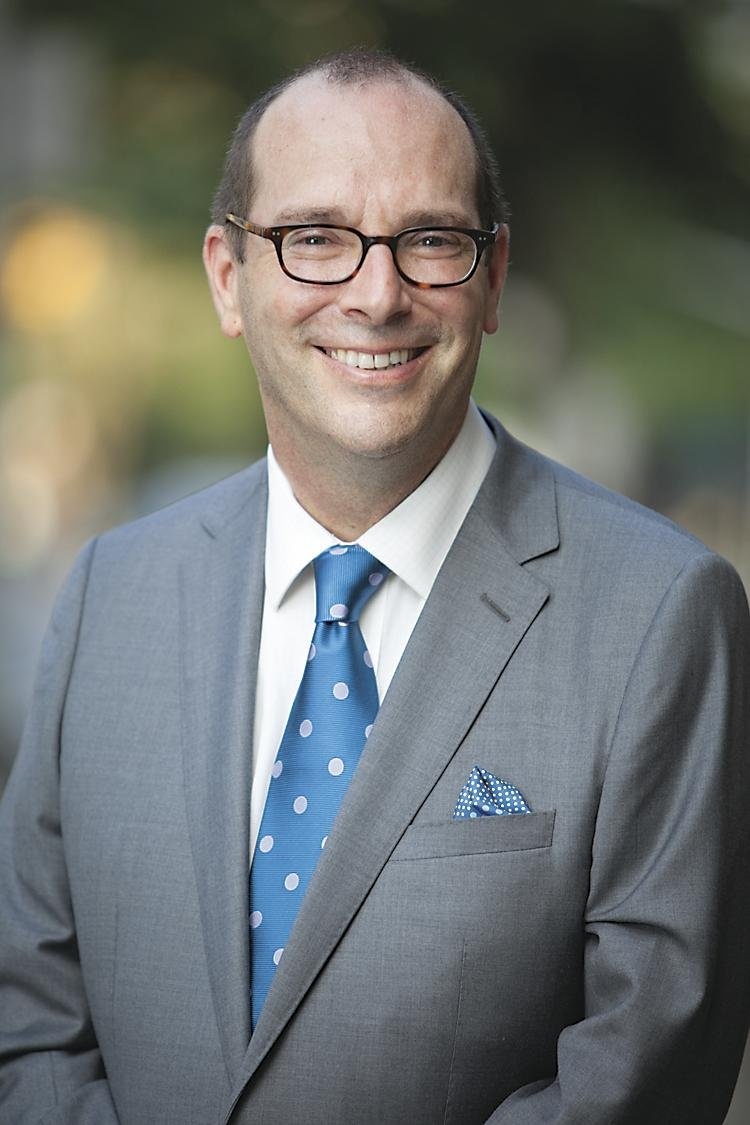
After graduating from Yale University with a Ph.D. in music theory, Craig Harwood headed toward a professor’s life of teaching and publishing research.
However, a stint at Amherst College steered him in a new direction. At Amherst, he taught classes and helped organize events that brought students together, including one in which students from five local colleges performed world music for one another.
“I found sitting in a library not nearly as satisfying as working with students as individuals and in groups,” says Mr. Harwood, 46.
In August, he left a post as director of Hunter College’s honors college to become director of the Paul & Daisy Soros Fellowships for New Americans. In his new job, he will build on his experience of helping students and foster their support of each other.
Gift of Gratitude
The two-year program provides tuition and living expenses of up to $90,000 for 30 students annually in the graduate program of their choice. Participants must be permanent residents of the United States, naturalized U.S. citizens, or the children of naturalized citizens.
Paul and Daisy Soros, both Hungarian immigrants, created the program in 1997 with a $50-million donation to support gifted students and draw attention to contributions that immigrants make to America.
Mr. Soros, who died in June at age 87, defected from Hungary in 1948 as a communist government took power. He eventually made his way to America, received a master’s degree in engineering from Polytechnic University, and founded an international engineering firm. (Mr. Soros was the brother of George Soros, the financier and philanthropist.)
“Some people feel that immigrants place a heavy burden on the social infrastructure of our society,” says Mr. Harwood. “People should also consider the immense contributions that immigrants make to our society and the many ways they improve our lives through medicine, politics, and creative expression like music, art, and writing.”
The fellowship, which draws a thousand applicants annually and selects 30, has supported 475 people so far. Among the diverse group of alumni are the U.S. ambassador to Uruguay, the first Asian-American woman to win tenure at Harvard Law School, and the former chief executive officer of the Chicago public-school system. This year’s class of fellows includes aspiring economists, scientists, anthropologists, and filmmakers whose families come from Afghanistan, Bangladesh, Korea, and Mexico, among other places.
More Outreach
Mr. Harwood didn’t arrive at his job with an international background; he grew up in a Jewish family in San Diego. “I had a really white, middle-class bagel upbringing,” he says.
But throughout his career, Mr. Harwood says, he has been impressed with the drive students from other countries, or whose families come from other countries, often bring to their education in America.
“I like working with students who have an appreciation for their education and who want to take that education and use it to make a contribution to society,” he says.
The fellowship’s board members hope Mr. Harwood will make his own contribution to the program by raising its profile and broadening its scope of applicants, in particular ensuring that more public institutions know of the program.
Mr. Harwood, who got his undergraduate degree from the City College of New York, has attended and worked at both public and private colleges.
That background appealed to the fellowship’s board. “What’s important to us is that we draw from as wide a base as possible,” says Jeffery Soros, the group’s board president and one of Paul Soros’s sons. “He can relate to students who are from both kinds of institutions.”
Mr. Harwood also plans to strengthen the program by increasing e-mail updates with current and former participants, exploring the idea of organizing an annual gathering, and enhancing the group’s use of social media. He hopes these efforts will help alumni to connect with one another individually and in groups for advice and career networking.
One of the challenges of his new position will be maintaining close contact with the current crop of fellows, says Mr. Harwood. Although he met with undergraduate students several times a day in his previous jobs, the 30 Soros fellows are spread around the country.
“It’s not like they can pop into my office,” he says. “I’ll have to be creative and super-proactive in the ways we communicate with one another.”
Craig Harwood, director, Paul & Daisy Soros Fellowships for New Americans
Education: B.A., Queens College, City University of New York; Ph.D., music theory, Yale University
Career highlights: Director, Macaulay Honors College, Hunter College; dean, Davenport College, Yale University
Salary: He declined to disclose it.
What he’s reading: The Constant Choice, by Peter Georgescu
Extracurricular activity: Mandolinist in the Professors of Bluegrass, a band that also features Peter Salovey, the president of Yale University, on double bass