
Donor-Advised Funds Show Robust Growth, Chronicle Study Finds

By Holly Hall
Contributor
May 27, 2012 | Read Time: 7 minutes
A growing cache of charitable dollars is up for grabs in the nation’s donor-advised funds, which have accumulated tens of billions of dollars and are now worth more than they were before the recession.
The funds have more than made up for the drubbing they took in the downturn, and now some are seeking new ways to help deserving charities get some of the bounty.
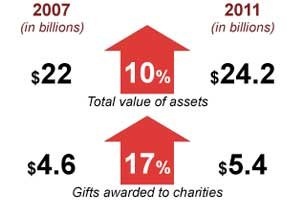
According to The Chronicle’s biennial survey of 126 large donor-advised funds, assets at the biggest funds were 10 percent higher than they were in 2007, just as the economy began to sour. What’s more, signs of growth continue in 2012: Total assets of the top 10 largest funds are up 16 percent, led by a 25-percent increase in assets at the Fidelity Charitable Gift Fund. Other indicators, such as the number of funds, gifts, and grants as well as the value of gifts and grants, show that most donor-advised funds in this top group are on par to match or surpass the growth seen last year.
A Spurt in Giving
Donor-advised funds allow people to establish a charitable account with cash, stock, or other assets in exchange for a tax deduction. Whenever donors want to, they can recommend which charities receive grants from the funds, whether right away or even years in the future.
Organizations that sponsor the accounts are now growing so fast that they are beginning to rival the nation’s wealthiest foundations, especially in terms of grant making.
For example, assets held by the Fidelity Charitable Gift Fund, the largest sponsor of donor-advised funds, reached $7.4-billion this year, slightly more than assets held by the William and Flora Hewlett Foundation, the nation’s fifth-largest grant maker.
But Fidelity is giving away far more money. Last year, Fidelity grants totaled $1.3-billion, nearly $900-million more than Hewlett gave.
But some nonprofit experts still worry that donor-advised funds take in far more than they give away and make it difficult for charities to reach out to donors who hold the accounts.
The situation was so bad in 2005-7 that the Internal Revenue Service cited the funds as a tax abuse, saying too many people hoarded their money after getting the tax break or made grants to benefit themselves rather than charities.
“Donor-advised funds were in the dirty dozen of IRS abuses,” says Dean Zerbe, a former aide to Sen. Charles Grassley who worked with the Iowa Republican on legislation designed to correct problems with the funds.
“It would be nice for charities to receive money for gifts that donors already got charitable deductions for,” says Mr. Zerbe. “The charitable community should be thinking of how to get this money.”
Anonymous Donations
It’s not that charities aren’t interested in going after the funds in donor-advised accounts. It’s just not that easy to do, even after a 2006 law that Senator Grassley championed placed new requirements on the funds.
Sponsors of donor-advised funds, which are typically either community foundations or national charities created by financial companies or other entities, must now report annually on the number of funds they oversee as well as total assets, contributions received, and grants made each year. Some go beyond that, listing every grant recipient and the amount each charity receives.
But many donors make their grants anonymously from the funds, so it’s hard to find out who has one. Commercial funds don’t accept grant proposals, and none of the funds allow charities to send proposals directly to people with donor-advised funds.
Nonetheless, some of the financial companies that sponsor donor-advised funds are stepping up efforts to help get charities in front of their donors, something that community foundations have long done.
While most people with donor-advised funds aren’t looking for new causes to support, experts estimate that 25 to 30 percent of donor-advised grants nationwide are available to groups that can appeal to donors.
The Schwab Charitable Fund has agreed to test a new online service that allows donors to search for charities that have been rigorously evaluated and can prove they made a big difference in supporting education, improving health, alleviating poverty, or serving young people.
Starting next month, Schwab plans to add a link to the online resource on its Web site and promote it to people who establish donor-advised funds.
Vetting Charities
The service marks a significant change for Schwab. Like other big national funds, it has previously taken a hands-off approach when it comes to evaluating or endorsing specific charities.
“We are trying to get good tools in front of our donors that allow them to choose groups others have rated,” says Kim Laughton, Schwab’s president.
The online service, created by the Social Impact Exchange, a national group that works to expand the reach of effective charities, has vetted 50 charities in 3,000 locations nationwide. As it evaluates more charities, it will add information about them to the database for donors to review.
“There is a growing interest among donor-advised funds in how to provide more guidance to donors,” said Alex Rossides, the network’s executive director.
“It is an important step that national donor-advised funds are willing to do this,” he adds. “It has the potential to allocate large amounts of philanthropic capital to high-impact organizations.”
Pledge Cards
Other donor-advised funds advocate a different type of online resource to help charities reach their donors.
Eileen Heisman, president of the National Philanthropic Trust, envisions a Web site that would allow nonprofits to post special projects or other needs. That way, people with donor-advised funds could search for projects by location or topic and contribute separately or collectively from their funds to meet those needs.
As an example, Ms. Heisman points to DonorsChoose.org, the popular Web site that allows public-school teachers to post classroom projects that individual donors can support.
Once a project attracts enough money to pay its cost, donors receive a report about how the money was spent and a thank-you letter.
“Many donors don’t want help,” Ms. Heisman says, “but if they knew there was a place to look for what charities need, I bet it would get used.”
While ideas like Ms. Heisman’s would be expensive to put in place, commercial funds suggest other low-cost ways charities can reach out to people with donor-advised funds.
The Vanguard Charitable Endowment Program, for example, urges charities to put on pledge cards and other solicitations the option of making a gift from a donor-advised fund. Then, if they get such a gift, the charity can build a relationship with the donor that may lead to regular grants or even a gift of the money left in the fund when the donor dies.
Giving Circles
Community foundations are also seeking better ways to help people with donor-advised funds learn about issues they care about and find related nonprofits.
At the Chicago Community Trust, donors have online access to their charitable accounts, and the system forwards them information about charities similar to groups they’ve previously supported.
The Silicon Valley Community Foundation has started giving circles for people with donor-advised funds who share a common interest in issues such as the arts, the environment, and needs in Africa.
“These donors come in and learn together and develop a shared sense of what the problems are,” says Emmett Carson, the foundation’s president.
Giving-circle donors, he adds, sometimes make a joint request for proposals from charities working on their causes and then pool grants from multiple donor-advised funds to make sizable gifts.
Tailoring the foundation’s work to meet donors’ specific needs is a sign of how much the funds have changed over time, Mr. Carson says.
Community foundations used to expect more say in how donor-advised funds would be spent, but “the world has changed in a fundamental way,” says Mr. Carson.
Fewer and fewer donors are willing to let community foundations or any other organization decide where their money goes.
“Donors no longer have a sense that you are smarter than they are,” Mr. Carson says.
“It’s not about the funds,” he adds, or what they want to do with donors’ money. It’s about realizing that people are empowered to do things on their own and helping them carry out their wishes.
“We try to provide an environment where donors can learn and understand.”
Noelle Barton, Emily Gipple, and Marisa López-Rivera contributed to this article.




