
In Farm Country, a Charity Envisions Bright Horizons—and Faces Growing Pains

By Michelle Gienow
Contributor
July 24, 2011 | Read Time: 6 minutes
When Bill Gross works at his day job flying cargo planes for UPS, he often looks out at a checkerboard landscape of farms and fields far below the aircraft. It used to pain this pilot, who grew up on a farm, to know that the view from the ground is often less pastoral.
“Nowadays you drive across any state in the Midwest and you can see old abandoned farmsteads, rural towns that are just emptied out,” he says. “Family farms are becoming an endangered species.”
Mr. Gross has witnessed the process firsthand in his hometown of Cleveland, N.D. “Every year there are fewer family farms because the children leave—go off the farm for a better job or just because it’s not economically feasible to support multiple generations on one farm,” he says.
The exodus of young people devastates towns near the farms too. The only for-profit business left in his hometown, he says, is a grain elevator.
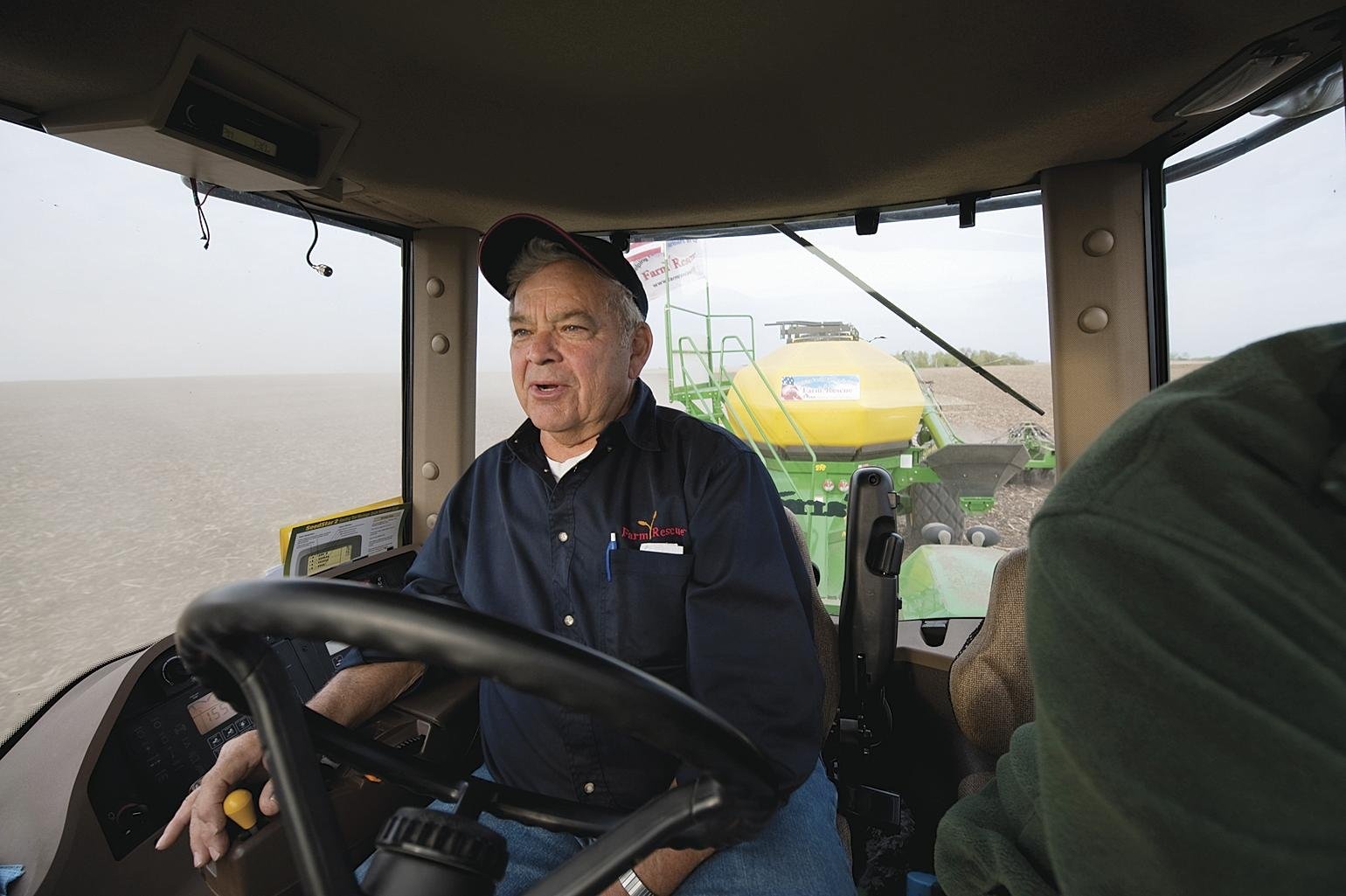
To help support the farmers left in these sparsely populated regions, he was inspired to found Farm Rescue in 2005. The charity’s volunteers plant or harvest crops for farm families unable to do it themselves due to a major injury, illness, or natural disaster.
Says Mr. Gross: “Our long-term hope in helping is to enable future generations to remain on the farm, which will help small-town America.”
Strangers Helping Strangers
The organization’s help is just one form of assistance that many observers say America’s heartland needs. Grant makers and policy makers gather this week in Kansas City, Mo., for a Council on Foundations conference intended to increase philanthropic efforts in tackling rural issues.
But the challenges facing the country’s small towns and agricultural regions are considerable, and charities that serve those areas struggle to garner support and achieve momentum.
Farm Rescue—which is based in Jamestown, N.D. (population 15,427), with a staff of two in addition to its founder—has had fund-raising results that are healthy for a grass-roots organization but fall far short of meeting the region’s needs. The situation has limited the charity’s ability to deploy its corps of dedicated volunteers to far-flung farms and slowed its ambitions for expansion.
The nonprofit has an annual cash budget of $250,000, raised primarily through business sponsorships, with 20 percent coming from foundation grants; another $300,000 comes from noncash donations. Farm Rescue currently serves a region encompassing North and South Dakota, western Minnesota, and eastern Montana, although its volunteers come from all over the United States.
Joe and Kathy Zorc, of Lemmon, S.D., are one of 148 farm families that have received the charity’s aid so far. Mr. Zorc broke his leg last March; two months later, three Farm Rescue volunteers arrived and planted his spring wheat crop.
Mr. Zorc at first resisted the notion of help. “I kinda had my pride and said, ‘No, we’ll get along OK,’” he recalls. “But the neighbor who told me about Farm Rescue told me, ‘If you don’t fill out these papers, I’ll fill ’em out myself.’”
Reluctantly, Mr. Zorc applied to the program, and was accepted. “If it wasn’t for these Farm Rescue guys, I don’t know what we would’ve done, because we couldn’t do it by ourselves,” he says. “They were here four days and we got 1,400 acres planted. It was kind of unbelievable, strangers coming from all over to help out another stranger like that.”
For the past four years, Dick Weaver, a retired airline worker, has been one of these strangers traveling west from Mars, Pa., to help plant spring crops.
“The first year we went with Farm Rescue, we helped out on a farm where the family lost everything to a tornado,” he recalls. “All except one grain bin, their farm was just completely missing: cattle, equipment, house, everything. That was quite an experience, to see how this family had lost everything, and then be able to step in and help them get back on their feet—quite literally, help rescue their farm.”
Room for Growth
After six years of aiding distressed farm families, Farm Rescue has hit something of “a chokepoint,” says Mr. Gross. The charity has a pool of more than 1,000 volunteers who have signed up to help with planting or harvesting, but is able to use only about 50.
“We would love to engage more of these volunteers, but it costs money to activate them, to literally put them out in the field,” he says. “We simply don’t have financial resources to run a larger operation at this point.” (Volunteers pay their own travel costs to Farm Rescue events, and the charity covers any other expenses).
Ideally, he says, Farm Rescue would hire full-time team leaders, assigned to different regions, to organize farm interventions and the volunteers necessary to run them. That would enable the charity to mobilize more of its volunteers to assist more families in more places.
The organization recruits some of its volunteers at agricultural trade shows, says Mr. Gross, but the majority sign up through the organization’s Web site after seeing news coverage about Farm Rescue.
“Our volunteers have gotten us this far and we really love them, but there are limits to what we can accomplish with the structure we currently have,” he says. “The main growing pains for any nonprofit are financial.”
To help Farm Rescue meet its financial needs and expand beyond the four states it now covers, the charity is considering hiring a full-time fund raiser.
In addition, Mr. Gross is creating a foundation this summer to both raise money for the group and expand its reach. The Farm Rescue Foundation will serve a broader purpose as well, he says. “Farm Rescue has a fairly narrow mission, providing farmers with planting or harvesting assistance,” he says. “Having the foundation will enable us to extend a larger umbrella of help to all rural families.”
Mr. Gross hopes the group will eventually become a grant maker focused on supporting other charities that provide services in rural communities, “be it providing meals, or transportation for those who need to reach medical care, or funding farm-safety programs for children.”
Some larger grant makers are cheering Farm Rescue on. The Otto Bremer Foundation has supported Farm Rescue with several grants. “I’m really impressed with their logistic ability to provide as much hands-on help as they do with the small resources they have,” says Dominic Papatola, a Bremer program officer. “It’s relatively easy to deliver a check; it’s comparatively hard to deliver tractors.”
He would like to see Farm Rescue grow to more states, he says, but “like many nonprofits, they are of that odd size where they’re big enough to be doing really great work but maybe not big enough to be attracting major gifts.”
However, Mr. Papatola views both the organization and its foundation spinoff as promising enterprises: “I love their vision and I love their ambition, and it’s mainly just a matter of going through some practical steps before they can get there.”
Keith Kreps’ company, RDO Equipment Company, a John Deere dealer in Fargo, N.D., provides about $70,000 in equipment annually to Farm Rescue. Mr. Kreps, vice president of RDO’s northern agricultural division, says his company provides support because “so many charities out there go across a broader spectrum than just farmers. Farm Rescue is a perfect fit: through them we get to give back to the rural communities we do business in.”
“The best part is getting to hear directly from our customers about how a third-generation farm was rescued due to Farm Rescue and us,” he says. “It’s very gratifying.”




