
A Small Health Charity Takes On California in Legal Battle

By SUZANNE PERRY
Contributor
February 6, 2011 | Read Time: 7 minutes
Like many nonprofit leaders across the country, Norma Jean Vescovo is worried that the continuing wave of state budget cuts will have devastating consequences for the people her group helps.
But not many of her peers can say their concerns are getting the attention of the nation’s highest court.
The U.S. Supreme Court last month agreed to consider a case that pits Ms. Vescovo’s charity, Independent Living Center of Southern California, against state officials in a battle over payments for medical services provided to poor residents.
The high-profile case—which arises from the kind of debate that is echoing in many state capitols—could determine whether nonprofits and other private groups have the legal right to challenge certain state actions that they think violate federal law.
Seeking Solutions
California says it needs to cut spending on Medi-Cal, the state’s version of Medicaid, so it can plug a gaping budget hole and try to restore the recession-wracked state to fiscal health.
But Ms. Vescovo, whose group helps people with disabilities live independently, says lawmakers should find a solution that doesn’t hurt health care for the state’s most vulnerable people.
“They’re in a mess, they’re in a real problem,” she says of California lawmakers. “But you have to decide what kind of cuts are not going to kill people.”
Twenty-two states have lined up to support California in the lawsuit, and it’s no wonder. As governors and state legislatures begin work on their 2012 fiscal-year budgets, they face a bleak landscape.
The faltering economy has drained state coffers of tax receipts, which have fallen by the steepest amount on record, according to the Center on Budget and Policy Priorities, a liberal Washington think tank.
Meanwhile, economic hard times have driven millions of people to seek health coverage from Medicaid—a federal-state program that covers low-income, disabled, and older people—straining state budgets further.
Nearly every state imposed at least one new policy to control Medicaid spending in the 2010 and 2011 fiscal years. Those cuts affect nonprofit hospitals, nursing homes, disability groups, and mental-health programs, while increasing demand for nonprofit health services from uninsured people.
Bleak Budget Problems
The grim state-budget situation in California isn’t confined to health care.
Jerry Brown, the state’s governor, is also proposing deep cuts to California’s welfare-to-work program and to the state’s Department of Developmental Services to help close a $25.4-billion budget hole.
But the court battle over Medi-Cal highlights the kind of tensions that are flaring nationwide over state support for nonprofit groups.
And Medicaid looks set to be a particularly hot-button issue for 2012 budgets, especially since the economic-stimulus money that has been helping them cover Medicaid costs for the past two years is set to run out at the end of June.
In Arizona, for example, nonprofits are gearing up to do battle against a new plan to contain Medicaid costs there. Amy Kobeta, vice president of the Children’s Action Alliance, an advocacy group in Phoenix, says an effort by Gov. Jan Brewer to withdraw 250,000 childless adults and 30,000 parents from its Medicaid rolls would cause too much damage to community health centers and other providers.
Ms. Brewer last month requested a waiver from the new health-overhaul law, which bars states from tightening their Medicaid eligibility to qualify for federal money, saying that the “explosive growth” of Medicaid, almost 65 percent over the past four years, “threatens to consume the core functions of state government.”
Ms. Kobeta counters: “We’re going to work with contacts at the federal level and work with our national partners to advocate that the federal government not approve the waiver.”
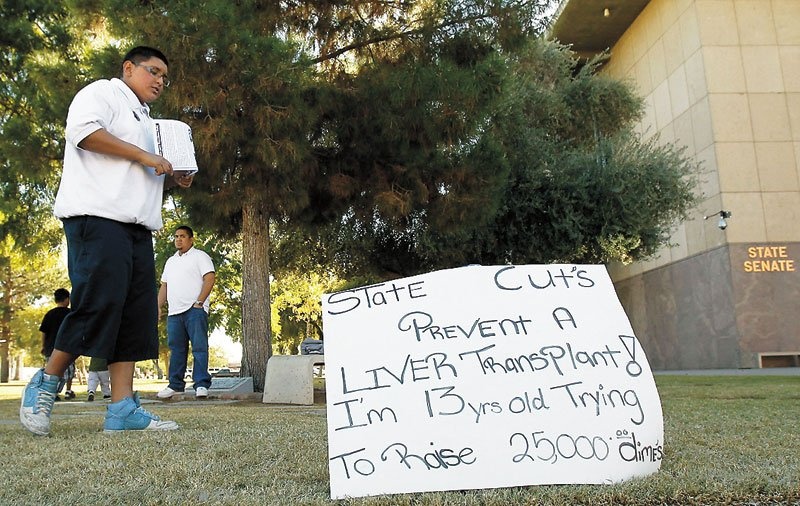
Ms. Brewer’s move follows other steep cuts: The state has trimmed payment rates to health-care providers and, in a decision that attracted nationwide headlines, ended financing last fall for certain organ transplants.
The case that is before the Supreme Court involves a decision by the California Legislature in 2008 to cut Medi-Cal payments to doctors, pharmacists, health-care centers, and others by 10 percent.
Independent Living Center, in Van Nuys—which helps about 5,000 people with disabilities a year get emergency services, counseling, housing, and job skills—challenged the law as part of its advocacy work.
The Sacramento and San Francisco chapters of the Gray Panthers, a social-justice group, joined the lawsuit and the Medicaid Defense Fund, a California nonprofit group that routinely sues to block Medi-Cal cuts, is handling the legal work.
Ms. Vescovo, the charity’s executive director, says the group feared the cuts would drive many independent pharmacists out of business and seriously hinder the ability of its clients to get the medications they need.
Independent pharmacists specialize in prescriptions that require special paperwork to get approval for Medi-Cal payments—something that many chain drug stores balk at doing, Ms. Vescovo says.
The center argues that California violated federal law, which requires states to pay providers enough to ensure that Medicaid patients have “equal access” to care and services as the general population—and says California should have conducted a study to determine what the impact of the Medicaid cuts would be.
A federal court ruled in the group’s favor in July 2009, saying federal law does not allow states to cut Medicaid solely to balance their budgets and that the “balance of hardships” tips in favor of the people who could be denied access to medical care.
But California appealed, and the Supreme Court agreed to review the decision (Maxwell-Jolly v. Independent Living Center of Southern California), along with two similar challenges to California’s law.
It specifically said it would decide whether private parties can sue to make a state comply with federal Medicaid provisions—a ruling that could affect the ability of groups nationwide to challenge state actions in court.
The 22 states that backed California argue that they need the flexibility to “make difficult choices” about programs they run jointly with the federal government, and that Congress has not authorized private lawsuits to appeal Medicaid decisions.
“If every decision to alter a program could be challenged under this method that’s in debate in this court case, it would introduce a new level of instability to these funding streams,” says Joy Yearout, a spokeswoman for Michigan Attorney General Bill Schuette, whose state joined the appeal.
The court is expected to hold oral arguments on the case next fall. While waiting for the outcome, Gov. Brown last month proposed $1.7-billion in new Medi-Cal cuts for the 2012 fiscal year, which starts in July. He also again suggested a 10-percent cut to providers, restrictions on doctor visits and prescriptions, and co-payments for a range of services.
Routine Uncertainty
For many charities that accept Medicaid payments, living with economic uncertainty is nothing new.
Even before the recession, for example, Courage Center, a Minneapolis group that offers rehabilitation services to people with disabilities, was struggling to make ends meet, says Jan Malcolm, the chief executive.
Medicaid provides from 20 percent to 25 percent of the center’s overall revenues, and some individual programs rely largely or even entirely on Medicaid reimbursements.
But those payments don’t cover the actual costs of providing services, and private health plans don’t make up the difference, Ms. Malcolm says.
And the bad news keeps coming. The Legislature adopted more than $400-million in cuts to programs that help people with disabilities for 2010 and 2011, including more than $283-million in Medicaid payments, the center says.
Ms. Malcolm says lawmakers often discount the value of services that seem like they are “nice to have, not need to have”—and they suggest that philanthropy pay for those.
The notion that private money can take up the slack is unrealistic, she says. “Foundations and corporate sponsors don’t think it’s their role to pick up the funding obligations that should be part of the public compact,” Ms. Malcolm says. “It’s a terrible no-man’s land we find ourselves in.”
As states eye further spending cuts that would reduce or eliminate social programs, Ms. Malcolm says she wishes both government and private donors could have some frank discussions that look beyond the next budget cycle.
“We need to have a conversation about what is the implication of these services not existing,” she says.





