Bach—and Social Justice—Make a Sweet Duet for One Charity Leader

By BRENNEN JENSEN
Contributor
October 17, 2010 | Read Time: 7 minutes
Providence, R.I.
Sebastian Ruth loves the music of Brahms and Bach, and he has always wanted to help poor children rise above their circumstances. One day, gripped by a determination to combine these two passions, he walked into a community center in Providence, R.I., with a viola tucked under his arm. There, alongside the basketball court of a city-run recreation facility serving working-class and largely black and Latino residents of the city’s hardscrabble West End, he told the staff he was available to provide free classical music lessons to any child who was interested.
Thirteen years later, that improbable encounter, now called Community MusicWorks, has won Mr. Ruth a place among the 23 John D. and Catherine T. MacArthur Foundation fellows announced in September. The fellowships, widely referred to as “genius” grants, give $500,000 to recipients to do with as they wish.
When he first made his offer to the community center staff, Mr. Ruth, now age 35, had recently graduated from Brown University and was empowered by a $10,000 grant from the school’s Swearer Center for Public Service, which helps students and alumni engage in charitable work. His motivation was a commitment to social justice, and a visceral belief that music and musicianship can transform both individuals and communities—fostering cooperation and empathy, while engendering self-esteem and lifelong intellectual curiosity.
“Why shouldn’t kids in the West End be exposed to classical music?” Mr. Ruth says, reflecting back on his decision. “I wanted to give kids opportunities to break down the social norms that say, ‘This is what people of color do, this is what white people do,’ and make this music a normal and acceptable part of everyday life in their community.”
‘Equity and Access’
What began with a young graduate’s grand, though untested, vision and a dozen rented violins has since grown into a charity Mr. Ruth runs with a $600,000 annual budget and 10 instructors providing free violin, viola, and cello lessons to more than 100 Providence youngsters (with another 120 on a waiting list). The group also hosts a resident string quartet that performs the classical canon across the city, including in school gymnasiums and soup kitchens.
In recognizing Mr. Ruth’s work with a fellowship, the MacArthur Foundation, in Chicago, lauded Mr. Ruth’s “vision of music as a nurturing neighborhood necessity,” and praised him for “creating rewarding musical experiences for often-forgotten populations and forging a new, multifaceted role beyond the concert hall for the twenty-first-century musician.”
“There’s a strong message of equity and access in what they are doing,” says Daniel Kertzner, a program officer at the Rhode Island Foundation, in Providence, which has provided more than $200,000 in support of Mr. Ruth’s charity since 2000. “It’s music, but it’s also about empowering the young people. The level and quality of music instruction is really high and they are drawing out and developing the young people as people. They have a very high track record of kids who go on to college.”
Beyond the Notes
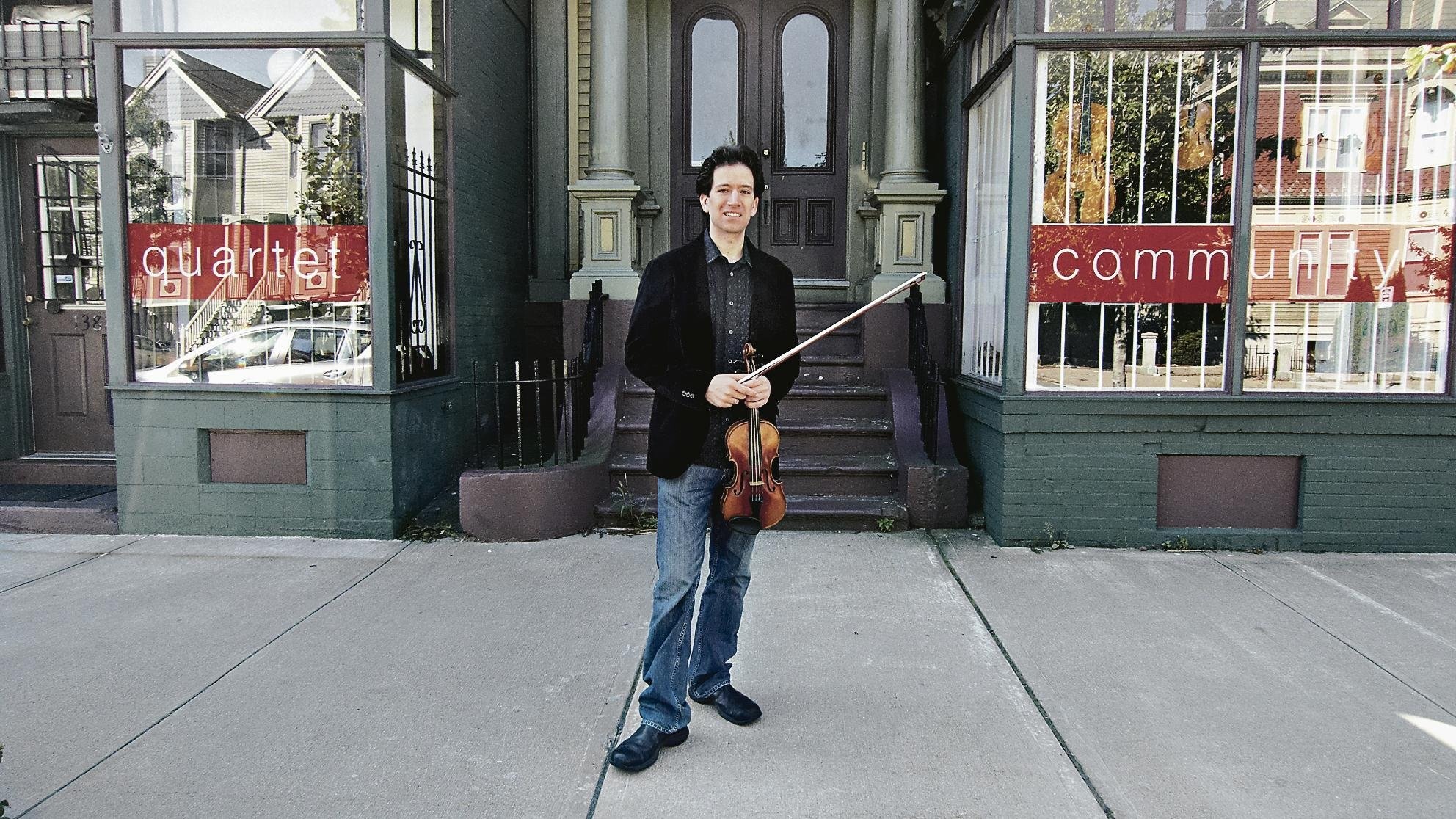
Community MusicWorks is based in a pair of storefronts carved out of a rangy Victorian house along a busy commercial strip. Violins and cellos hang in the windows and external speakers broadcast quartet practices out onto the sidewalk.
Parents pay a one-time $10 registration fee to enroll children, ages 7 to 18, while the lessons and loaner instruments are free. To be eligible, students must reside in one of seven local neighborhoods that are among the city’s poorest.
That the charity has such a permanent and notable presence in the community it serves is by design, says Mr. Ruth, a native of Ithaca, N.Y., where he began musical training at age 5. (His parents were music lovers, he says, though not musicians themselves.)
“As an outsider, I expected some amount of distrust when I started,” Mr. Ruth says. “But I think parents quickly saw that when we came to teach, we had high expectations for their kids, and knew what they could accomplish.”
“We are not missionaries or saviors,” he adds. “We are servants of a community.”
While the musical instruction is demanding, the goal of the program is not to unearth a child prodigy or create the next Yo-Yo Ma.
“We are not screening for talent or excluding people if they aren’t demonstrating some special gift,” Mr. Ruth says. “We are developing an idea of music education that is inclusive of a structured training in the technical aspects, but also grounded in ongoing dialogues about musicianship and service and civic engagement.”
This beyond-the-notes approach is perhaps best expressed in the “Phase II” program the charity runs for its teenage participants. The teenagers gather Friday evenings to eat dinner, make music together, and discuss what’s on their minds. “Some kids face serious family challenges or pretty big questions, like whether to join a gang or not,” Mr. Ruth says. “Community MusicWorks becomes a family for the kids and supports them through some tough moments.”
To date, some two dozen participants are described as “graduating” out of Community MusicWorks, because they participated from a young age through high school. All of them have gone off to college, bucking trends in a neighborhood where fewer than half of teenagers finish high school.
“Sebastian Ruth is the reason I’m here,” says Kirby Vasquez over the phone from her dorm room at Smith College, in Northampton Mass., where she’s a freshman on full scholarship, planning to study both film and women’s studies. “I started cello lessons at age 8 at Community MusicWorks and the students there get individual attention and they expect you to practice and keep up with the work. You don’t always get that at school, where the teachers are so busy. Having those expectations helped me to do more and take on a leadership role. It changed my life when they gave me an instrument to play.”
Learning to Mesh
While youth sports programs can also provide a structured setting for support and growth, Elizabeth Hollander, Community MusicWorks’ board chair, says there is something special about the “noncompetitive teamwork” of music.
“Playing in quartet is all about listening to the other players and trying to mesh with them,” she says. “It’s a community that demands excellence but is about learning to work with the next kid to improve the music for everybody.”
While trained in the music of Brahms, Bartok, and Bach, Mr. Ruth says he encourages his students to also develop their own musical voices. The charity runs improvisation classes where kids have been known to play their string instruments to hip-hop beats. The group also recently added a computer lab where the latest music and recording software allow the mixing of acoustic and electronic sounds.
“We’re not interested in a siloed musical world, but one where musicians have the skills to be compelling with lots to say as engaged human beings,” Mr. Ruth says.
Getting a Windfall
Four years ago the charity began a fellowship program that brings skilled musicians to Providence for two-year stints as teachers and performers. Equally as important, the visiting fellows learn the Community MusicWorks approach for duplication elsewhere. In 2008, the Andrew W. Mellon Foundation, in New York, awarded the charity a three-year, $300,000 grant to help develop additional ways to share its brand of music education. Similar musical charities are already up and running in Boston; New Haven, Conn.; and Pawtucket, R.I.
Mr. Ruth says he was in the car with his wife, Minna Choi, a violinist and longtime MusicWorks staff member, when the call came from the MacArthur foundation. He laughs at how he was instructed to pull over before hearing the big news. He is not yet sure what he will do with the money.
“I know in vague terms that part of this award I will reinvest into Community MusicWorks,” he says. “This gives me flexibility to think about ways to support and encourage musicians to pursue creative and risk-taking moves in their careers.”
Like walking into a community center with a viola and a vision.