
The Gates-Buffett Visit to China: What It Means for Philanthropy
October 1, 2010 | Read Time: 4 minutes
By Lijun He
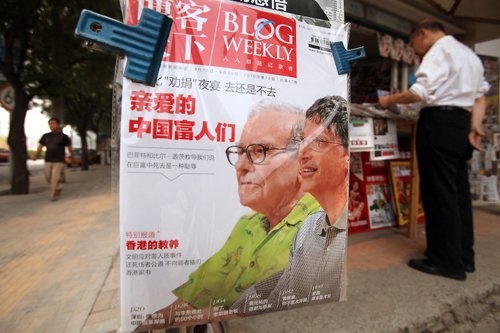
The world-renowned billionaires Warren Buffett and Bill Gates sat down for dinner in Beijing Wednesday night with a small group of China’s super-rich. Unusually for visits from Western businessmen, the subject under discussion was how to use wealth philanthropically, not how to create it. In today’s China, that made the dinner a highly visible and controversial one whose impact could be far-reaching.
Following on the heels of the campaign by Mr. Gates and Mr. Buffett to persuade American billionaires to give most of their fortunes to charity, the Chinese public, which mainly expresses opinions through online media, understood the visit as an effort to induce China’s wealthy to do likewise and has paid a good deal of attention to it. It was especially eager to know who would be attending and who would not.
To many people in China, the more money rich people donate, the more respectable they are. If people pledge or donate all their money altruistically, they are regarded as heroes in China. But if they refuse to do so (and some businessmen hesitated or even declined to attend the dinner), they would be considered one of the “ruthless rich,” people to be scorned. Also regarded unfavorably are “philanthropists in disguise,” who donate their money mainly for their own purposes or out of self- interest. Public calls to crack down on such behavior are common.
With the Buffett-Gates trip stirring up a discussion of their responsibilities, the Chinese rich could not afford to remain quiet. But their opinions were divided.
Some showed their uneasiness with the American billionaires’ dinner and said asking others to donate money could not be hailed as true philanthropy; true philanthropy, they say, doesn’t take persuasion. Others tried to respond to Mr. Buffett and Mr. Gates—and save Chinese businessmen from public criticism—by pledging all-out donations to compete with the most generous American philanthropists. And yet other businessmen and philanthropists used the occasion of the dinner to emphasize their difficulty in practicing philanthropy in the current imperfect and ambiguous policy system. They expressed particular concern about the misuse of their donations by government-run nonprofit organizations.
The Buffett-Gates visit has thus heightened discussion about the role of philanthropy in contemporary China. But it has not managed to avoid the implication that giving is mostly an obligation of the very wealthy, especially those who have benefited from the changes in China’s economy that began in 1978. Nor does the current discussion pay sufficient attention to what purposes philanthropy should serve or who should benefit from it. Responses from government officials and nonprofit organizations were rarely heard in public.
Even though it probably did not get much attention at the dinner table, those who cited the obstacles created by the current policy environment also have a point. China’s government gives little tax relief for charitable giving, and the public’s disdain for giving mixed with self-interest makes the situation worse. Grass-roots groups often lack enough legitimacy to raise funds effectively, while the Chinese government-run nonprofit organizations lack accountability, thereby dampening the enthusiasm of the wealthy to support them.
Trying to stimulate philanthropy within what is still a socialistic political system is an added problem. Echoing the views of the former Communist Party leader Deng Xiaoping, many Chinese believe that those who get rich first should give first, or, as he put it: “Let some get rich first so that they could help others for the common good.”
But just as Deng Xiaoping recognized the importance of moving the country toward a market economy if it were to prosper, his successors need to figure out how to stimulate and sustain giving by the rich, without sacrificing incentives to be entrepreneurial and create wealth. Moreover, how much oversight government should have over philanthropy remains an unresolved but fundamental question.
Since Mr. Buffett and Mr. Gates are admired as successful businessmen, their visit to China may help bring the country one step further toward acknowledging the impact that private efforts can have in solving society’s problems. But the Chinese will ultimately have to decide for themselves and in their own way how much encouragement they want to offer philanthropy. At most, their encounter with Mr. Buffett and Mr. Gates will have caused a lot of people—young and old, wealthy and not-so-wealthy, officials and ordinary citizens—to think more seriously about it.
Lijun He is a doctoral student in philanthropic studies at the Center on Philanthropy at Indiana University and a native of China.




