July 11, 2010 | Read Time: 5 minutes
To aid people devastated by civil war, genocide, and poverty, members of the humanitarian aid group Socialites Without Borders taught destitute Rwandans how to mingle.
So goes the joke opening to an article that appeared last summer in The Onion, the satirical news publication.
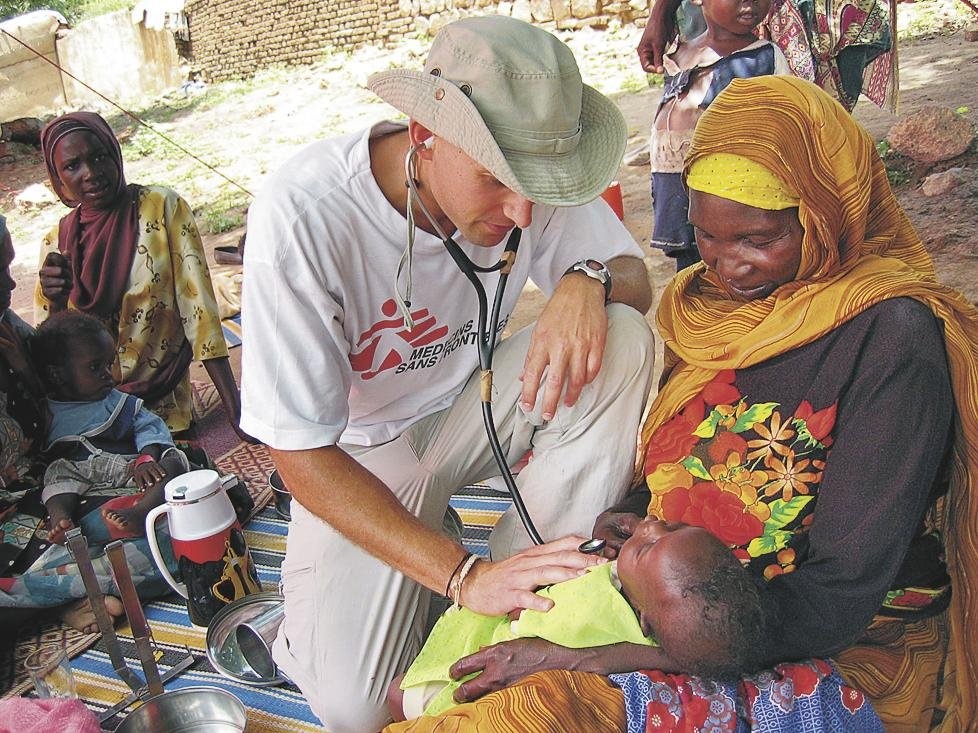
But to the international medical relief organization Doctors Without Borders, the ever-growing list of charities using “without borders” in their name is no laughing matter.
Among the real-life examples: Lawyers Without Borders, Clowns Without Borders, and Acupuncturists Without Borders. Engineers, bees, magicians, veterinarians, teachers, mothers, and elephants all have their own “without borders” groups. More than 100 such groups turned up in a search of Internal Revenue Service records, although not all the organizations listed by the tax agency may still be operating. Jason Cone, communications director at the Doctors Without Borders U.S. office in New York, says his group “actively monitors to see when organizations are taking up the name because our name is so tied up with our identity.”
“For others it might just be a snappy way to convey an idea,” he says, “but for us the name is intertwined with our ability to gain access to populations in danger and to provide medical assistance while operating impartially and independent of political interests.”
Doctors Without Borders was founded in Paris in 1971 using the name Médecins Sans Frontières. The name Doctors Without Borders was trademarked in the United States in 1999.
“Knowing that there is this proliferation of groups with this name, we do our best to manage them and assess the risk to our operations on a case-by-case basis,” Mr. Cone says.
Of particular concern, he says, are organizations that provide international health care. The charity has been willing to share the term with groups that work on causes unconnected to a medical mission as long as they agree to make clear they are not affiliated with Doctors Without Borders.
Name Changes
When the organization thinks the potential for confusion is high, it doesn’t hesitate to take legal action.
In February, Doctors Without Borders sued Patients Without Borders, a for-profit “medical tourism facilitator” in Boston that helps people seek lower-cost health care in other countries. The lawsuit, filed in Federal district court, charged that the name wrongly infringed on the Doctors Without Borders name. An out-of-court settlement was reached last month when Patients Without Borders agreed to phase in a new name.
Meanwhile, Doctors Without Borders faces its own federal court lawsuit after it accused Children Without Borders, a three-year-old charity in Milton, Mass., of trademark infringement and threatened legal action if the name was not changed. The children’s group, which provides health care to children in Costa Rica, is taking Doctors Without Borders to court, stating that a name change would be costly and damaging for the charity.
Mr. Cone, of Doctors Without Borders, disagrees, saying other groups have successfully made the name change. Leaders of Children Without Borders have expressed surprise that their organization’s name presented such difficulties.
“When we first started, we did a Google search of the name and at no time did any references come up to Doctors Without Borders,” says Henry Strapp, treasurer of Children Without Borders. “We didn’t think there was an overlap between our missions. At present, we run three clinics in Costa Rica that operate every day, unlike Doctors Without Borders, which go in, do their work, and then leave.”
Negotiating Agreements
Some groups have found middle ground in the name disputes.
“I don’t have a problem with Doctors Without Borders trying to preserve the integrity of that name,” says Christina Storm, founder and president of Lawyers Without Borders, a 10-year-old charity in Hartford, Conn., that helps lawyers perform volunteer legal work around the world.
Ms. Storm says she was able to trademark the name Lawyers Without Borders in 2000, after reaching a formal agreement with Doctors Without Borders stipulating that her group would not engage in any medical work and would include on all fund-raising material a disclaimer that states there is no connection between the two organizations.
A few years later, Lawyers Without Borders helped Engineers Without Borders USA, a charity in Boulder, Colo., that places engineers in pro bono assignments around the world, reach its own naming arrangement with Doctors Without Borders.
“It would be nice if ‘without borders’ came to simply mean professionals who were donating their time to make the world a better place, whether it’s doctors, engineers, lawyers, or teachers,” says Ms. Storm. She recalls a less than ideal application of the expression a few years back: Budweiser using ‘Beer Without Borders’ on huge billboards as part of a marketing approach the brewery once employed. Melanie Sellar, co-founder of Librarians Without Borders, a five-year-old Canadian charity that seeks to spread libraries around the world, says she doubts donors and others are confused by the different “without borders” groups.
“In the mind of the public, its pretty clear that Librarians Without Borders is not affiliated with Reporters Without Borders or Clowns Without Borders or Teachers Without Borders,” she says.
Some smaller without-borders groups appear to fly beneath the radar altogether.
“Our name was inspired by Doctors Without Borders, and I imagine they are the granddaddy of the without-borders groups,” says Thomas Verner, founder of Magicians Without Borders, a Lincoln, Vt., organization that performs magic shows in refugee camps and orphanages. “It never occurred to me that there could be any trademark-infringement issues with the name. Should I be worried?”
Apparently not. “We typically do not reach out to entities such as Clowns or Magicians once we confirm that they operate in wholly different fields, Mr. Cone, of Doctors Without Borders, wrote in an e-mail. “We’re not trying to stop all uses of ‘without borders’ names.”
Though philanthropy has probably not seen the last group choosing to adopt some variation of the “borderless” name, Nancy Schwartz, a nonprofit marketing consultant, advises start-up charities to look elsewhere.
“Any time a phrase or word is used all over the place, the imagery become much less distinctive and people pay less attention to it,” Ms Schwartz says. “I don’t think it’s an effective thing to do because the organization that premiered that name is so well known. You don’t want to be a copycat.”