A Creative Nonprofit Manager Seeks to Influence the Business World

By Caroline Preston
Contributor
June 13, 2010 | Read Time: 8 minutes
New York
The headquarters of the charity Do Something are in a plum spot of Manhattan, just off Union Square. But inside its offices are telltale signs of nonprofit thrift.
Many of the charity’s dozen college interns and 19 full-time employees work in “the pit,” a pleasant but modest central room where workers sit side by side along two long tables. The chief executive of the charity, which promotes youth service and volunteerism, shares a small office with her assistant. Shortly after 9 a.m., only one of the young employees who make up Do Something’s staff has started work, but some of those yet to arrive will stay until 10 p.m. And on a day when the temperature will reach 85, the air conditioning is broken.
Doing more with less is an ethos for nonprofit leaders. And it’s one reason why Do Something’s chief executive, Nancy Lublin, believes business executives can learn from nonprofit groups. Her new book, Zilch: The Power of Zero in Business, shares strategies that she and her nonprofit peers have put into practice to manage, market, and improve their organizations—all on a puny budget.
That message flips on its head the concept that nonprofit groups ought to be more like businesses. James A. Phills, director of the Center for Social Innovation and a professor at Stanford University’s Graduate School of Business, says the theme is a crucial one. “We tend to associate money and power with expertise and knowledge,” he says. “[But] business can, and in fact has, learned from nonprofits.”
Respect for Charity Heads
For Ms. Lublin, 39, the book is also about getting respect for savvy nonprofit executives, such as Women for Women International’s Zainab Salbi and Kaboom’s Darell Hammond, and helping other charity employees learn from them. “Not-for-profit leaders—or at least the ones I write about in the book—are great leaders, great managers, and it’s time they were recognized as such,” she says.
Ms. Lublin says it took being an unhappy law-school student and then creating a charity to realize she was, at heart, a businesswoman.
In 1996 she started the nonprofit group Dress for Success—which provides job-interview attire for women hoping to move off welfare—using $5,000 bequeathed to her by her great-grandfather. Today, the organization operates in more than 100 cities.
And Ms. Lublin has led Do Something since 2003, when she was brought on to turn around the group, which had just laid off all but one of its 22 employees.
‘Fast’ Work
Her personal story and work experience, paired with her exuberance, have made Ms. Lublin a relatively well-known quantity in the nonprofit world for some time. But lately she has been taking on a more public role, speaking out not only in the book but also in a monthly column in Fast Company magazine.
How Ms. Lublin got the Fast Company gig epitomizes her fearless approach.
She wrote an e-mail to the magazine criticizing the way it was running an awards program. That frank talk so impressed the publication that it hired her.
Her writing has ruffled a few feathers. After she published a column called “Foundations’ Four Biggest Faux Pas,” a handful of foundations wrote the magazine asking Ms. Lublin to tone it down. (“Don’t assume that your Ph.D. diploma—which I see on the wall every time I visit—means that you understand the challenges of executing and implementing some of the good plans you fund,” Ms. Lublin wrote, for example.)
A ‘Balanced’ Style
While messages like that one might seem unusually sharp in the staid world of philanthropy, Ms. Lublin says she doesn’t see herself as particularly controversial. Nor do others who know her.
“The single word I would use to describe her leadership style is balanced,” says Kimberly Davis, president of the JPMorgan Chase Foundation, which helps finance Do Something. Ms. Lublin “promotes the cross pollination of learning between the nonprofit and for-profit sectors.”
Ms. Lublin would agree. To expand Dress for Success, she relied on a Harvard Business School case study on Dunkin Donuts’s franchise model. But after putting in place the policies and procedures for the group to succeed, Ms. Lublin began to feel that any good leader could expand the charity to more new markets.
So in 2002, she decided to leave, something she encourages all founders and longtime leaders to do.
“So often, organizations are more like cults; they live and die based on a dynamic founder or CEO,” she says. “It’s important for organizations to live beyond their founders.”
Soon after, Ms. Lublin was asked to lead Do Something, which today uses social media and other technology tools to encourage young people to get involved in social causes.
“I was taken by the fact that she is very passionate and very smart but also has a warmth about her,” says Andrew Shue, the group’s co-founder. “She works harder than anybody I know.”
Mr. Shue started the organization when he had a leading role in the television show Melrose Place. But after Melrose Place was canceled, Do Something was kicked out of its free office space at MTV and looked like it might go the way of the TV series.
Ms. Lublin’s main turnaround strategy was to narrow the group’s focus, working only with people under 25. That meant spinning off a program for teachers and parents and axing another.
Not everyone liked the idea right away. “I was more optimistic about our ability to have essentially two different organizations within Do Something,” says Steve Buffone, a New York lawyer who chairs the Do Something board. “In a number of months, I realized I’d been wrong and Nancy had been right.”
It also meant changing the way the organization described its purpose, from an overly broad and vague statement—“Helping young people change the world”—to something with a concrete goal that could really motivate people. The new statement: “To engage 2 million young people (under 25) in the year 2011,” a goal Ms. Lublin says the group is on pace to reach. This year the group expects to assist at least 1.2 million youths.
Solid Finances
Seven years since joining the group, Ms. Lublin says Do Something’s finances are solid, primarily because the group has forged partnerships with so many corporations, which provide more than 80 percent of its money.
Despite the recession, the group expects to raise more this year ($3.5-million in cash and $6-million in products) than last. Do Something boasts successes in its programs too, such as collecting 625,000 pairs of jeans in a monthlong campaign for homeless shelters that serve young people and encouraging the singer Rihanna to become a spokeswoman against dating violence.
One of Ms. Lublin’s main goals is giving opportunities to young employees. She metes out to some of her more senior workers, like her 27-year-old chief marketing and chief technology officers, invitations to give speeches and teach her nonprofit-management classes at Yale and New York universities.
She also tries to foster a culture that values hard work but shirks martyrdom. Employees get Valentine’s Day and their birthdays off, and they can take a sabbatical after two-and-a-half years. Small luxuries, like fancy chocolates or trips to a Broadway play, are an occasional all-staff indulgence. Ms. Lublin, who turned down raises and bonuses until recently, says she would never lose a great employee over pay. Her salary has remained at $150,000 since 2003, although she is now typically compensated about $175,000, including bonuses.
Despite efforts to keep workers challenged and happy, most Do Something employees do leave for graduate school, new cities, and other adventures.
Ms. Lublin says she enjoys helping her employees plan their path after Do Something. She, too, expects to leave the organization in the not-so-distant future, freeing up a rare charity CEO position for someone younger than herself.
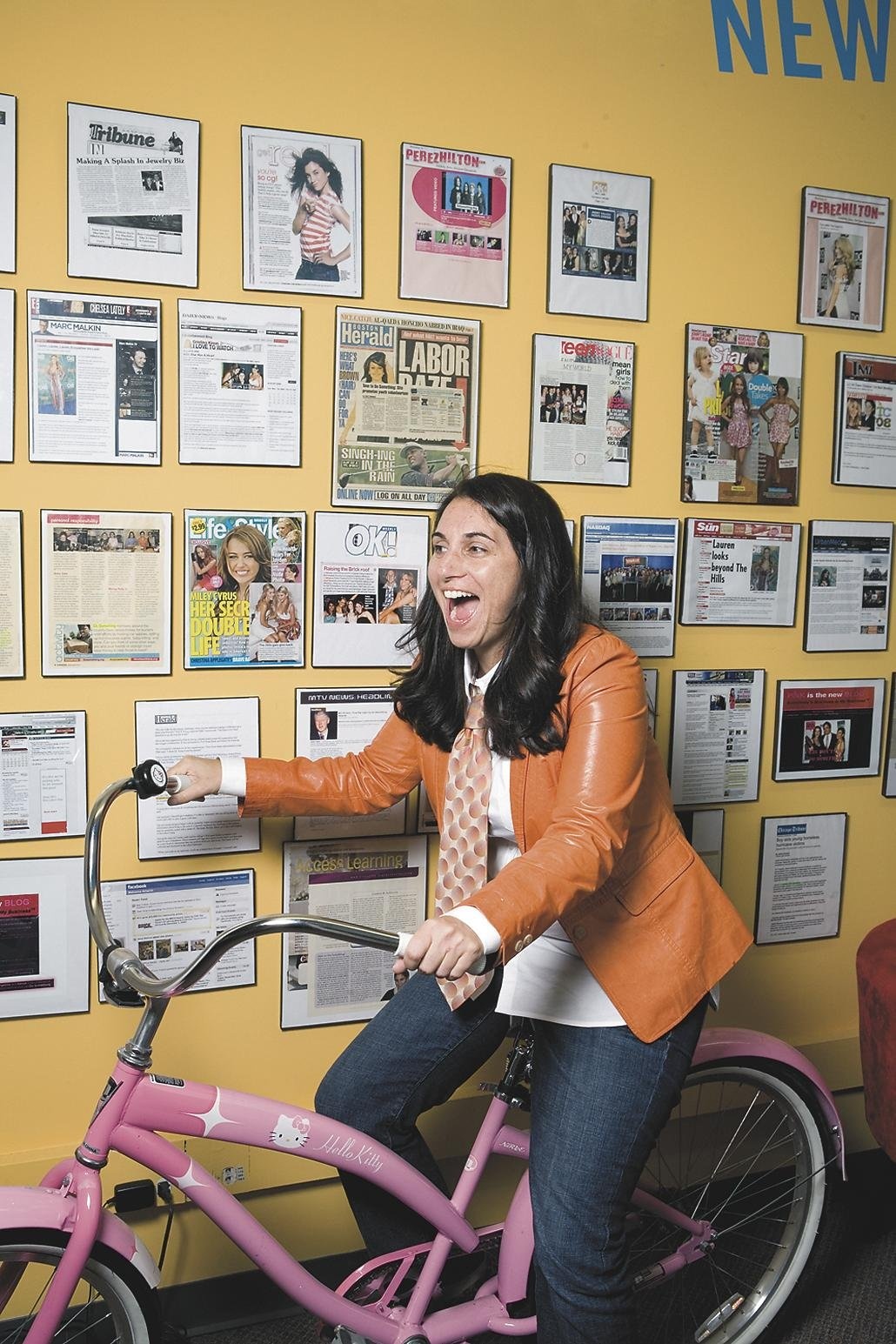
“This place should walk the walk and be run by a young person, not just someone who behaves and thinks like a young person,” says Ms. Lublin, who, with her red ballet flats, purple dress, and pink Hello Kitty bike parked at the office entrance, does look more Gen Y than corporate.
But her personal life tells a different story. Ms. Lublin has a 3-year old and a 5-year-old with her husband, whom she met four months before deciding to leave Dress for Success. “That introduced some balance,” she says. At Dress for Success, she says, “I literally went two years without even kissing anybody. Talk about no work-life balance.”
She has stayed passionate about work while carving out more time for family, but it’s not easy. Her kids beg her not to travel; her eldest recently demanded to know the name of a donor she had to visit on a trip that took her from New York. And she fields work e-mails on her BlackBerry while at Saturday night dinner parties. Ms. Lublin says she is “great about thinking about other people and giving sometimes unsolicited advice about what they should do next.”
But her own next career move is a mystery: “I’m terrible about myself.”