Interactive Map Helps Charity Show New Yorkers the Impact of Burning ‘Dirty’ Heating Oil

By NICOLE WALLACE
Features Editor
May 2, 2010 | Read Time: 3 minutes
The crisp winter air in Manhattan is likely to be a lot cleaner in the future next year—thanks in part to an environmental group’s creative use of mapping software.
The Environmental Defense Fund, in New York, sought to raise public awareness about the problem of using certain types of heating oil that are major pollutants.
During the coldest months of the year, it’s not unusual to see New York apartment buildings expelling giant plumes of thick, dirty smoke. As long as they have a permit, buildings in the city can legally burn No. 4 and No. 6 heating oil, essentially what is left over from the oil-refining process.
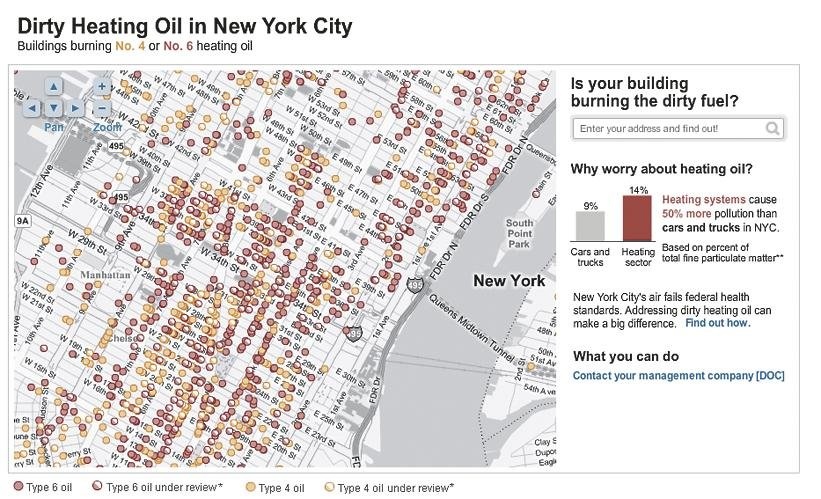
Only 9,000 buildings burn the low-grade oil—but the impact is significant, according to the advocacy group.
“These dirty buildings create more soot pollution than all cars and trucks combined in the city,” says Isabelle Silverman, a lawyer with the Environmental Defense Fund.
One of the strongest weapons in the group’s advocacy arsenal was an interactive, online map that let New Yorkers look up their own buildings.
The environmental organization also provided a detailed report that discussed the health risks posed by burning low-grade heating oil and the potential efficiency benefits of converting to higher-grade oils, as well as information about how New Yorkers could encourage their building owners to convert.
$8,000 Effort
Creating the interactive map wasn’t easy.
The charity first had to persuade the New York City Department of Environmental Protection to provide the data from permits and permit applications to burn No. 4 or No. 6 heating oil, something that Ms. Silverman says took some negotiation.
Then it took an outside contractor roughly eight weeks to assemble the data into a standard format and build the map. The final cost was more than $8,000.
In addition to developing the online map, the charity also created a map that showed the concentration of buildings burning low-grade heating oil by ZIP code.
“It hit home right away,” says Ms. Silverman. “You see, Oh my God, the richest parts of Manhattan have the dirtiest buildings.”
Nearly 1,000 people took advantage of a feature on the campaign site that gave people the opportunity to send an e-mail message to the mayor urging the city to require buildings to switch to cleaner heating oil.
At the end of January, officials at the mayor’s office called the organization to say that they had gotten the message and to ask the organization to stop the influx of e-mails.
The Environmental Defense Fund began its campaign in the middle of December, and a month later, Mayor Michael Bloomberg said in his State of the City address that his administration planned to make “our air cleaner by greening the heating fuels used by schools and large buildings.”
According to Ms. Silverman, the Environmental Defense Fund expects the city to soon issue a rule that would ban No. 6 heating oil in two years and require buildings to convert from No. 4 heating oil when their burner breaks, a policy she says would eliminate the use of low-grade heating oil over the next 15 to 20 years.