April 4, 2010 | Read Time: 7 minutes
When Acorn announced it was closing last month, explanations for the death of the community-organizing group were predictably split.
Conservative commentators said that the group failed due to scandals and corruption, while Acorn officials insisted they were laid low by “well-orchestrated, relentless, well-funded right-wing attacks.”
Many independent observers believe the truth exists somewhere in between.
What is clear is that the negative headlines surrounding Acorn caused foundations and other donors whos who had supported the group during brighter days to run away, as Wade Rathke, Acorn’s founder, put it, “like roaches when the lights come on.”
Now, as roughly half of Acorn’s former state affiliates try to reorganize under new names, a more-local focus, and with better financial controls, one question will be key to their success: Will the foundations come back?
Former affiliates of Acorn—which stands for the Association of Community Organizations for Reform Now—are regrouping in California, Massachusetts, New York, Texas, and several other states, but few of the new organizations have yet won support from national foundations.
In January, the California chapter reorganized as the Alliance of Californians for Community Empowerment, and is already enacting changes that will lead to better board oversight and financial management, says Amy Schur, its executive director, who held the same post with the Acorn affiliate.
The boards of many Acorn affiliates were made up exclusively of low- and moderate-income people in the geographic areas Acorn served, but the California organization will for the first time bring in board members from outside those neighborhoods who have expertise in accounting, finance, and legal issues.
The organization is working with Adler & Colvin, a well-known law firm in the nonprofit world, to set up its organizational structure. The group is also seeking “new voices and new blood” in senior management, Ms. Schur says.
The California association has already received nearly $1-million from four foundations in the state, including the California Endowment.
But the big national foundations that have supported the former group and other Acorn affiliates in the past have not yet given the new charity any grants.
Ms. Schur says she expects to seek money from the Ford Foundation and Atlantic Philanthropies in the near future.
“It’s a process,” she says. “Those funds will come back as people begin to feel comfortable with the strength and soundness of our new organization.”
Lost Grants
Some of the big national foundations that once supported Acorn—and pulled their support amid the scandals—aren’t eager to discuss the topic.
For example, The Chronicle’s calls to the Marguerite Casey Foundation were not immediately returned in the days following Acorn’s collapse.
The Ford Foundation has not yet received requests for support from former Acorn affiliates, but will consider providing grants to groups that meet the grant maker’s “high standards for fiscal responsibility, governance, and ethics,” says Joseph Voeller, a foundation spokesman.
Acorn boasted of more than 400,000 members at its peak, and the group enjoyed some notable successes. Its living-wage campaigns increased pay for low-income workers in several states, and eventually led to the 2007 increase in the federal minimum wage.
Acorn successfully took on some banks over predatory lending, and it estimates that it signed up more than 2 million new voters frombetween 2003 toand 2008.
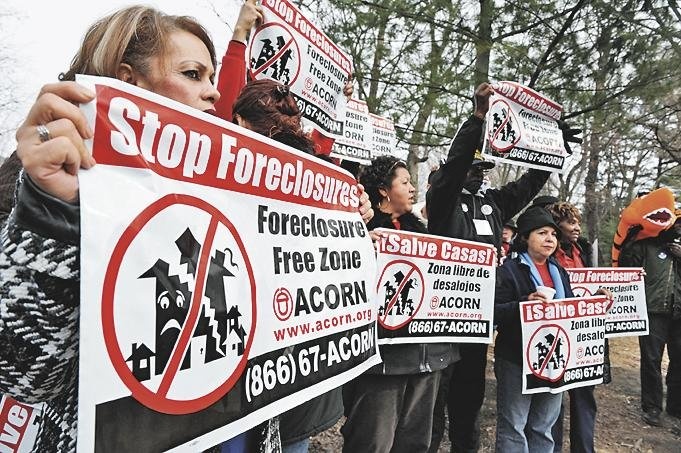
The group also had a large housing arm, now renamed Affordable Housing Centers of America, that continues to counsel low-income homeowners on how to prevent foreclosure.
In the statement announcing its closing last month, Acorn said it would develop a plan to “resolve all debts, obligations, and other issues.”
Among national groups advocating for low-income people, Acorn was unusual because of its broad membership in the poor neighborhoods it was trying to serve.
“They had a level of accountability to the people they were helping that was unmatched by most antipoverty organizations,” says John Atlas, the author of Seeds of Change, a history of Acorn that Vanderbilt University Press will publish this year.
Acorn’s troubles began in June 2008, when Mr. Rathke stepped down as chief organizer after it was revealed that he and other managers had kept secret the details of a nearly $1-million embezzlement by his brother, Dale, back in 2000. (The funds were eventually repaid.)
During the fall 2008 presidential campaign, conservatives accused Acorn of voter-registration fraud.
And then in 2009, as governance changes enacted in the wake of the embezzlement scandal were taking root, video footage emerged allegedly showing some of the group’s workers telling conservative activists, posing as a pimp and a prostitute, how to hide their criminal activities.
“Acorn would have recovered had it not been for the incident involving the fake prostitute and pimp,” Mr. Atlas says.
‘Cowardly’ Move
Some supporters of Acorn continue to be angry for the role that foundations played in Acorn’s demise.
“They were cowardly and they backed away at just the wrong time,” says Pablo Eisenberg, senior fellow at the Georgetown Public Policy Institute and a Chronicle columnist.
Mr. Rathke, who now heads Acorn International, which is independent of Acorn and operates in eight countries, says the foundations should have anticipated “a wild ride” when they first provided funds to a group helping lower-income residents achieve power in their neighborhoods.
“Does it have to be perfect?” Mr. Rathke asks. “Maybe I’ve been working in too many ghettos and barrios, but perfection is hard to find.”
‘Authentic Voices’
Some foundations, including the Needmor Fund, a $25-million foundation in Toledo, Ohio, that has made 20 grants over the past five years to Acorn affiliates, did stay with the group for most of the past two years.
Needmor suspended making grants to the affiliates for four months in 2008 after the embezzlement scandal became public, but resumed making grants by September of that year, according to the foundation’s executive director, Dave Beckwith.
Today, Needmor supports former Acorn affiliates in Texas and Florida that are reorganizing.
“We know in these places that the organizations represent the authentic voices of people with problems, and they’re working to try to solve those problems,” Mr. Beckwith says. “Where that voice is powerful, authentic, and grass-roots, we will continue to fund it as long as the group is well managed.”
Ginny Goldman, who heads the Texas Organizing Project, says the new group has just 12 employees, down from 25 when it was part of Acorn. The group, which reorganized in December, has no offices and is operating out of an AFL-CIO union hall in southeast Houston.
“We had to get down to a fighting-weight budget in order to survive,” Ms. Goldman says.
Like the new group in California, Ms. Goldman says the Texas Organizing Project is working with lawyers and accountants to insure the new group is “transparent and structurally sound,” and has appointed an advisory board made up primarily of union leaders and antipoverty policy experts.
Mr. Beckwith, of Needmor, believes the former state affiliates are wise to bring in new board members and managers.
“This is an example of learning from the past,” he says. “Acorn always believed that the people with the problems should own the organization. But the skills and experience required to manage even a modest-size nonprofit organization don’t come automatically.”
Federal-Money Debate
The Texas Operating Project is pushing for federal assistance for low-income people in Houston who still have blue tarps on their roofs two years after Hurricane Ike. The group is also working to make sure that low-income Hispanic residents in the Rio Grande Valley know how the recent health-care legislation will benefit them.
Congress yanked Acorn’s federal money shortly after the pimp-and-prostitute scandal, but in March a U.S. judge reiterated a previous ruling that the law blacklisting Acorn was unconstitutional because it singled the group out.
Even so, many of the reorganized state organizations are unlikely to seek federal funds.
“I suspect most of the new groups will be very wary,” says Steve Kest, who was executive director of Acorn, the No. 2 position, before he leftaving in February. “It was certainly a flashpoint in the attacks on Acorn.”
Also, most of the federal money that went to state organizations paid for so-called direct services, like tax preparation. Many of the new groups, including the Alliance of Californians for Community Empowerment, are abandoning those services.