High-Tech Projection and Texting Help New York Charity Attract Support for Its Fight Against Homelessness

By NICOLE WALLACE
Features Editor
March 21, 2010 | Read Time: 2 minutes
A New York charity is experimenting with new technologies to make city residents more aware of the local homelessness problem—and to reach out to new donors.
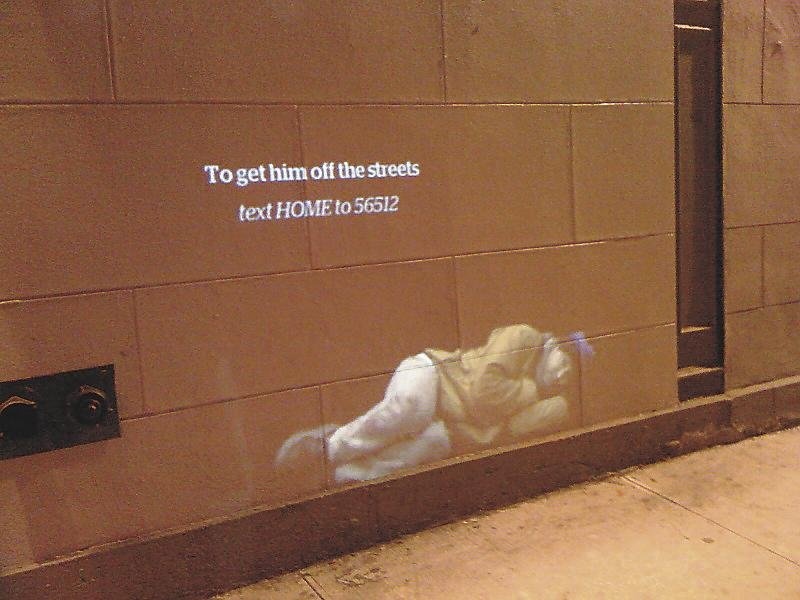
For three evenings in March, Pathways to Housing projected the image of a homeless man sleeping on the sidewalk and shivering in the cold in downtown Manhattan. Words also projected onto the side of a building asked passersby to send a text message to help get him off the streets.
When someone sent a text message, it triggered a new video loop in which the man got up and walked in the door of his new apartment.
The idea was to convey visually the organization’s approach to combating homelessness, which emphasizes getting people into housing first and then tackling their other problems, such as mental illness and addiction.
As the image of the man depicted in the video got up, the charity’s name and Web site address were projected next to the image. The person who sent the text message received a message asking if he or she wanted to make a $5 donation that would be added to his or her cellphone bill.
Too often pedestrians look away when they pass homeless people, says Sam Tsemberis, leader of Pathways to Housing.
“You can’t bear to see the pain or the suffering,” he says. The light installation, on the other hand, draws people in, he says, and gives them an easy, non-threatening way to interact with the homeless.
Pathways to Housing set up the projection at nine locations. Of the 200 people who sent text messages, more than 30 opted to make a cellphone donation. The organization says that the number of people visiting its Web site rose, as did the number of people who became fans of its Facebook page.
The charity hopes to show the light display—which was created by a Manhattan marketing company pro bono—elsewhere in New York and in Washington.
You can find a video showing how the charity’s campaign worked at http://philanthropy.com/extras.