Some Gifts Under $5-Million Proved Transformative for Charities in 2009

By NICOLE WALLACE
Features Editor
February 7, 2010 | Read Time: 3 minutes
Early in 2009, the Hebrew Immigrant Aid Society had to cut more than $500,000 from its $23.5-million budget. But at the same time, in the midst of the recession, the New York charity was starting a new fund-raising program to seek large gifts.
Several months later, the new effort landed its first big donation.
In October, Sergey Brin, co-founder of Google, marked the 30th anniversary of his family’s arrival in the United States by making a $1-million unrestricted gift to the resettlement organization, which had helped his family migrate from the Soviet Union.
“It was really a shot in the arm for us,” says Gideon Aronoff, the charity’s chief executive. “It was the cornerstone gift in our nascent major-gifts program.”
Mr. Brin’s mother, Eugenia, serves on the Hebrew Immigrant Aid Society’s board, and together with Mr. Brin’s father, Michael, came up with the idea for MyStory, an online social network run by the charity through which Russian Jewish émigrés around the world can share their immigration experiences and reconnect with friends and relatives.
$1-Million Gift Helps Children in Baltimore
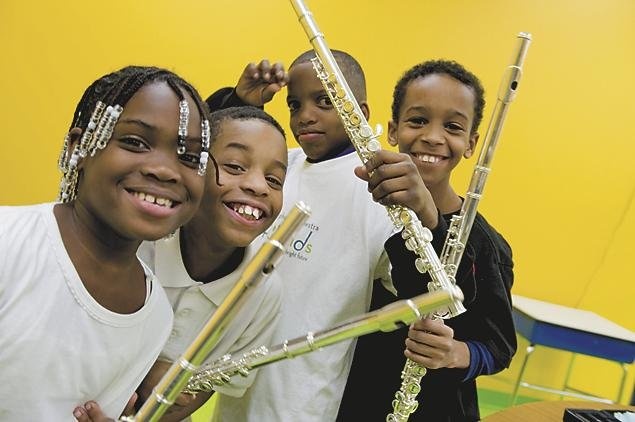
OrchKids is an after-school program in Baltimore that combines intensive musical instruction with nutrition education, mentors, and field trips.
“It’s attempting to help children realize their potential without being pulled back down again by some of the challenges that young children living in disadvantaged neighborhoods have to deal with on a day-to-day basis,” says Paul Meecham, chief executive of the Baltimore Symphony Orchestra, which started the program a year and a half ago.
Because of the economy, the orchestra delayed plans to expand the program to a second elementary school.
But thanks in large part to a $1-million gift from Robert E. Meyerhoff, a real-estate developer in Baltimore, and his longtime companion, Rheda Becker, the orchestra was able to increase the number of spots in the program to 180 for the 2009-10 school year, up from 30 the previous year. Their donation will cover 50 percent of the program’s expenses for four years and start a reserve fund that over time will become a restricted fund to endow the OrchKids program.
The couple are longtime supporters of the orchestra: Mr. Meyerhoff is the nephew of Joseph Meyerhoff, the man for whom the symphony’s headquarters is named, and Ms. Becker has narrated children’s concerts at the symphony for more than 30 years.
A Surprise Windfall for Three Iowa Charities
Three nonprofit organizations in southwestern Iowa were notified in September 2008 that they had been named as the beneficiaries of the estate of Wayne Alwill, a farmer in Manning, Iowa, who had recently died at age 78.
The bequests were a complete surprise to the charities. None of them—the Danish Immigrant Museum, in Elk Horn; Living History Farms, in Urbandale; or the Shelby County Historical Society, in Harlan—had ties to Mr. Alwill.
Within three weeks of Mr. Alwill’s death, the executor sold the stocks in the estate, protecting it from the worst of the stock-market meltdown.
By the time the estate was settled in 2009, each of the three charities had received $1.3-million.
The motives that drove Mr. Alwill’s generosity remain elusive. Staff members at the Danish Immigrant Museum have combed through attendance records but didn’t find any evidence that Mr. Alwill had ever visited the museum, which had opened in 1994.
The museum isn’t even certain if Mr. Alwill was of Danish descent, says John Mark Nielsen, the organization’s executive director.
Mr. Alwill’s grandparents lived in a disputed area on the border of Denmark and Germany and then emigrated to an area of Iowa that was right between large numbers of Danish and German immigrants.
“His great-grandfather fought in what’s called the Dano-Prussian War, but it’s not even clear on which side he fought,” says Mr. Nielsen.