Creating Communications Networks for Relief Groups in Haiti

By NICOLE WALLACE
Features Editor
January 25, 2010 | Read Time: 2 minutes
The massive earthquake that struck Haiti this month almost completely destroyed the country’s communications infrastructure, says Bill Brindley, chief executive of NetHope, an organization through which 28 large international-aid groups collaborate on technology issues.
“Our members on the ground tell us that it’s like responding to a disaster five or ten years ago,” he says.
Technology specialists from NetHope, its member organizations, and Inveneo – a nonprofit group in San Francisco that brings information technology to developing countries – have been working long hours to establish communications networks for relief groups that are responding to the disaster.
“In situations like the one in Haiti, communication is critical to delivering aid,” says Mr. Brindley. “Without connectivity, member agencies cannot coordinate the delivery of food, water, health care, and information – or even unite survivors with their loved ones.”
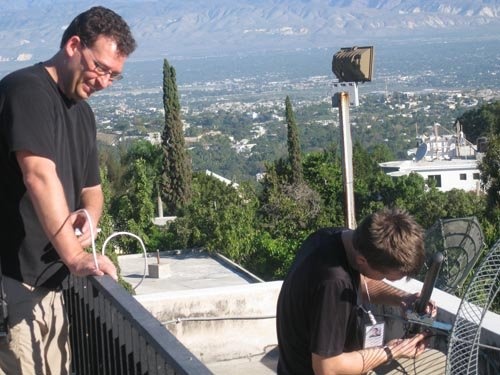
Late last week, engineers installed satellite dishes on the rooftops of two CHF International buildings in order to set up a high-speed Internet connection that can be shared by NetHope member organizations via a wide-area wireless network. They were able to install long-distance Wi-Fi Internet links to connect two offices of Save the Children and the offices of Catholic Relief Services to the network.
In coming days, the team will work to link other NetHope members to the network.
NetHope is also deploying dozens of their Network Relief Kits to Haiti.
When the kits were first tested in Indonesia after the tsunamis, they were 50-pound suitcases that opened up to provide a ready-to-go computer network and access to the Internet.
Now, five years later, the kits are backpacks.
Each kit can link laptops on a wireless network, connect to the Internet using a mobile satellite terminal included in the kit, and support wireless phones and phone lines in which messages move over the Internet. The kit also includes a solar charger that can be used when there is no power.
The network kits will be used by organizations that are out of the range of the wireless network and in situations when mobility is key, such as when a group of relief workers sets up a new site for aid distribution.
Says Mr. Brindley: “As they move from place to place, teams can utilize this backpack to immediately set up connections and begin to coordinate supplies and displaced persons.