Grant Maker Pledges $500-Million to Help America’s Kids Slim Down

By nicole lewis
Contributor
April 19, 2007 | Read Time: 9 minutes
In the hope of speeding up efforts to fight the growing problem of childhood obesity,
ALSO SEE:
ARTICLE: What’s for Dinner?
ARTICLE: A Philadelphia Effort to Spread ‘Local Food’ Raises Its Ambitions
ARTICLE: Foundations Collaborate to Promote Easy Access to Fresh Food
ARTICLE: Big Grants from Foundations: a Snapshot From History
the Robert Wood Johnson Foundation, in Princeton, N.J., has pledged $500-million over five years to help children increase their physical activity and to encourage them to eat healthier foods.
“It’s clear that this is one of the largest, if not the largest, threats to our nation currently, and it’s preventable,” says Risa Lavizzo-Mourey, the foundation’s president. “If we can reverse the epidemic where it begins, in childhood, then the payoff for the country is just enormous.”
The commitment is one of the biggest any American foundation has guaranteed to a single cause, although other foundations may have ended up spending more over time to deal with other major issues.
The percentage of overweight children ages 6 to 19 has more than tripled in the past 30 years, according to results from a 2003-4 survey by the Centers for Disease Control and Prevention, in Atlanta, the most recent such study available.
Nearly 19 percent of children ages 6 to 11 are overweight, the centers said, as are 17 percent of children 12 to 19. In the centers’ outline of health trends in America last year, childhood obesity was cited as increasing the risk that more Americans would face high cholesterol, liver abnormalities, diabetes, and weight problems as adults.
“What we are going to see is a real crisis in the health-care system unless we pour money into prevention,” says Patricia Crawford, co-director of the Dr. Robert C. and Veronica Atkins Center for Weight and Health at the University of California at Berkeley. “We know if we put money into treatment it has not been successful — it’s hard to reverse something that has already occurred.”
The Johnson foundation, the third wealthiest in the United States, expects that if its grants achieve their intended goals, the percentage of overweight children in the United States would begin to decrease by 2015.
Thomas H. Kean, the Johnson foundation’s chairman and the former governor of New Jersey, says the obesity commitment may just be the first of substantial pledges the foundation will make in a variety of areas.
“As a board, we have asked the staff to look for larger bets with greater consequences,” he says. “If five years from now, the research shows something else is the biggest problem affecting us, then you’ll see the foundation make a big commitment in that area.”
Making a Statement
Ms. Lavizzo-Mourey says the $500-million for obesity represents additional spending from the foundation’s endowment, and will not be distributed at the expense of its other grant-making programs, such as its efforts to expand health-insurance coverage among Americans and fight drug abuse.
“We picked a number that we think is commensurate with the size of the problem and a number that makes a statement about our long-term commitment,” says Ms. Lavizzo-Mourey. “Millions and millions of promising young lives are being redirected away from health and a hopeful future to disease and early death.”
News of the Johnson foundation’s significant commitment was applauded by other foundation officials and obesity experts, but some public-health observers and others are reserving judgment until they see exactly how the money will be spent.
Georges C. Benjamin, executive director of the American Public Health Association, in Washington, says Johnson’s pledge “puts substantial resources on the street. Now we have to see how they display those resources,” he says. “At the end of the day, how do we get people to change behaviors that are fundamental to their daily existence?”
Pooling Efforts
While the amount pledged by Johnson outstrips any other commitment, many foundations have been pouring more money into obesity-fighting efforts in recent years. Several foundations, including the W.K. Kellogg Foundation and the California Endowment, along with Johnson, plan to pool some of their money so they can make a bigger difference. The minimum contribution for a foundation to join the collaborative project will be about $20,000, but the bigger foundations will contribute more, says Marion Standish, program director for community health and health disparities at the California Endowment, in Los Angeles.
“We are all interested in seeing policy change move faster than it has,” says Ms. Standish. “We don’t want to wait like we did on public-health issues like gun control or tobacco.”
Other nonprofit groups and grant makers have also stepped up efforts to keep children from getting fat. Among the larger efforts:
- Since 2000, the California Endowment, in Los Angeles, has committed $38-million to the cause, including a $26-million grant-making program that seeks to improve opportunities for school-age children in six poor towns and cities to eat healthy meals and snacks and to enforce physical-education requirements during school, as well as advocate safer parks.
- The Dr. Robert C. and Veronica Atkins Foundation, in Jenkintown, Pa., has pledged $14.5-million since 2004, including a $10-million award in January, to support the Center for Weight and Health at the University of California at Berkeley. The late Dr. Atkins wrote a series of popular diet books and started a dietary-supplement and food company known today as Atkins Nutritional.
- In 2005 the William J. Clinton Foundation, in Little Rock, Ark., and the American Heart Association, in Dallas, formed the Alliance for a Healthier Generation, which has been urging schools and restaurants to offer healthier meal and snack options. One of the alliance’s major supporters is the Robert Wood Johnson Foundation, which made a four-year commitment of $8-million last year.
- The W.K. Kellogg Foundation, in Battle Creek, Mich., is about to embark on an effort of at least a decade to create more opportunities in towns and cities across the country for Americans to eat healthy food that is locally grown as well as take part in physical activity.
The foundation has made an initial pledge of $18-million to start the program in eight states and may spend as much as $100-million on the effort as it expands, says Linda Jo Doctor, a program director at the foundation.
Interest is also growing among the public: In a 2005 opinion poll by the Harvard School of Public Health, in Cambridge, Mass., three-fourths of Americans cited obesity as an “extremely” or “very” serious health threat.
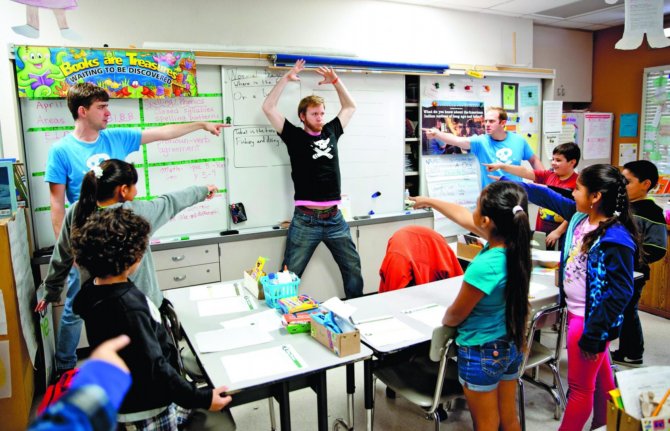
And in January, about 1,700 people — including educators, business executives, public-health officials, and government leaders — attended the four-day California Childhood Obesity Conference, in Anaheim. Attendance at the conference, which takes place every other year, has nearly doubled since it began in 2001. Among its new sponsors: the Rosalinde and Arthur Gilbert Foundation, in Santa Monica, Calif., which gave $50,000 to underwrite a session on using movement and theater to encourage children to exercise.
Exploring New Tactics
Since 2003, the Robert Wood Johnson Foundation has spent $80-million on numerous projects to promote healthy eating and exercise among children.
For example, it awarded $205,112 to study how different types of playground equipment affect how long children play and how much exercise they get from each activity, and $265,944 to promote the use of local produce and healthy eating in Austin, Tex., schools.
The Johnson foundation plans to continue focusing on how schools as well as communities can help children eat better and be more active, says Kathryn Thomas, a senior communications officer at the foundation.
However, some of the new money might also be used to explore new tactics in the battle against obesity, such as how to use public-service announcements or other communications tools to broadcast the importance of good nutrition and exercise, says Ms. Thomas.
The foundation is also considering expanding its grants to groups working to encourage supermarkets to open in poor neighborhoods, so residents have easy access to fruits and vegetables, as well as grants that promote healthy eating among schoolteachers and other people who work in schools, thereby providing students with role models.
The new effort will make grants to organizations that serve children and teenagers from 3 to 18; in the past, the foundation focused mainly on groups aiding children no older than 12.
Seeking Cooperation
Ms. Lavizzo-Mourey says a network of groups, including government, corporations, schools, and families themselves, as well as other donors, will be needed to complement the Johnson Foundation’s $500-million effort.
“It seems like a lot of money, but it will not get the job done unless we get commitments from others in society,” she says. “The urgency of this problem simply cannot wait.”
But other foundations might not be so eager to join in, says Joel L. Fleishman, head of a foundation-research program at Duke University, in Durham, N.C., and the author of a recent book on grant makers.
“The likelihood that other foundations will join in after a foundation takes the initiative and starts something like this is not high because it becomes stamped as their effort,” he says. “To get cooperation usually it is a lot easier to start before something is formulated and then announced than it is to do it afterward.”
And at least one nutrition and exercise expert doesn’t believe obesity is the issue that should get the limelight. “We have still got a lot of people who are homeless, hungry, and without health insurance in this country. Those are far bigger issues,” says Glenn A. Gaesser, a professor of exercise physiology at the University of Virginia, in Charlottesville, and author of the 1996 book Big Fat Lies: The Truth About Your Weight and Your Health.
“Most of this so-called obesity problem could probably be resolved if everyone just took a 30-minute walk every day and tried to eat a couple more fruits and vegetables each day,” says Mr. Gaesser.
But people can’t eat healthy foods or go for regular walks if there are no supermarkets that sell fresh produce or safe places to stroll in their neighborhood, says Debra Haire-Joshu, director of the obesity-prevention center at the Saint Louis University School of Public Health, in Minnesota.
“You can’t buckle your seat belt if you don’t have a seat belt. You can’t put a baby in a car seat if you don’t have a car seat,” she says. “People will make the right choices, or will have the opportunity to make choices, when they understand what they are eating and how they have access to it, and right now we can’t say that.”
The Johnson foundation’s 2006 annual report includes a detailed message from Ms. Lavizzo-Mourey explaining the genesis and purpose of its $500-million childhood obesity effort. The report is available on the foundation’s Web site.