Charities Step Up Advocacy as Congress Nears Fiscal Cliff

By Doug Donovan
Contributor
December 2, 2012 | Read Time: 6 minutes
Nonprofits across the nation are scrambling to convince Congress to cushion the expected blow from massive federal spending cuts scheduled to hit in January.
Some groups have been aggressively working to preserve the charitable tax deduction that helps spur private donations.
Others have been busy proving the value of the social safety net they’ve built with billions in government aid, which is now at risk.
But few have been advocating for tax increases that could avert cuts to federal funds, the second largest revenue source for nonprofits (after tuition, fees, and other charges charities impose).
Some nonprofit leaders say that’s a big mistake.
“Every nonprofit should be speaking out on the need for new revenue, and we should be opposing massive spending cuts. We haven’t rallied around that one-two message,” says Gary Bass, executive director of the Bauman Foundation and a longtime public-policy expert in Washington. “If you’re a local or state nonprofit, the number-one issue is increasing tax revenues.”
Two of the major coalitions that lobby on behalf of charities, Independent Sector and National Council of Nonprofits, have focused either too narrowly on preserving the charitable deduction or too broadly on the impact of cuts, says Mr. Bass and other nonprofit advocates say.
“We have not been seen speaking out for increasing revenues,” he says. “Our leaders have not led.”
Nonprofits in Limbo
Nonprofits are focusing their attention on Washington because of the $109-billion in automatic cuts in federal spending that are scheduled to go into effect on January 2, a step over the “fiscal cliff.” Taxes would also rise for many Americans.
President Obama and Congress are trying to craft a less draconian approach to closing the deficit, but it seems likely that at least some programs that support nonprofits will be reduced and the tax code altered in ways that could affect donors.
But how much will be cut in a deal? Nobody knows for sure.
That has left nonprofit leaders in an awkward situation. They know federal cuts will continue to cause them “significant problems,” yet only 55 percent said in a recent Bridgespan Group survey that they have an “adequate understanding” of the potential reductions.
Even members of Congress are in the dark.
“You talk to 20 members and you get 20 different scenarios,” says David Bradley, executive director of the National Community Action Foundation, which lobbies for programs that assist low-income families and individuals. “The most frequent comment you get from members is, ‘What are you hearing?’”
Advocacy by nonprofits has been scattered because no one knows what is going to happen, says Patrick Lester, director of fiscal policy at the advocacy group OMB Watch.
“It changes day by day,” he says.
Spending vs. Tax Breaks
The most visible and organized advocacy has centered on the charitable tax deduction, a priority for Independent Sector and its 600 member groups. The Charitable Giving Coalition, which represents at least 50 organizations, is expected to bring more than 225 nonprofit officials to Washington this week to hold more than 200 meetings with lawmakers to discuss the impact of altering the charitable deduction.
“The charitable tax deduction, people now realize, is on the chopping block,” says Diana Aviv, Independent Sector’s chief executive.
A proposal to cap deductions, now a popular idea among lawmakers, would cause charitable giving to drop sharply, she says, and that is money that gives nonprofits administrative flexibility that restricted government grants cannot. “The rich people will not be affected by this. All they do is reduce the number they give,” Ms. Aviv says. “Poor people will be affected.”
But Mr. Lester says nonprofits need to be careful not to be viewed in Congress as advocating more to protect a deduction that benefits wealthy donors than for protecting government money used to aid the poor.
“The charities are great poster children for not increasing taxes on upper-income folks,” he says. But government spending is the real lifeblood for social-service nonprofits. “The spending side of the ledger is where the real action is for nonprofits.”
If nonprofit advocates persuade Congress to save the charitable deduction, they could lose the battle against spending cuts that might hurt more nonprofits, Mr. Lester says. “They’ll get pennies back on the dollar from the charitable deduction,” he says, “while they’re taking a significant hit on the spending side.”
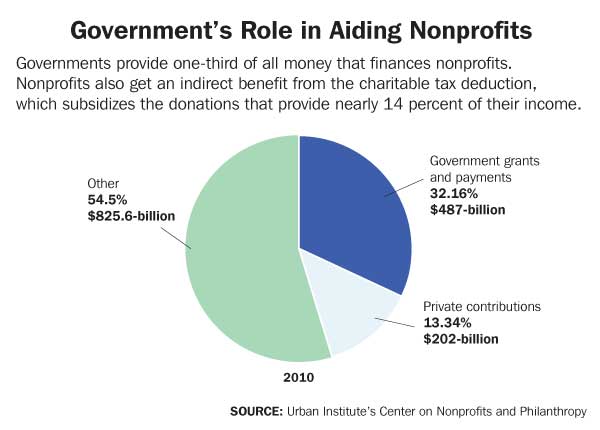
Governments at all levels provided $487-billion, or a third of the nearly $1.5-trillion in revenue that financed nonprofits in 2010, according to the Urban Institute’s Center on Nonprofits and Philanthropy. Fees generated 49 percent of that revenue while private donations—including those subsidized by the charitable deduction—accounted for 13 percent, or $202-billion.
Nearly 33,000 nonprofits that deliver human-services receive government contracts and grants, which was the largest source of revenue for 60 percent of those groups, the center says.
“There are much greater concerns at stake here than one tax break,” Mr. Bass says. “When it comes to spending cuts, you’re talking about a fairly significant impact.”
Changing Emphasis
That’s certainly not lost on Tim Delaney, chief executive of the National Council of Nonprofits, which represents 36 state coalitions of charities.
The group’s fiscal-cliff advocacy Web site, GiveVoice.org, is titled “Take Action: Protect the Charitable Giving Incentive.”
But it spells out both the threats to spending cuts from what is known in Washington jargon as sequestration (the automatic spending cuts) and to the charitable deduction.
“Most people have assumed that the sequestration cuts will go away, so they have probably put more emphasis on the charitable tax deduction,” Mr. Delaney says. That has changed because no deal has emerged, he adds.
As for advocating for revenue increases, Mr. Delaney believes that’s a step charities should avoid.
“It’s not their mission to say you should be lowering or raising taxes,” Mr. Delaney says. “That may evolve over time as the cuts become more severe and the pain increases.”
One coalition, Strengthening America’s Values and Economy for All, sent a letter to Congress in October signed by 1,900 organizations advocating tax increases and other measures to avert cuts.
The group, led by the Coalition on Human Needs, wrote that wealthy citizens need to “start to pay their fair share of taxes.”
“Our nation’s wealthiest have benefited disproportionately from the tax reductions enacted since 2001,” the letter stated. “We cannot afford to continue giving tax cuts to those who need them least.”
Deborah Weinstein, executive director of the coalition, says she is optimistic that Congress can achieve a fair deal.
“There are sensible solutions that don’t slam the brakes on the economy and that don’t hurt people who are really struggling,” Ms. Weinstein says. “Low-income and vulnerable people have to be protected in this process.”