The Tax Bill’s Champion for Nonprofits? A Former Christian Camp Director
How 15 years running a nonprofit camp helped shape Sen. James Lankford’s legislative priorities.

By Ben Gose
Senior Editor
July 24, 2025 | Read Time: 10 minutes
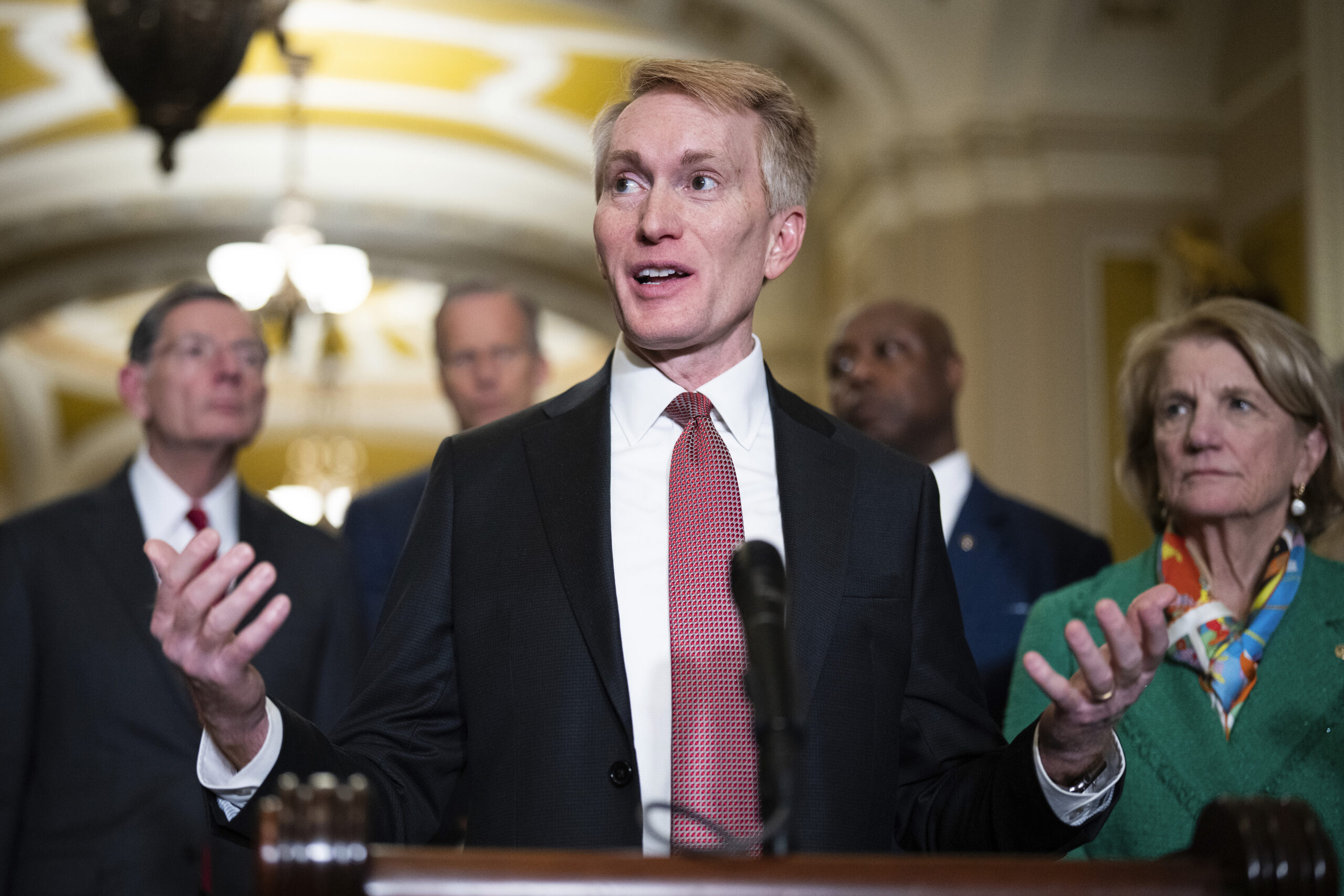
Members of Congress bring a diverse set of professional backgrounds to Washington — with plenty of lawyers, business owners, and educators. Sen. James Lankford, a Republican from Oklahoma, is something of an odd duck: One of the few legislators with substantial leadership experience at a nonprofit, he ran the nation’s largest Christian youth camp for 15 years.
Senator Lankford arrived in Washington as a U.S. Representative in 2010, and he moved to the Senate in 2014 after winning a special election. Lankford says he quickly discovered he needed to pay attention to the unique needs of nonprofits, given the lack of awareness of how they operate. Just like other Americans, members of Congress are less likely to donate to charity and attend religious services than previous generations — both of which contribute to a weaker understanding of how nonprofits function.
Nonprofits and the Tax Bill

-
Government and Legislation
The Tax Bill Will Add New Money Woes to a Reeling Nonprofit Sector
-
Government and Legislation
Billions in Charitable Giving Could Be Lost, New Research on Tax Bill Shows
“When I talk to people about nonprofits, most people will respond, ‘Well, they’re just like small businesses,” Lankford says. “I’ll usually laugh and go, ‘Yeah, they wish they ran like a small business.’”
Lankford is widely regarded by nonprofit advocates as one of the strongest champions in Congress for the charitable sector — and that’s despite his vote for the “big beautiful bill,” which has generally been panned by the sector for its cuts to Medicaid and food assistance programs. (Lankford argues that those provisions are primarily about getting states to step up and do more.)
Lankford and fellow Republican Sen. Todd Young of Indiana are credited with helping to kill a provision in the bill that would have sharply raised taxes on private foundations and cost the charitable sector billions per year.
During the pandemic, Lankford advocated successfully for the inclusion of charities and faith-based organizations in the Paycheck Protection Program, the federal program that was initially open only to small businesses and provided forgivable loans to help them cover payroll.
But Lankford is most proud of his work — some seven years in the making — to help establish a permanent charitable deduction for the 90 percent of Americans who don’t itemize their taxes. Arguably the biggest win for the charitable sector in the new tax law, the deduction takes effect in 2026. It will allow singles who don’t itemize to deduct up to $1,000 in cash gifts to charities and couples to deduct up to $2,000.
Lankford has been focused on a charitable deduction for non-itemizers since 2017, when the expansion of the standard deduction prompted 20 percent of American households to stop itemizing — meaning they received no tax benefit from their giving.
A 2024 study by three philanthropy researchers found that charitable giving dropped by $20 billion in 2018, the year the change took effect, with most of the decline affecting charities that provide basic needs.
Lankford’s years of advocacy for the non-itemizer deduction comes from hard-earned awareness of the role that small donors play in helping charities thrive. From 1995 to 2009, Lankford served as director of student ministry for what’s now called Oklahoma Baptists. The job featured months of planning — including legal work, hiring, and writing curricula — followed by an extremely busy summer.
Waves of young people — 5,000 a week and more than 50,000 per summer — descended on Falls Creek Youth Camp, which he directed, about 80 miles south of Oklahoma City. Lankford played a role in fundraising at Falls Creek, too, helping the camp raise money for a $25 million, 7,200-seat tabernacle.
“It’s where teenagers in Oklahoma go to get away from their parents for a week during the summer, but also find a new perspective on faith and life,” Lankford writes in his new book Turnaround: America’s Revival. “Years later, I still hear the stories of how a week at camp changed someone’s perspective forever.”
The experience explains why Lankford worked so long on an incentive for small-dollar donors, says Brian Walsh, executive director of Faith & Giving, a coalition of faith-based organizations that has lobbied for the charitable deduction.
“He has an intimate and intuitive knowledge about not only what charities do but how vital giving by individuals is to charities and how that makes it possible for charities to help people in need,” Walsh says.
During the debate over the tax bill, Lankford says that other Republicans pressed him on whether the federal giving incentive for small-dollars donors was worth the cost, estimated at nearly $74 billion over 10 years. “What economic stimulus would it provide?” they asked.
“I made it very clear to my colleagues that we need strong nonprofits as a safety net,” Lankford says.
Small donors aren’t just contributing money to charities, Lankford says — they’re helping in other ways, too.
“Your most active volunteers are usually the small-dollar donors,” Lankford says. “The more you can incentivize small-dollar donors, the stronger you are making nonprofits. They’ll have a larger and larger pool of people to be able to reach out to and say, ‘Hey, you gave us $20 or $50 or $100. Would you also come and volunteer?’”
One of the more unusual friendships in Congress is the bond between Lankford and his Democratic colleague Sen. Chris Coons of Delaware. The two worked together for many years on an incentive for donors who don’t itemize before this year’s breakthrough. Coons says they became close at the Wednesday morning Senate prayer breakfasts, where roughly 20 senators gather to talk about their faith journeys.
“We have very different political priorities, but James is a man of great integrity,” Coons says. “There are 2,000 references in [biblical] literature to the joyful obligation to care for those at the margins. In James’s view, he thinks that principally should come not from government action but from personal action. To follow through on that, he feels a calling to really support charitable giving.”
The Chronicle recently talked to Lankford about the charitable deduction for non-itemizers, what he draws on from his time as a nonprofit leader, and the role of nonprofits in society. Here are some highlights, edited for clarity and brevity.
Why are nonprofits important?
Our nation has three safety nets — the first is the family, the second is churches and nonprofits, and the third is government. Government cannot carry all of the social needs in the country — it just cannot.
Government most effectively sends out a check, but it really doesn’t train people for work or help the hungry or the homeless or the hurting in practical ways beyond just finances because there’s just not the structure to do that. That’s something that families do, that’s something that nonprofits do. So for me, whatever we can do to strengthen the nonprofit world benefits the entire country because nonprofits are the hands and the feet — they’re doing the mentoring and the training and engaging people in very practical ways.
Did you learn anything from running the Falls Creek camp that has been helpful during your time in Congress?
Definitely. One is hiring staff — bringing people on board and empowering them to do the tasks. That’s something I had to do a lot of all those years. The fundraising part obviously carries over into Congress as well — even though political fundraising and nonprofit fundraising are very different. And learning to work with people who disagree.
We had about 125 churches that were there every week. The leaders and sponsors didn’t all agree about how things were being done. You had to learn to listen to people — and filter out what’s a good idea from what may also be a good idea but is one that will never, ever work.
What explains the breakthrough this year — after so many years of trying — on the charitable deduction for people who don’t itemize?
It’s amazing when people say it looks like that was easy. We had seven years of pushing — meeting with nonprofit organizations, and those nonprofit organizations then meeting with members of the House and the Senate to be able to continue to bring this up. We had to provide the reasons this is important. The American Enterprise Institute did a study showing the loss to nonprofits with the change. That was helpful as a data point. But it literally was just year after year after year of pounding this. Most things that happen quickly here on Capitol Hill are actually things that happened over years. It may pass quickly at some point, but the groundwork has been laid for a very long time.
How did the proposed expansion of taxes on private foundations come out of the “big beautiful bill”? There were rumors that you were approached by members of the House who wanted to see those taxes survive — and that they’d give you the expanded non-itemizer deduction as long as the Senate signed off on the private-foundation tax.
We just made it very clear that we were not going to agree to that. There might have been some staff discussions on that back and forth, but no one else reached back out to me, honestly. I made it pretty clear — Hey, that’s a bad idea. I’m not going to hurt the private foundations. Your large-dollar donors, your private foundations — they give a lot of help to nonprofits. They’ve got to stay strong.
In Turnaround, you discuss a tough time in your childhood after your parents divorced. Were there any federal, state, or charitable programs that helped your family during that time?
I actually do not think we were on any federal or state programs during that time. My mom moved back in with her parents into a little garage apartment behind my grandparents’ house. She was there for several years until she got on her feet, and then we had a tiny little rental house in East Dallas that we lived in. She was a single mom, and she just busted it to make it work.
Are there any charities in your home state that you’d like to highlight?
There are so many great charities in Oklahoma — there really are, and I’m not just saying that.
I love telling the story of A Pocket Full of Hope. It was started by Lester Shaw, an educator at a high school. He was at a conference and they were talking about pockets of poverty and he just asked the simple question — ‘Well, aren’t there pockets of hope out there?’ So he started mentoring a couple of kids and said I’m going to create some pockets of hope in these pockets of poverty. That grew into this ongoing mentoring program where they help kids during really tough moments in middle school and high school.
Everyone looks at the United Way and Red Cross and these very complicated organizations and thinks, I couldn’t do that. Well, I think you could do A Pocket Full of Hope. Part of what I tried to do in Turnaround was to say if you’re sitting there wishing things could get better, the way it gets better is people actually engaging and finding things to do.