With Federal Funding Slashed, This Nonprofit Aims to Reinvent Itself
About half of Jumpstart’s funding comes from AmeriCorps, support the Trump administration recently cut.

By Eden Stiffman
Senior Editor
July 10, 2025 | Read Time: 8 minutes
What happens when long-established nonprofits lose access to the federal funding that has been a mainstay for decades? That’s the new reality for countless organizations, including Jumpstart for Young Children — which is regrouping in ways that hold broad lessons for its peers.
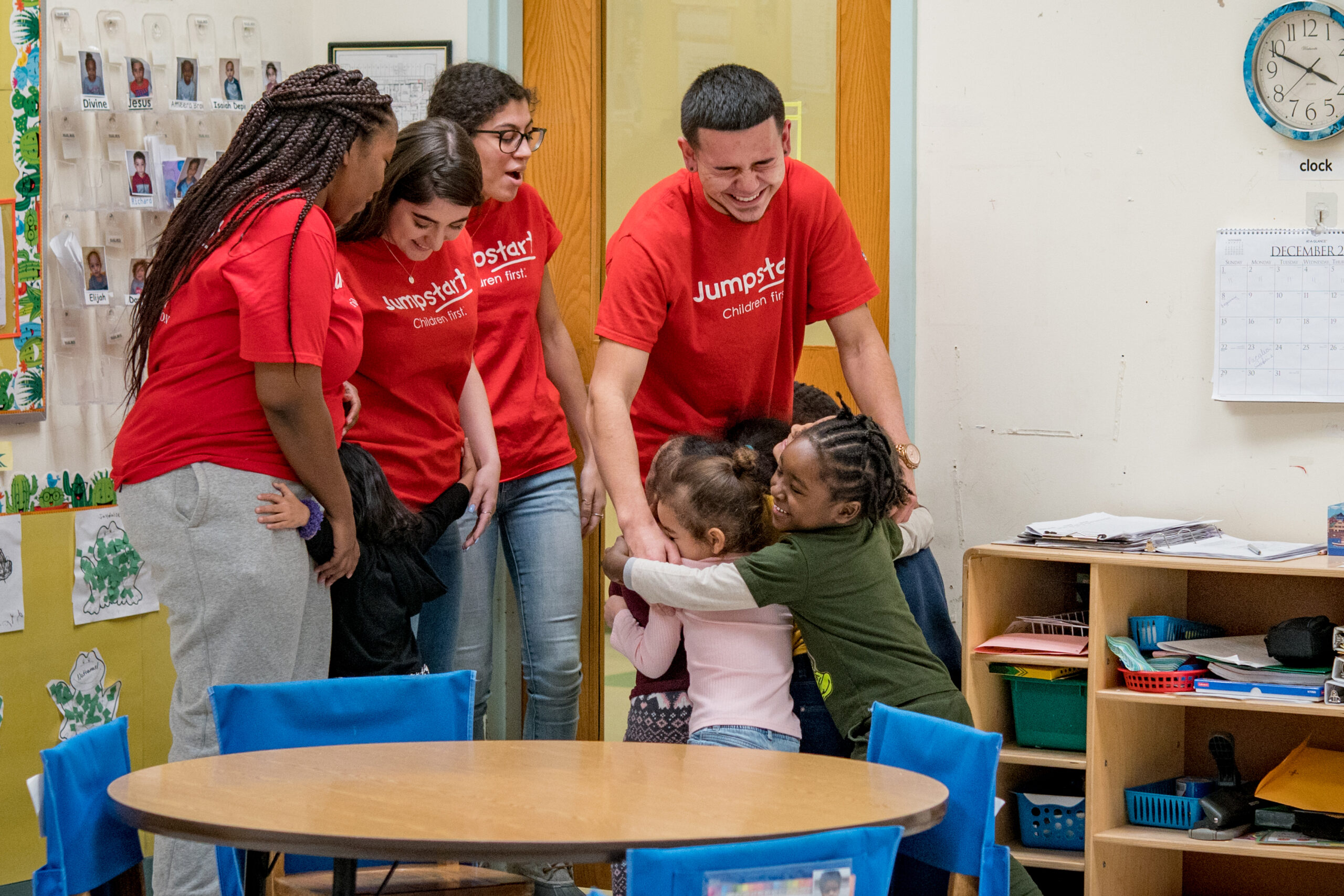
Since its founding in 1993, Jumpstart has trained tens of thousands of college students to work in pre-K classrooms and develop kids’ language, literacy, and social skills. The nonprofit was started by two Yale University students who were inspired by a summer camp tutoring experience and wanted to bring that back to low-income communities near their New Haven campus.
In the following decades, growth was propelled by more than $150 million of federal support. Jumpstart received its first AmeriCorps grant in 1996, and federal dollars have consistently been a major source of revenue. More than half of its $18 million annual budget — to operate 65 sites in 13 states plus the District of Columbia with about 2,300 college students serving 21,900 kids — came from AmeriCorps in the last fiscal year.
Then in April, the Trump administration announced it was slashing AmeriCorps grants. The steep cuts forced JumpStart to accelerate plans, already underway, to reinvent its program delivery.

“We want to build something that allows us to pivot and to do that in a way to be sustainable for the next 30 years,” said Jumpstart CEO Crystal Rountree.
Securing government funds was often seen as the holy grail for nonprofits seeking to prove their model and expand their impact. Now groups that have long relied on federal support to scale up their work are being forced to rebuild their revenue model, scale back, or even go under. With a substantially smaller staff and budget, Jumpstart is looking to target the locations where it can have the biggest impact. Jumpstart leaders say these strategic changes are especially important in the wake of the pandemic, as fewer kids are entering kindergarten with the skills they need.
“We need to do different with different,” Rountree said. “What’s going to help us stay relevant?”
Adapting the Model
When Rountree came to Jumpstart in January 2024, diversifying revenue was a top priority.
“Even if it wasn’t AmeriCorps, over-reliance on any single funding stream is risky,” she said.
She had come from Teach for America — which trains recent college graduates to work in high-need schools — where she was chief revenue and development officer. While Jumpstart had a strong track record, she quickly realized it needed help with fundraising. Its staffing model was expensive to scale.
Jumpstart long worked like this: It hired a site manager at a university to recruit and train students, identify local preschool partners, and handle all the back-end work. At some sites, universities were the employers and received reimbursement from Jumpstart to cover program expenses. Students could earn pay and often work-study hours through participation.
Before the AmeriCorps cuts, Jumpstart announced some staffing changes. Previously, one site manager supervised every 30 student corps members. Beginning this fall, Jumpstart staff will manage the student corps relationships and recruit at more than one campus. The nonprofit also intends to open up recruitment beyond traditional four-year colleges and universities as a way to support more kids and offer more pathways to employment in the early-childhood workforce.
Soon after Rountree joined the organization, she announced the first of several rounds of layoffs — cuts she said were needed to end the year on solid financial footing. In making those choices, she looked at where work was being duplicated and where some administrative work could be done cheaper by bringing on a consultant instead of a full-time employee.
Over the next year and a half, the staff went from around 150 full-time employees to just under 30 today. Rountree expects the staff size will stabilize between 40 and 50 going into next year.
“Change fatigue” has been hard on Jumpstart’s remaining staff, Rountree said, but she senses an optimism and excitement about what could be on the other side.
Jumpstart’s board had engaged in scenario planning early this past January. But as the Trump administration began issuing executive orders that resulted in funding being paused, she urged her team to move faster. “We needed to move into that future strategic state at an accelerated pace,” she said.
Notices of grant terminations forced university-based program sites to close abruptly and required corps members and staff to conclude their service earlier than planned. “Not being able to really finish the school year or say goodbye was hard for the preschool students and our volunteers,” Rountree said.
Uncertainty remains about which government funds will come through. While Jumpstart did not receive its direct grant from the national AmeriCorps pot, the group is still awaiting decisions from several state AmeriCorps commissions, which pass through some of the funds to nonprofits like Jumpstart.
Because the national funding supports the infrastructure to administer AmeriCorps programming across all states, Jumpstart is still evaluating whether it makes sense to pause all AmeriCorps-related work, said Gina Hutchinson, Jumpstart’s head of marketing and brand. “Without it, we would need to divert resources that are essential to delivering high-quality programs.”
The next annual budget will likely be significantly smaller, somewhere between $9 million to $10 million, down from $18 million for the last fiscal year.
Jumpstart is exploring other ways to deliver on its mission and meet revenue goals. By doubling down on summer programming, the nonprofit may be able to serve more children in a shorter period. The organization also is looking at ways to deepen engagement with participating families to extend learning at home. In addition, Jumpstart is considering licensing its curriculum and approach in communities outside its target geographies.
From Scaling to Focusing
Government funding is especially consequential for larger nonprofits, according to an analysis from the Urban Institute. Data from the 2023 Nonprofit Trends and Impacts Study showed that almost 9 of every 10 nonprofits with $10 million or more in annual expenses reported receiving government funding, and 54 percent of their revenue came from government sources.
Over the years, Jumpstart was able to tap into federal Work-Study and AmeriCorps funds for national service programs.
Its growth into new states and campuses was initially opportunistic. “At first, you’ll just go anywhere,” Jumpstart’s former CEO Rob Waldron told Bridgespan in a 2004 case study on its expansion. “It’s like being asked to the prom. You’re just so glad to have been asked.”
But now the group is trying to be strategic as it scales back. Looking ahead, Rountree anticipates Jumpstart will be in about half as many locations as it was last year, focused on Connecticut, Washington, D.C., New York, Massachusetts, Georgia, and California. Her team is evaluating both where the group has the highest density of program sites as well as where it has the most density of local philanthropic support.
In addition to philanthropies like the Boston Foundation that grant general support, some donors provide funding for programs in their backyards, like the Gray Foundation in New York.
By concentrating its work in fewer communities, “we can go deeper and wider,” Rountree said. She believes there will be more opportunities to pursue state and local funds in addition to other sources of federal grants as her group adapts.
Support from foundations and individual donors will be key. So far, the group’s current donors have been responsive to Jumpstart’s evolving needs. Some are increasing their funding or offering support to help build Jumpstart’s fundraising capacity. Others are loosening grant restrictions to help the group cover short-term costs.

As she and her team speak with prospective funders, they’re trying to understand how those foundations are responding to this moment of intensified needs. Some are increasing support for existing grantees and aren’t accepting new proposals now. It’s important to keep those relationships open, she said.
“What we’re not doing is asking philanthropy to replace the federal funding,” said Rountree. “We’re really thinking about how we reimagine how we deploy our resources to really focus on maximizing the outcomes for children.”