A Bold Experiment in How Community Foundations Can Galvanize Local Philanthropy
The Hartford Foundation for Public Giving is using its centenary to raise funds for an unusually large scholarship program, in addition to other efforts to spur economic mobility.

By Eden Stiffman
Senior Editor
August 22, 2025 | Read Time: 6 minutes
Turning 100 often means a gala or two, and the Hartford Foundation for Public Giving is indeed hosting them. But the Connecticut institution is also marking its centennial with a bold experiment in how community foundations can deepen existing investments.
Along with expanded funding in participatory grant making and the arts, the local philanthropy is doubling down on helping students get through college unburdened by debt.
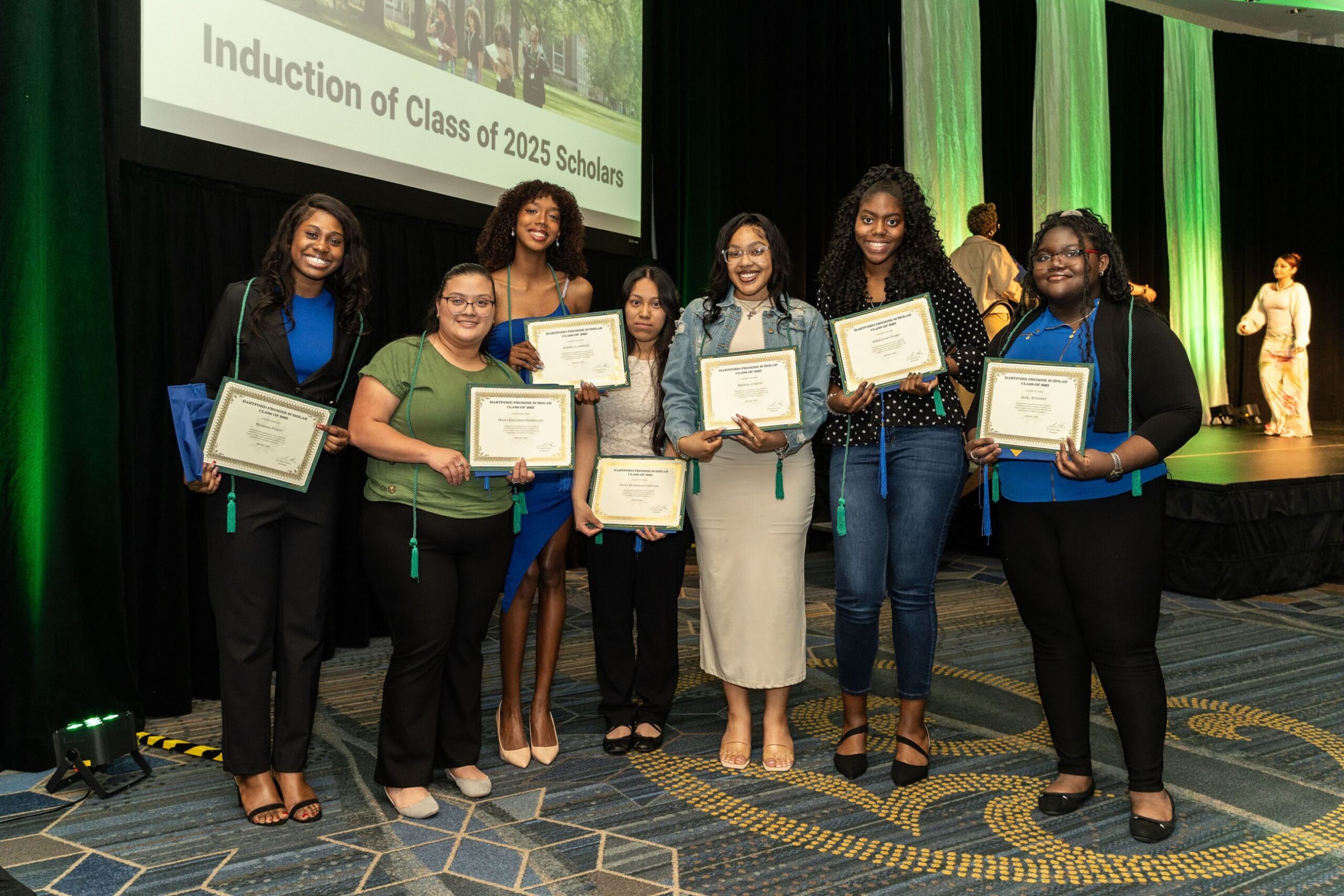
In the coming weeks, 110 Hartford high school graduates will begin college with the help of what experts say may be one of the nation’s largest — and most selective — community foundation scholarship programs. Through its new Greater Futures Scholarship Fund, every eligible graduate of any of 12 public high schools in greater Hartford can receive up to $100,000 over four years for college, paired with the wraparound support services of Hartford Promise, a decade-old nonprofit that has helped hundreds of students enroll in and finish college.
Bulking up the scholarship fund is an extension of its work to improve employment opportunities and boost economic mobility in the region. Hartford, a city of roughly 120,000, has a median household income of about $45,000 — well below the state average — and one of Connecticut’s highest child-poverty rates. The foundation supports 29 towns in the greater Hartford region.
The scholarship investment comes amid a growing national conversation about how philanthropy funds college access. The award is designed to reduce or even eliminate student debt, covering not only tuition, but expenses like housing, books, and transportation after other aid is applied.
The move also demonstrates how community foundations can use moments of visibility to rally donors and pursue more ambitious goals.
“This is one way for us to, at a local level, address what has become a national crisis,” Jay Williams, president of the Hartford Foundation, said. “We certainly benefited from the fact that we were coming up on our 100th anniversary. That provided us a platform where there’s going to be a lot of attention.”
As its 100th year progresses, the foundation will roll out other expanded areas of grant making. Earlier this year, it announced the expansion of a community-led philanthropy effort in 29 towns it supports, with each getting $100,000 to grant out.
Rethinking a Legacy Program
The idea to overhaul the foundation’s decades-old, $3,000-a-year scholarship program emerged soon after Williams became CEO in 2017, when a board chair pushed for an expanded vision that matched the scale of the $1.1 billion foundation.
More About Scholarships
-
Higher Education Giving
Mega-Gifts Are Funding University Tuitions. Which Students Do They Help?
As the centennial approached, leaders saw a chance to pair the launch with the anniversary’s visibility to draw donor interest and signal a long-term commitment to the region’s students.
Rather than build a parallel program, the board opted to align their scholarship with Hartford Promise’s existing eligibility criteria and infrastructure. Reviewing some 400 student fee bills helped reveal the real costs families face.
“It was really the foundation that came to us with the fact that they wanted to, as part of their centennial, make this big statement and stand on the importance of education and their commitment long-term to Hartford,” said Hartford Promise president, Dr. Sivan Hines.
Some 70 percent of Promise scholarship recipients are first-generation college students, 75 percent come from families with low incomes, and 90 percent are students of color, primarily Black and Latino. The nonprofit works with students as early as eighth grade to help them meet and maintain GPA and attendance requirements. Once in college, the nonprofit provides ongoing support, and reports an 86 to 89 percent college persistence rate and a 76 percent graduation rate, Hines said.
Hartford Promise will contribute $5,000 annually while the foundation kicks in up to $20,000 each year. Students must live in Hartford, attend one of 12 public high schools continuously since 9th grade, maintain a 3.0 grade point average, and achieve a 93 percent attendance rate. There’s no application; students who qualify automatically receive the award.
Place-based scholarship programs are designed to both expand the pipeline into higher education and to strengthen local communities by boosting educational attainment, attracting families, and helping develop a more skilled local workforce. Most have no high school GPA requirements, said Michelle Miller-Adams, a senior researcher at the W.E. Upjohn Institute who has studied tuition-free college programs for nearly two decades and tracks a set of 220 programs.
She called Hartford’s approach “extremely unusual,” for offering a generous scholarship only to the most talented students.
How Community Foundations Are Changing

“It’s probably one of the largest per-pupil college scholarship investments made by a community foundation,” Miller-Adams said.
Williams said the foundation supports expanding the pool of college-bound students — and he expects that pool to grow each year — but believes “it is also essential that the students demonstrate a commitment and aptitude that will increase their odds of college persistence and graduation.”
Dr. Hines added that the larger award could motivate students. It offers an incentive to show up at school, she said, and could help address the chronic absenteeism that so many districts face in the wake of the pandemic. “It will make families really want to push to make sure that students qualify for the scholarship,” she said.
Funding an Expanded Program
The foundation redirected an existing $20 million scholarship endowment to the new Greater Futures program and, for the first time, launched a fundraising campaign.
The four-year drive to raise $10 million has already attracted more than $7 million in commitments, Williams said, from a mix of individuals, families, corporations, and other foundations.
If successful in reaching its goal, he hopes Hartford can offer a real-world case study in how to marshal an anniversary’s visibility to galvanize donors and deepen partnerships to set a more ambitious agenda.
Sustaining the program will be key, Williams said. In addition to drawing from the endowment, he anticipates needing to raise an additional $2 million to $3 million annually to keep up with incremental growth, beginning about four years from now. The foundation is funding a longitudinal study to track the impact of the program on student trajectory and the local economy over time.
The City of Hartford began supporting Hartford Promise this year, Dr. Hines said, but so far the state has not contributed funds. “That,” she said, “is something that we hope to see change.”