
A New Award Puts the Focus on How Philanthropy Can Do More in the South
May 20, 2022 | Read Time: 5 minutes
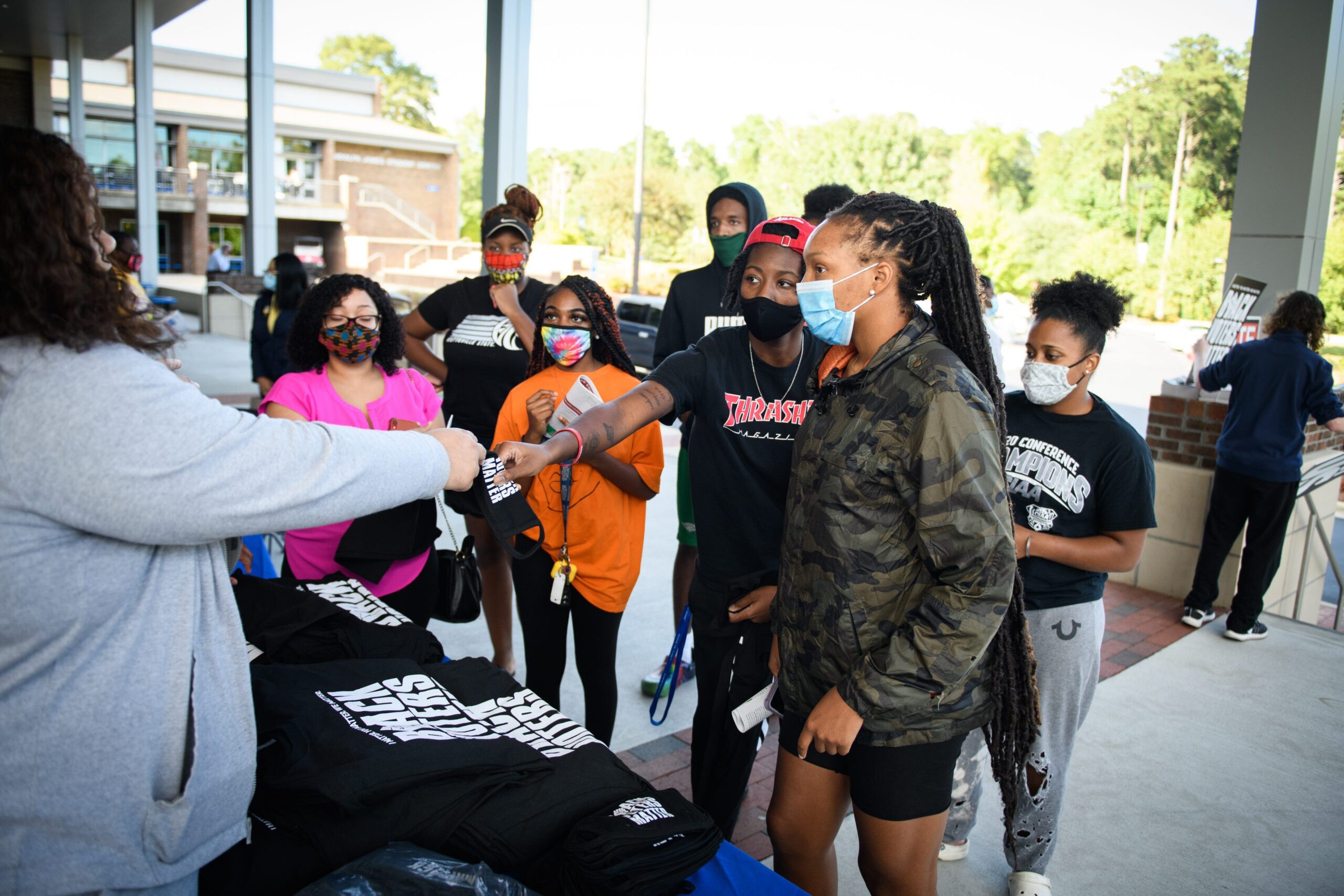
Since the founding of the United States, Southern activists have led many of the most powerful progressive movements for social change. That leadership continues today, with groups such as Black Voters Matter, the Poor People’s Campaign, and Gulf States for a Green New Deal; as well as activism on overhauling the legal system, advocacy against censorship, and advancing LGBTQ and women’s rights.
And yet, despite the South being home to 56 percent of Black Americans, more than six in 10 LGBTQ Americans, 90 percent of historically Black colleges and universities, and the highest rates of poverty and economic injustice, philanthropic foundations invest less there, by nearly half, than the rest of the United States.
Of late, the only major Southern investments from ultra-high-net-worth philanthropists have come from MacKenzie Scott and Dan Jewett, who have poured funds into community foundations, food banks, YMCAs, and HBCUs. Sadly, Scott and Jewett’s exceptional approach to giving is just that — an exception. It should be the norm.
As a communications professional who has devoted my career to working at some of the nation’s largest foundations and nonprofits, I’ve seen both the good and the bad in the current norms in philanthropic giving. Too many charitable foundations treat the federal requirement to distribute at least 5 percent of their assets annually as a ceiling, not a floor, even as research has shown that a temporary lifting of payouts from 5 percent to 10 percent would raise an estimated $55 billion for charities each year. When you add donor-advised funds into the equation, that figure rises to an estimated $60 billion.
What if philanthropy and high-net-worth individuals were to step up, not only by giving more and focusing on the areas of greatest need, but also by democratizing and decentralizing their grant making to give decision-making power to those who understand where those donations could do the most good? What might the South and the state of Southern organizing and advocacy look like if strategies weren’t dictated from wealthy out-of-state donors, but instead informed by those actually doing the work?
This isn’t a theoretical question for me; I grew up in the Appalachian foothills of northern Alabama, living in a rural community, raised by working-class parents. I still maintain close ties with organizers, activists, and social-justice nonprofit workers there.
So when I left the foundation world to found my own company, I decided that the business would do what philanthropies should also be doing. I urge other consultants that focus their practices on the nonprofit world to do the same to set an example.
We’re celebrating my company’s one-year anniversary by launching an award to help address systemic underinvestment in Southern social-justice work and activism, with a focus on 10 states across the Deep South and Appalachia. We’re committing an initial $30,000 in unrestricted funds, with an additional $15,000 in pro bono support, to a social-justice organization that is working to address critical equity and justice issues.
We’ve also committed to give 10 percent of annual revenue before expenses to social-justice groups each year. We believe philanthropic foundations should be investing far more in these areas, too — and investing at higher levels — but as a business, we are committed to paying out more than twice the minimum requirement that foundations have by excluding our expenses from payout percentage calculations.
If philanthropy, which exists to do good, can pay out 5 percent of revenue after expenses each year, we believe for-profit social-impact consulting firms that primarily or exclusively serve nonprofit and philanthropic clients should be doing even more than philanthropy, not less.
Because we also believe that those closest to the work are also most equipped to address them, we have enlisted the support of Southern-based community activists and advocates to identify the winner of our award, as well as a team of social-justice, nonprofit, and philanthropic experts who work in these areas every day. They represent organizations such as the ACLU of Alabama, Global Citizen, the Leadership Conference on Civil and Human Rights, the Asian American Foundation, Lean In, and the Tow Foundation.
Our application process requires a simple short-answer essay to a single question: “What do you hope to achieve with this award?” The answer can be no more than 500 words, and the advisory committee will use those answers to determine where funds will go.
If philanthropists seek a truly equitable model that does not simply put a glossy guise of impact over the same approaches that harm marginalized people, we hope that they will join us in this unrestricted, decentralized grant-making strategy that relies on leaders among the people we’re striving to help.
To join us, philanthropists must move away from the status quo. That means shifting from exclusionary gatekeeping, bureaucratic grant-making processes, restricted funds, long applications, and regional biases that have led to systemic underinvestment in groups led by people of color, rural areas, and entire regions such as the Deep South and Appalachia.
Otherwise, they risk irrelevance in a rapidly changing social, political, environmental, and ethical landscape that — quite rightly — cares more about impact than intentions.
In 2022 and beyond, social-impact-driven philanthropy should involve a collective, community-informed, and transparent giving strategy conducted to allow organizations to focus on simply moving their work forward — not creating vanity programs driven by grant makers disconnected from the work on the ground.
As LaTosha Brown, a founder of Black Voters Matter, explains, “As goes the South, goes the nation. If we have not learned that in any critical moment in time, we should know it now.” Philanthropy would be more in line with its mission, vision, and values if it heeded that call.
Kindred Motes leads KM Strategies Group, a social-impact advisory consultancy working with philanthropy, nonprofits, and advocacy movements for social good. He was previously a communications official at the Wallace Global Fund and Vera Institute.




