David Brooks Wants to Repair America’s Fraying Social Fabric
The conservative New York Times columnist is bringing together people who are building relationships to improve their communities in the hopes of sparking a social movement.

By Jim Rendon
Director, Fellowship Program and Impact Journalism
October 22, 2019 | Read Time: 15 minutes

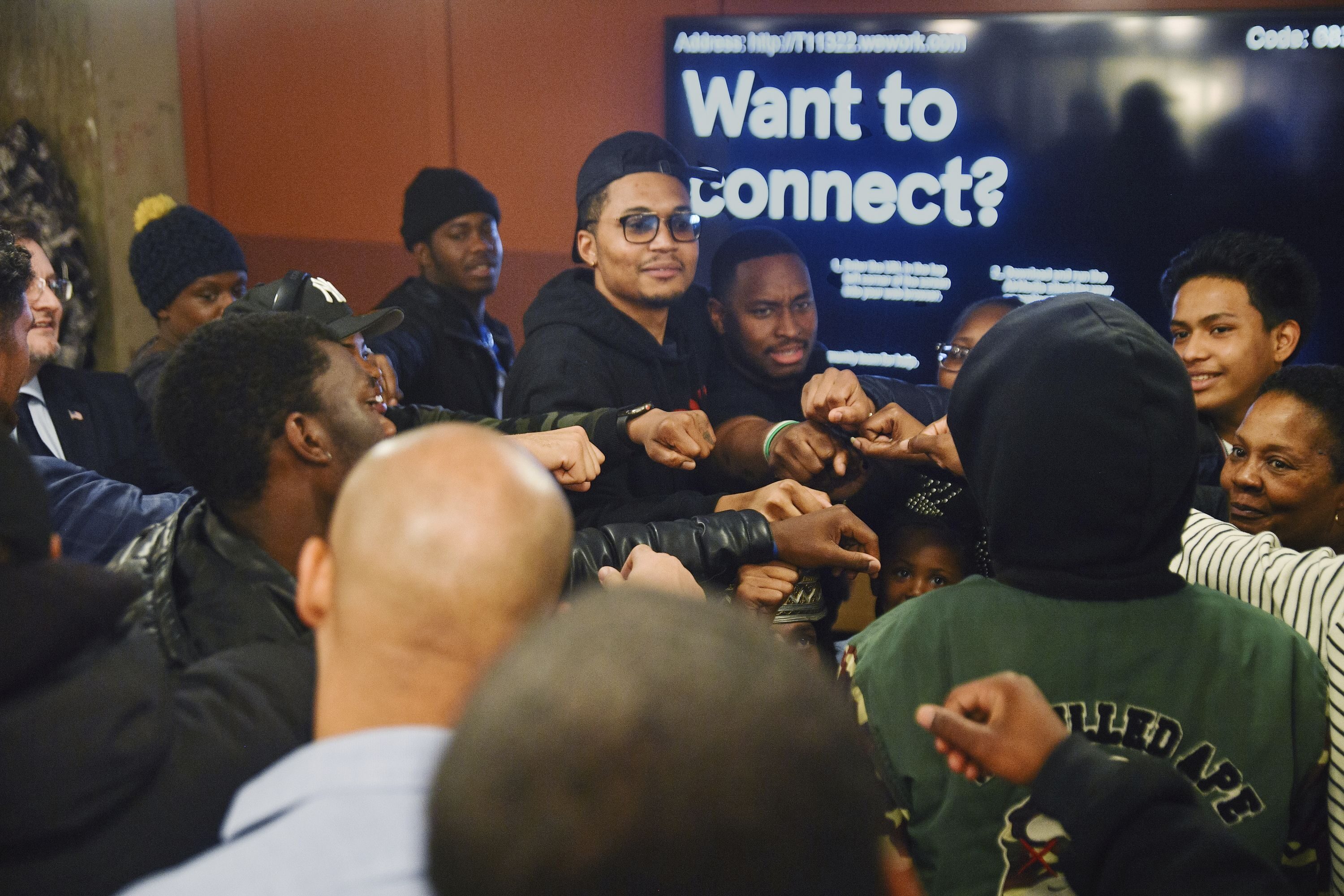
WASHINGTON — Inside a conference room in a WeWork shared office space just blocks from the White House, Ibrahim Lyles asks a half-dozen teenagers to say one thing they do or don’t like about America. Through long silences, Lyles prods them to talk.
“I don’t like the police,” says Will, a tall 16-year-old in torn black jeans. He speaks quickly and confidently but then slides back down in his chair. He pulls his sweatshirt up to his chin, as if trying to avoid attention.
Lyles is a mentor with GoodProjects, a nonprofit that helps struggling young people and their families improve their lives. The teenagers have all been charged with, or were convicted of, crimes as juveniles. Some are homeless.
For the rest of the meeting, Will (he is identified by first name because he is a minor) says little. Another teenager rests his head on the table. Two girls talk with each other, ignoring everyone else.
It seems that little has been accomplished.
After the meeting, Darius Baxter, a co-founder of GoodProjects, asks Will to come back. He says Will is a leader who can sway his peers, and he and Lyles try their best to connect with him.
“Summertime is coming up. I’m tired of burying our young men,” Baxter tells Will. Baxter’s plea for Will to buy into their program and change his life is urgent, confrontational, and replete with profanity. He tells Will that kids in this program have been killed. Will could be another victim unless he loses his attitude and starts to care about his future.
Baxter and Lyles need to be heard in this conversation. “To them it’s like, you are young, you feel invincible,” Baxter says of the teens he works with. He needs for them to understand that far from being invincible, they are deeply vulnerable to gun violence.
Lyles says the best way to connect with Will and his peers is to meet the teens where they are, to speak their language — cursing and all — and be open. “It’s not stooping down to his level. It is being equal to him,” says Lyles of his talk with Will. “I was once you. You are just talking to yourself. I’m just an older version of you.”
Sitting across the table from Will, Baxter changes his tone. “I want you to be great,” he tells Will. “You keep your ass out of trouble. You listen to your mentor. I guarantee you, we will get you out of poverty in six months.”
Will’s gaze rises to meet Baxter’s and Lyles’s as he stands to leave the room. “I see something in you,” says Baxter.
He and other staff members are trying to provide some of the love and community these teenagers may well lack. They try to create a trusting relationship. The teenagers can call 24 hours a day. “We don’t just go into a home for a moment,” says Lyles. “We go into a home forever.”
The Fraying Social Fabric
Baxter and Lyles are what the New York Times conservative columnist David Brooks calls Weavers. They seek out others regardless of their differences, create a sense of community, and help to improve the lives of those around them. At a time when people are divided by bitter politics, when the country’s social fabric is being torn apart by bigotry, anger, and suspicion, these people are weaving our society back together one relationship at a time, Brooks argues.
Small organizations like Good Projects and even lone individuals are at work throughout the country, addressing different problems in big cities, rural villages, and everywhere in between. It’s the way they do their work — building relationships — rather than the kind of work they do that is most important, Brooks says. He wants weaving to spread so far that it changes society.
“It’s a movement that doesn’t know it’s a movement,” he says. “And once you’re in a movement, you have a lot of resources. You have each other.”
Brooks has firsthand experience with the very problems he sees. A few years ago he suffered through his own crisis of loneliness and disconnection. His marriage ended, he felt abandoned by his Republican colleagues. He spent a lot of time alone, working. He realized that America’s cultural myths — that self-sufficiency and individual success will make us happy — had failed him.
As he was struggling, Brooks met members of a family who opened their doors to dozens of young people in need and started an organization called AOK. He began eating dinner with the 30 or so kids who stopped by that house every Thursday night. There Brooks found a loving, supportive community — people who help each other with a place to sleep, college applications, even a kidney donation.
“I had come to the conclusion that social isolation was the problem underlying lots of problems, such as polarization and social mobility,” Brooks says. “It was being solved by people at the local level.”
He talked with Dan Porterfield, CEO of the Aspen Institute. It hired Brooks part-time and helped him staff a small program called Weave: The Social Fabric Project so he could travel the country to learn more. He wrote about many of these remarkable individuals in his columns.
“Interdependence, practical problem-solving, community empowerment, civility, and respect, those values are Aspen values through and through,” Porterfield says. “The Weaver initiative is drawing out living examples of those values.”
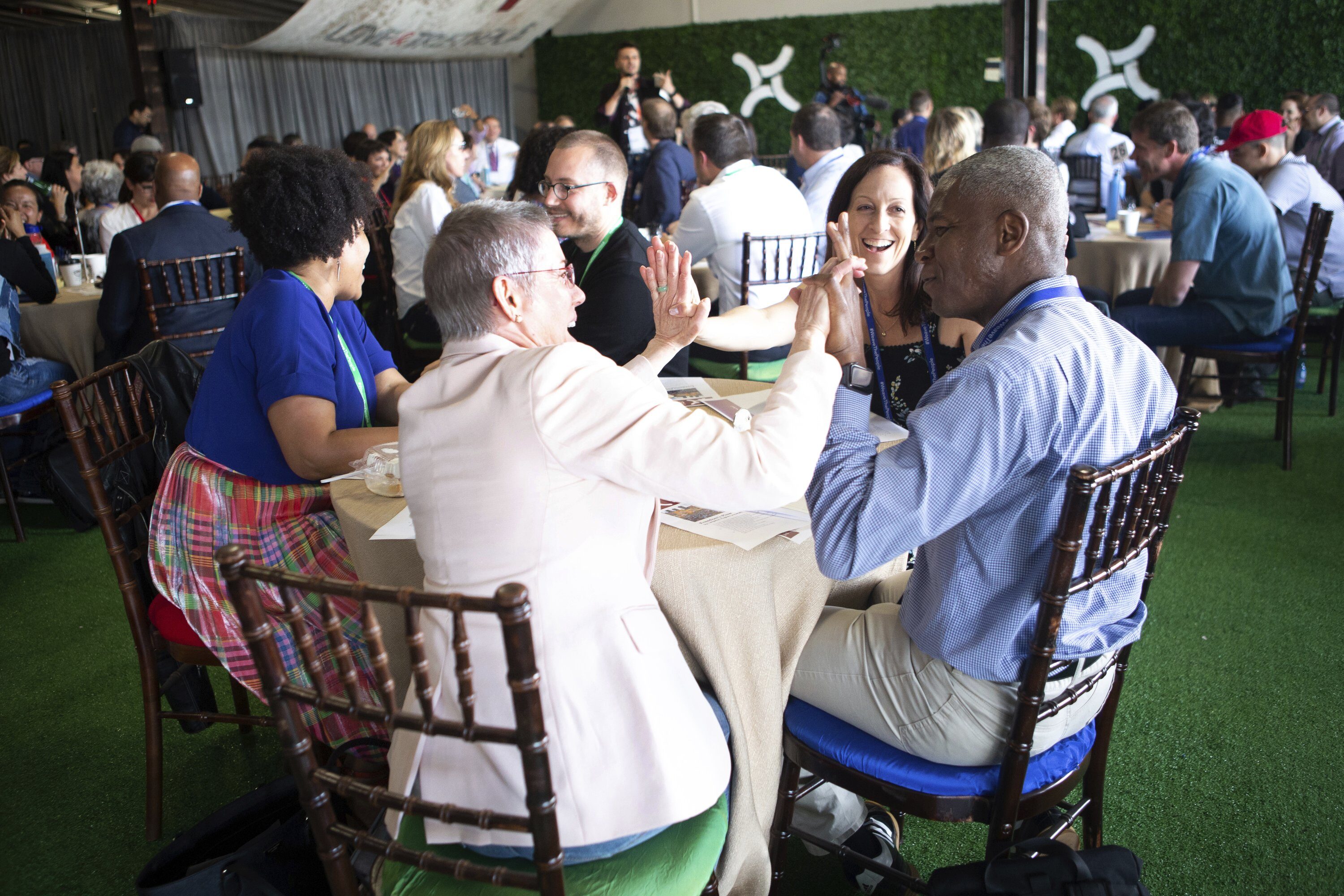
This spring Aspen brought more than 200 of these people together here for a conference called #WeaveThePeople. Participants came from all over the country. Most of the attendees were white, but people from many races and backgrounds also attended. There were conservatives and liberals. Some work to curb poverty and promote racial equity. Others are trying to save shrinking rural towns or stop opioid abuse.
They have little in common except the way they do their work. “They think it is normal to invite your neighbors over for dinner,” Brooks says. “They think it is normal to have a relationship with someone who is completely unlike yourself.”
Strengthening and promoting that simple approach regardless of how it’s applied is Brooks’s goal. “They build relationships, and relationships don’t scale,” he says. “But norms scale.”
‘Human Connectedness’
Brooks wants to transform the way people interact. He wants it to be normal for people to befriend others whose background and beliefs they don’t share, for individuals to abandon selfish career goals for the betterment of their community. He envisions a nation of George Baileys, from It’s a Wonderful Life, jettisoning their individual desires to lift up others around them.
But social movements, regardless of their goals, are rare says Suzanne Staggenborg, a professor of sociology at the University of Pittsburgh. They require organization, planning, targets, tactics, and good timing. They may seem spontaneous — people like to think that Rosa Parks started the civil-rights movement. But a lot of hard work and strategizing occurred before and after Parks’s pivotal refusal to sit at the back of the bus, the professor notes.
“The big social movements, many of them were protest movements. They are not just people being nice to each other,” says Staggenborg. “Whether something like this can have that kind of impact, I’m pretty skeptical.”
But for Aspen, the fact that Brooks is promoting community-building through relationships rather than a particular issue is Weave’s appeal. “If David were focusing on a single issue area, and trying to create a movement around a single issue, that might not be as easy for us to be a part of,” Porterfield says.
Brooks attributes today’s high levels of loneliness, depression, and suicide to a lost sense of community that he says was more common in decades past. For example, he says, in 1970, Americans entertained in their home 20 times a year. Now it is just eight.
But decades ago, women and minorities were generally excluded from white, male society. Few African-Americans were ever invited into a white person’s home. Though problems remain, the world is a much better place for women and people of color today, says Palma Joy Strand, a Weave conference attendee who is co-founder of Civity, which facilitates communication among people of different backgrounds.
“We had this very hierarchical, bonded society that was great in some ways and not healthy in other ways, and we have blown that apart,” she says. “That has done great things for a lot of people, but we have not learned how to reconnect.” The question, she says, is how to recreate the social fabric from the remnants.
Brooks is trying to do just that, says Dan Cardinali, CEO of Independent Sector, who met Brooks at the AOK dinners. He agrees that society has changed for the better, but part of that change, he argues, was disruptive and has helped to create the isolation and divisiveness that Brooks laments. “David is driving at the idea that we need to point to and celebrate communities that are reworking those connections,” Cardinali says. “At the local level, we are getting the next-healthier level of human connectedness.”
But some conference attendees were skeptical. “I don’t think he is creating a movement,” says John Cooper, assistant vice president for public partnership and outreach at Texas A&M University, who helps communities prepare for and recover from disasters. “This is not new, what he is doing. He is maybe building on some commonly held principles and methods.”
Jessica Disu, also known as FM Supreme, a performing poet and activist who mentors young women in Chicago, who attended the conference was reluctant to identify with Weave’s efforts. “If you are not trying to help the poor and disenfranchised, that is not a movement I want to be a part of,” she says. “There was not a mention of poverty or the poor, and that was very loud to me.”
Looking for Money
Weavers, as Brooks calls them, are by their nature members of small organizations — sometimes a lone individual barely making ends meet — focused on local issues. They often lack the skills and networks required to obtain grants or much funding at all.
Aspen, which already works with small community organizations, is offering to help by providing leadership-training programs, the opportunity to participate in its networks and fellowships, and help with grant proposals. Some Weavers have even been offered speaking slots at the high-profile Aspen Ideas Festival.
Representatives of several foundations were at the Weave conference, and Cardinali says many local groups can benefit from just getting into the room with grant makers. “We live in a highly segregated society by race and class,” he says. The conference, broke down some of those barriers and gave people the opportunity to just get to know one another. “I think good things will come out of it,” he says.
Brooks says several foundations are interested in his Weaver idea. As an Aspen program, Weave must raise some of its own funds. What’s more, Brooks wanted the grant makers to meet participants.
One of those grant makers, Jennifer Hoos Rothberg, executive director of the Einhorn Family Charitable Trust, attended the conference. The foundation’s mission — helping people get along better, which it says is integral to building a more cohesive America — aligns with Brooks’s vision.
She was excited by the opportunity to learn more from those doing the work of connecting and building relationships. “We have to push ourselves constantly to get closer and closer to the people and places and experiences that help to inform our worldview,” she says.
The conference, however, wasn’t designed for people to pitch grant makers. Sammie Ardito Rivera, project director at Marnita’s Table, in Minneapolis, which works to create meaningful connections among diverse groups (often over food), says her organization could serve more communities if had additional funding. But the conference didn’t help. “I didn’t see funders,” she says.
Troye Bullock, a co-founder of GoodProjects, says he and his partners met several funders. “It definitely wasn’t something that was facilitated. But there was more of a chance to connect with a funder there than at any other conference because of the close-knit feel.”
Learning From Peers
Brooks is a reluctant leader. He organized the gathering in the spring and coined the Weaver name. His TED talk on the Weavers was posted in April. But he does not want to be in charge. “Movements are not led by a person at the top anymore,” he says, pointing to the #MeToo movement. “They are radically decentralized.”
But his small organization is trying to help these groups work together. It is finding technology platforms that will allow Weavers to connect with one another so they can create local groups and meetings on their own. The organization is also considering creating a guide to help individuals become Weavers and may create tools to help businesses, schools, and other groups incorporate Weaver ideas.
Some larger nonprofits are already doing a better job of listening to smaller organizations, Cardinali says, something the Weave movement can help to spur.
For some who attended the Weaver gathering, the next step means building on what they found there.
Traci Fant, founder of Freedom Fighters, a social-justice organization in Greenville, S.C., says that she made valuable connections at the conference. She plans to visit an activist she met who works in New Orleans. She has been emailing with people from Nebraska. “I want to visit and see hands-on what these people are doing and come back home and report back to people in Greenville,” she says.
Matt Niswander, a foster parent and chairman of the Tennessee Young Farmers & Ranchers, who treats opioid addicts in his work as a nurse practitioner, says meeting so many other community activists was transformative. After the conference, he says, he pushed to have an openly gay rancher come speak to his group over some objections from conservative board members. It forced a discussion with the group’s board that never would have happened before. It actually wasn’t hard to convince the other board members Niswander says, and the speaker has been booked. He credits the Weave conference.
“This Weaver thing is in my head, it literally changed my life,” Niswander says. “I will never be the same.”
Jim Rendon is a senior writer who covers nonprofit leadership and fundraising for the Chronicle. He recently wrote about how low pay hurts nonprofits and workers and about the challenges that nonprofit leaders of color face. Email Jim or follow him on Twitter.