
Bill Gates Is Wrong: This Is No Time to Back Down on Climate
“Conservation is not a luxury of stable times. It is the test of whether civilization can save itself.”

By Daniel Katz and Anna Veldman
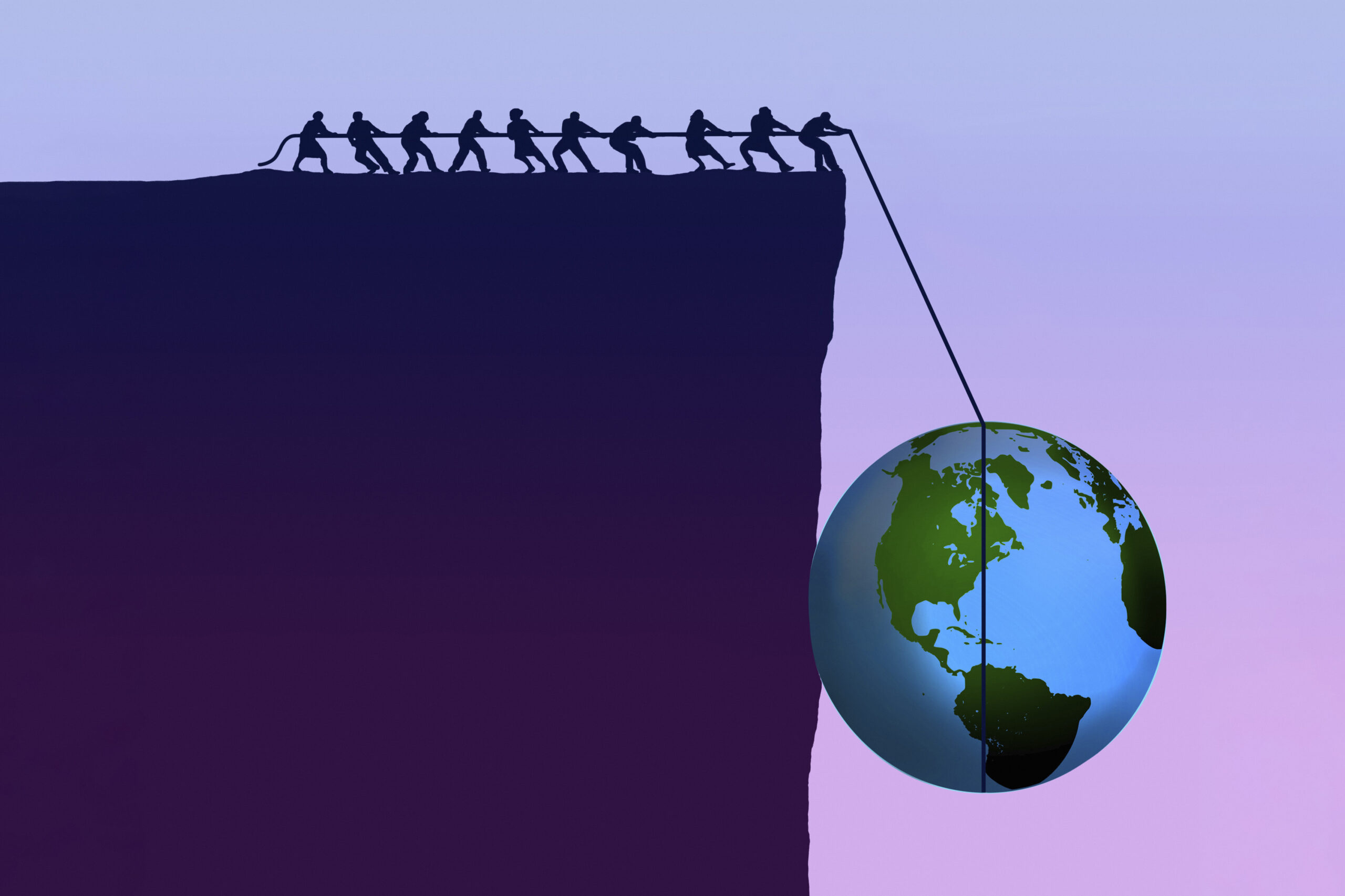
December 11, 2025 | Read Time: 4 minutes
Around the world, political systems that once promised reasoned debate and representation for all now strain under the weight of polarization, disinformation, and cynicism. And yet, while democracy teeters, the planet suffers. The ice still melts. The forests still burn. The coral reefs still bleach. The species that vanish each day, from birds and insects to trees and plants, will not wait for us to resolve our political crises.
But at a moment when governments are failing, philanthropy is wavering. Bill Gates recently announced that he is pulling back from the climate crisis to focus on human suffering, ignoring the reality that minimizing environmental damage multiplies every form of suffering the nonprofit world seeks to end. As Brett Jenks, CEO of the international conservation organization Rare, recently wrote on LinkedIn: “When you’re in a sinking rowboat, you must plug the hole AND bail the water.”
At a time when international aid for global conservation is drying up, and the Trump administration doesn’t even bother showing up for the world’s largest climate conference, philanthropy needs to step forward, not back.
That means that those of us who work at foundations and nonprofits must act with even greater creativity and resolve to keep the planet livable. Traditional philanthropy is acceptable for conventional problems, but we live in unprecedented times that demand innovative answers. To effectively address the climate crisis, philanthropy needs to encourage risk-taking, often by funding out-of-the-box ideas that might otherwise never get off the ground.
History shows that transformative movements, such as civil rights and women’s suffrage, began at the margins, powered by small groups with big visions. Today, the same is true for environmental progress, where small nonprofits scattered throughout the world are leading the charge to protect the environment.
Consider, for example, the work of Perpetual, a $1 million organization that is reimagining how entire cities can reuse food items such as cups and containers, potentially cutting tons of waste and carbon. Another under-the-radar nonprofit, Connect Forest People (Conexåo Povos da Floresta), in Brazil, is bringing internet access to Indigenous communities in the Amazon, providing them with a vital tool for protecting their land and human rights.
Huge Funding Gap
Despite their outsize impact, organizations like these are woefully underfunded. Groups with revenue of under $1 million, which make up most of the more than 32,000 environmental nonprofits in the United States, receive less than 4 percent of grant funding, while those with more than $20 million in revenue get half the grant dollars. Small nonprofits are typically overlooked because grant makers don’t have the information they need to identify the most promising groups.
That’s why the two of us are helping to launch a new initiative called the Big Green Tent, which will deploy teams of experts to vet nonprofits and ensure donors can give with confidence. Each endorsed organization will appear in a weekly newsletter designed to attract new funding and make environmental giving simpler, smarter, and more effective. This is part of a broader effort by the Overbrook Foundation, where Daniel works, to make it easier for philanthropists to share knowledge and encourage greater investment in small but high-performing organizations.
We believe this sharing should take many forms, including across generational differences. As the co-founders of the Big Green Tent, we write this together as representatives of two generations bound by urgency. One of us (Daniel) is in his 60s, old enough to remember when modern environmentalism was a new idea, when rivers caught fire, smog choked cities, and the first Earth Day felt like a revolution. The other (Anna) is 25, part of a generation that has never known a world not under threat, that has grown up watching our cities flood and wildfires burn on YouTube, Instagram, and TikTok.
This intergenerational partnership is not symbolic; it’s strategic. The climate crisis is too vast and time too short for any single generation to bear alone. That’s why we believe that linking seasoned organizational leaders with young go-getters is critical to success.
Overcoming Despair
Conservation is not a luxury of stable times. It is the test of whether civilization can save itself. Here in the United States, it’s especially easy to despair. The political headwinds are fierce. Climate action is a partisan battlefield. Environmental regulations are framed as overreach, scientific consensus as opinion, and the very notion of shared responsibility as naïve.
But retreating from conservation because politics is hard is the same as surrendering democracy because elections are messy. Both require persistence, compromise, and the courage to think beyond the present moment. Indeed, every acre protected, every wetland restored, every ton of carbon avoided matters.
We support environmental organizations not just as institutions but as expressions of courage, places where people choose to care about something greater than themselves and beyond their own lifetimes. These organizations are the connective tissue of global conservation, often doing the work that governments won’t or can’t. They plant the seeds of change — ideas and movements that grow until even the largest political and market forces bend to their roots.
Supporting the environment isn’t charity. It’s self-preservation.





