Trump Posed an Existential Threat. This Nonpartisan Group Pushed Back
The Partnership for Public Service has long worked with Republicans and Democrats to strengthen the federal work force. After Trump’s return to office, it found itself in direct conflict with an administration bent on dismantling the civil service and upending its mission.

By Jim Rendon
Executive Editor
January 29, 2026 | Read Time: 14 minutes
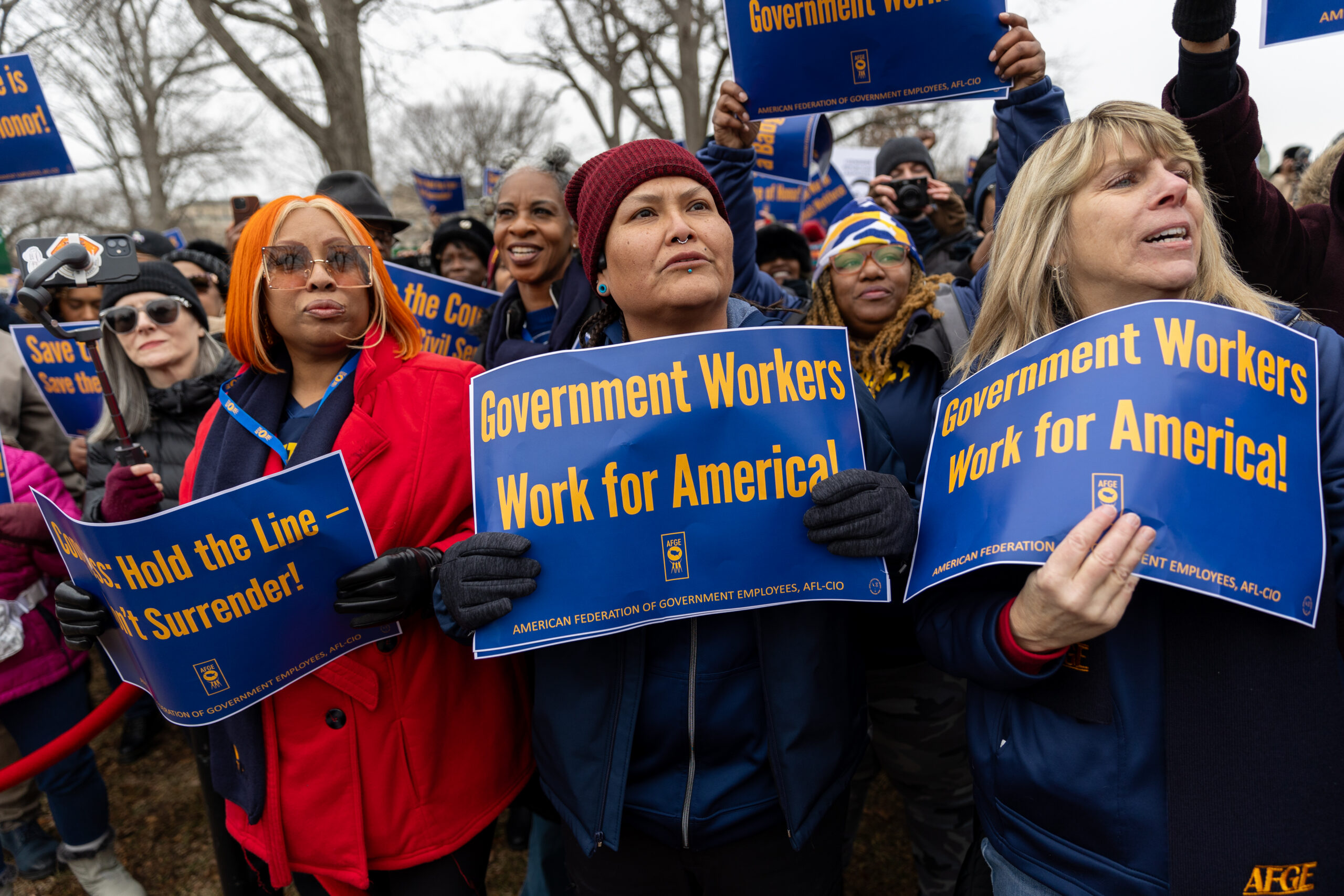
Washington, D.C. — In his first year back in office, President Trump set his sights on dismantling the federal work force. During his campaign, he attacked federal workers as “crooked” and “dishonest.” The Department of Government Efficiency forced massive government staff reductions. Russ Vought, the Office of Management and Budget director, who has led even more firing and budget cuts, said he wants to put federal workers “in trauma.”
That strategy set the administration on a course for direct conflict with a nonprofit that has long worked to bolster the federal work force: the Partnership for Public Service.
In the past year the group has been forced to make defining choices about how to navigate an administration that has targeted its mission and the group itself directly and how to remake itself in an era of constant emergency.
Since its inception 25 years ago the partnership has focused on improving the way the federal government works by helping it recruit better talent, develop leaders, define and support a presidential transition process, and improve public understanding of government programs and employees.
Initially funded by a single donor, by 2024 the group had grown into a $36.5 million operation backed by a broad range of foundations, with about 175 employees, and a reputation for working effectively across party lines.

Max Stier, the group’s CEO, says that surrounding himself with great people — from advisers to board members and staff — has been key to the group’s success, as has its decades of dogged persistence in a somewhat obscure niche. Foundation leaders, especially former Ford Foundation president Darren Walker, are important sounding boards for Stier. Stier has also cultivated a relationship with Michael Lewis, one of the country’s best-selling authors, whose books Moneyball and The Big Short were turned into blockbuster films. Due in part to behind-the-scenes insight from Stier, Lewis has written multiple books about public employees, giving the group’s goal of boosting understanding of government workers a stratospheric bump.
“I have found the people who have stuck with us in a time of real difficulty are the people who have that core character and are willing to stand up and be courageous even if it puts them at risk,” says Stier. “That combination of character and competence to me is fundamental.”
But now, with the partnership and its mission under unprecedented assault — the administration canceled most of the group’s contracts for training federal workers, costing it millions of dollars — Stier and his board have had to think hard about what nonpartisanship means in this environment. How should the group respond in a way that is true to its vision and allows it to fulfill its mission? It has always worked effectively with Republican and Democratic administrations. Though it is supported by progressive foundations like Ford and Open Society, Republicans have long praised its work.
“There’s nobody out there like the partnership, advocating for a competent, well-staffed, well-paid, and respected civil service,” says Josh Bolton, who was George W. Bush’s director of the Office of Management and Budget and chief of staff and now serves as CEO of the Business Roundtable. “For the running of government, that’s critical.”
For Stier, one touchstone has helped guide him. In his glassed-in Washington, D.C., office, Stier sits on a sofa and flips through a book he has kept close for nearly 25 years: Biography of an Ideal: A History of the Federal Civil Service. Tucked between its pages is a letter from Kay Cole James, director of the Office of Personnel Management under George W. Bush, underscoring the importance of a nonpartisan, expert civil service at the heart of American government.
Stier has returned to that ideal again and again since helping to start the partnership. And now this book has helped clarify for him how the partnership can challenge the Trump administration without betraying its nonpartisan identity.
Over the past year, the group developed a new strategy that emphasizes pushing back against the administration. It launched new programs to help federal employees who have lost their jobs and is educating the public about the impact of budget cuts in their communities by working with groups like veterans organizations and social media influencers. It is moving its work to the state level for the first time. And Stier is out front criticizing attacks on the civil service.
“This is not partisan, this is Trumpism, and that’s a really important distinction.” Stier says of the administration’s assault on government employees and agencies. “This was a complete attack on our fundamental DNA, and we knew that we would have to speak up.”
Preparing for Trump 2.0
Months before the last presidential election, the partnership began preparing for what a second Trump presidency could look like. It anticipated an escalation of Trump’s previous attacks on the federal work force. The Heritage Foundation’s Project 2025 advocated for eliminating half the federal work force in a year.
The partnership also expected to be a target. During the 2024 campaign, Stier says Heritage submitted Freedom of Information Act requests seeking details on the partnership’s federal contracts. Those contracts — including leadership training, diversity programs, and internships that brought hundreds of young people into federal agencies to inspire government careers — typically made up about 45 percent of the Partnership’s revenue — about $15 million in 2024.
To prepare, the partnership hired a consultant, and the group’s leaders and board spent months determining how a second Trump presidency could impact the organization, and how it would respond. The planning, which Stier says was funded in part by the Packard Foundation, which gave the group $738,000 in two grants, according to its 2024 informational tax return, was critical to helping the organization anticipate the changes to come.
Within the first few months of the Trump administration, the vast majority of the partnership’s government contracts were canceled. In 2025, those contracts made up just 25 percent of its revenue, down from about 45 percent, and by 2026 it will be just 16 percent, the group says.
Thanks to the advance planning, the nonprofit was ready to lay off the staff that provided that training, cut spending, and ramp up fundraising to avoid a financial crunch, says board chair Tom Bernstein, who has served on many nonprofit boards and is chairman emeritus of the United States Holocaust Memorial Museum in Washington, D.C. The group’s head count fell from about 175 to 106.
“Would we have been able to pivot fast enough, would we have been able to understand how to respond effectively?” Stier says. “Are we going to stand up to Trump or not? All those were big questions we had answers to right away. If we hadn’t had them, we would’ve been floundering.”
As part of that pivot, this spring, for the first time, the partnership became a resource for laid-off federal workers, helping them navigate the uncertainty of their situations. Stier has also criticized attempts by Vought and others to decimate federal agencies. During this fall’s government shutdown, Stier was a regular presence on morning news shows, CNN, and NPR, discussing whether firing furloughed workers is legal and the consequences for everyday people.
The group’s rhetoric has been uncompromising. A statement announcing a January news conference says the Trump administration “has produced the most catastrophic dismantling of federal government capacity in modern history. In just one year, the Trump administration has arbitrarily pushed out over 200,000 federal workers, wiped out entire federal agencies and politicized previously apolitical government institutions to enrich himself and punish his detractors.”
Other good-government groups have welcomed the partnership’s higher profile. “If there’s any time to have an organization like the partnership — banging their fists down on the table saying, ‘What’s going on is wrong; here is everything that public servants do that’s right’ — it’s now,” says Bill Shields, executive director of the American Society for Public Administration.
The shift has been risky, but Stier says his organization had no choice. “We’re not in business to stay in business. We’re in business to achieve our mission,” he says. “Our mission is front-and-center being undermined by the different vision of government that is being pursued by this administration. And that requires us to either stand up or go home.”
The Leader Behind the Partnership
The partnership was the brainchild of Samuel J. Heyman, a businessman who began his career at the Department of Justice under Robert F. Kennedy and remained committed to improving how government attracts and retains talent.
He hired Stier — a lawyer who had worked for a Republican congressman, at the Department of Justice, and clerked for Supreme Court Justice David Souter — to start and run the group in 2001.
Heyman gave $45 million to the group over its first decade when the organization pioneered important initiatives, including helping the government recruit from colleges, streamline its hiring practices, and start its annual service awards.
The partnership was launched at a terrible time to announce any new initiative: September 12, 2001. Just one day after horrific terrorist attacks propelled the nation into the war on terror, Stier decided to embrace the unfortunate timing. In 2007 he told the Chronicle that the attacks only amplified the risks Americans faced and how important it is to have a responsive government.
Stier does not seem like a natural born fighter. He has a lawyer’s air of reason and caution. But that belies his deep enthusiasm for the mission of the partnership. He is unflagging in his passion for the idea that having a better, stronger, more effective civil service is necessary for the government to best serve the public. That is a key part of what keeps him going, says former Ford Foundation president Walker.
“He is incredibly resilient. Given the context Max is operating in, many leaders would have succumbed to depression,” Walker says. “Yet he remains positive and optimistic about the idea that public service is the highest calling for a citizen.”
After nearly 25 years running the partnership, Stier has become one of the foremost experts on the federal government. Just ask best-selling author Lewis.
Stier has helped guide Lewis through the federal bureaucracy, connecting him with fascinating government employees. Four books have stemmed from that relationship and have helped put a spotlight on the partnership’s issues in a way that few nonprofits could ever hope for.
“I have not found a person who knows more or cares more about the federal government, and I’ve now interviewed thousands of people around this subject,” says Lewis. “I could go to him and say, ‘Tell me about the Department of Agriculture. Tell me what it does. Tell me why it’s important. Tell me two people inside who you think are interesting. He’s served this role as my social introduction to the federal government, and he’s still doing it.”
Philanthropy for Good Government
Foundations generally don’t have programs focused on good government, making the partnership an awkward fit for many grant makers. But the group’s mission often resonates with foundation leaders, many of whom Stier works with directly.
The mission to improve the way the federal government works is important to any organization that hopes to create social change, says Walker. Philanthropy cannot sustain long-term change without the aid of the private sector and the government, he says. “If progress is your objective — progress at scale — it is hard in a democracy to ignore the role of government.”
The group grew early on, thanks to support from Atlantic Philanthropies. Since 2020, Ford has given 11 grants totaling $7 million. The Open Society, Gordon and Betty Moore, and William and Flora Hewlett foundations, Craig Newmark Philanthropies, and other big-name grant makers have backed the group. In 2024, it brought in $18 million in contributions alongside nearly $15 million in revenue for services it provides to the government.
Richard Menschel, a retired senior director at Goldman Sachs, gave $300,000 to the partnership through his Charina Endowment Fund in 2023, though most of his giving focuses on health, education, and cultural intuitions. “If government doesn’t work well,” he says, “it’s hard for civil society to work well.”
Stier says that grant makers including the MacArthur Foundation and the Democracy Fund have been quick to support the group’s new strategy. In May, Ford approved a $1 million grant to the partnership. The Democracy Fund made grants to the organization totaling nearly $3 million from 2019 to 2023 and is encouraged by the partnership’s confrontational stance today.
“They are defending the work that has been done by public servants,” says Rudy Mehrbani, senior director of the Democracy Fund’s governance program, “but also public service as an honorable profession.”
Changing Public Perception of Government
In the fall of 2023, the partnership gave Laura Cooper a Service to America medal recognizing her as Federal Employee of the Year. It’s one of the ways the partnership boosts the profile of federal workers and draws media attention to their work.
In her role at the Department of Defense, she coordinated the U.S. military support of Ukraine after Russia invaded in 2022. Cooper and her team oversaw billions of dollars in military funding and urgent weapons transfers.
Cooper, who testified to congress as part of Trump’s first impeachment, left the government just before Trump was sworn in for a second term. She says that her award, long a point of pride for her, has taken on new meaning. “Now is when the existing federal work force needs support and recognition to be able to continue in the face of what is overwhelming adversity,” she says. “And the rest of the country needs to understand the mission of federal employees.”
In 2020, the partnership conducted research on public attitudes about the federal government and found that many Americans viewed it as ineffective and inefficient, particularly if they had a negative experience. The findings were unsurprising, since bashing the federal government is a decades-long tradition among politicians. Ronald Reagan famously said, “The nine most terrifying words in the English language are ‘I’m from the government and I’m here to help.’”
The partnership has long positioned itself not as a cheerleader for government but as an informed reformer. It simply wouldn’t be credible to claim that government is perfect, says Michelle Amante, the partnership’s senior vice president of government programs. “We’ve been advocating for reform for 20 years. There needs to be a better way to serve the American people,” she says. “But burning it down is not the way to go.”
Now, in the face of the administration’s attacks on the federal work force, the partnership is ramping up its communications work. It hired an outside firm to help tell the story of federal agencies through social media influencers, journalists, and “trusted messengers” like veterans organizations and local chambers of commerce. It participated in a panel discussion in April, hosted by the Writers Guild of America East to encourage TV and film writers to incorporate government stories in their work. According to the group’s online polling, 75 percent of respondents want to hear positive stories about how their government works.
To illustrate the effects of staffing cuts, the partnership created a “harms tracker” to show how the government’s diminished capacity affects communities. The partnership is now preparing a project to show how cuts to science funding impact individual states. That effort, and others about cuts to agencies like the National Institutes of Health, have drawn interest from both new and existing funders, says Amante.
The group is also working to localize its message. People connect more with stories close to home, says Lindsay Laferriere, the partnership’s director of rebuilding trust in government.
This local focus represents another shift for the organization. Although Stier previously resisted expanding into state and local governments because of its scale, he now sees a need and an opportunity. To expand to the states, he says, the partnership needs three things: capacity, leadership, and funding. Until now, leadership and funding have been lacking.
With a planning grant from the James Irvine Foundation, the group is exploring whether it could bring its transition planning to California. And 40 states are now participating in its AI leadership development program.
Stier hopes more grant makers will follow, enabling the group to pursue its efforts in more welcoming local environments even as it pushes back on the administration’s tear-down of the federal work force. It’s a fight he knows he must take on.
“Resistance to Trump isn’t being a partisan,” says Stier who cherishes his nonpartisan role. “It’s actually representing a different worldview that the government’s purpose is to further the public good rather than the individual in charge. That proposition is one that we had a consensus on for 140 years that he is trying to blow up.”
The Ford Foundation is a financial supporter of the Chronicle of Philanthropy.
Reporting for this article was underwritten by a Lilly Endowment grant to enhance public understanding of philanthropy. The Chronicle is solely responsible for the content.