The Power of Pairing Money With Mentorship
With $70 million from MacKenzie Scott, Native Forward Scholars Fund is expanding its successful hands-on program — something that others hoping to grow can learn from.

By Eden Stiffman
Senior Editor
February 27, 2026 | Read Time: 13 minutes
When Eldred Lesansee arrived at Columbia Law School in the fall of 2022, he carried more than the usual first-year anxieties.
A member of the Pueblos of Jemez and Zuni in New Mexico, Lesansee was the first in his family to attend law school. Beyond the academic challenge, the pressure was financial — potentially hundreds of thousands of dollars in tuition and living expenses — and emotional. He was far from home, studying a legal system that has often worked against Native people.
“Law school is super traumatic in those senses because you’re going through all that and you’re going through all the rigorous amount of work,” he says. What made the difference was having a steady source of support beyond the classroom.
Native Forward Scholars Fund, the nation’s largest direct scholarship provider to Native students, offered Lesansee financial aid and mentoring, while also linking him to other scholarship recipients and alumni who had been through experiences like his. That combination, he says, offered a consistent sense of belonging that made it possible to thrive, graduate, and launch his legal career.
“Not only was it a resource, it was a confidence booster and a connection to the community,” he says. “To invest in Native Forward really is to invest in actual direct impact in tribal communities and students’ lives.”
Native Forward’s trajectory also offers broader lessons for nonprofits and philanthropies in any field: start small and refine an approach before expanding; build relationships that strengthen people and institutions alike; and diversify revenue to sustain long-term change. Those principles have helped the organization expand its impact and attract major investments from donors like the Gates Foundation and MacKenzie Scott.
Supporting students not just to get to college but to succeed once they are there is at the heart of Native Forward’s work.
For more than five decades, the organization has supported Native undergraduate, graduate, and professional students from more than 500 tribes. It has done so in a philanthropic landscape where Native-led nonprofits receive less than half a percent of all foundation giving, a gap that only recently began to narrow when MacKenzie Scott started directing hundreds of millions of dollars in unrestricted support to Native-led groups (including $70 million to Native Forward).
The stakes are high. Native college enrollment has fallen more than 40 percent since 2010. Now, in the aftermath of Supreme Court rulings on affirmative action and escalating political attacks on DEI programs, many campuses are scaling back initiatives that helped Native students enroll and succeed.
Against that backdrop, Native students contend with many barriers. These include underresourced schools and geographic isolation to being the first in their family to navigate college or graduate school. Native students face higher rates of poverty and higher levels of mental-health stress compared with the general population. At the same time, rising college costs, campus climates that can undermine belonging, and data systems that often undercount Native students and obscure the need for targeted support, have further contributed to enrollment and graduation declines.
Results reflect the power of Native Forward’s model. Sixty-nine percent of its undergraduates graduate, compared with national averages hovering near 40 percent for Native students. Ninety-five percent of its graduate students complete their degrees, according to the organization.
The goal was never just helping Native Americans earn degrees. Many scholars return home and use their education to strengthen their communities. Alumni include tribal attorneys, educators, health professionals, and policy leaders — among them, former Interior Secretary Deb Haaland, Pulitzer Prize-finalist Tommy Orange, and Cynthia Chavez Lamar, director of the Smithsonian’s National Museum of the American Indian.
What makes the difference, says CEO Angelique Albert, is the pairing of financial aid (ranging from $5,000 to $30,000 per year, depending on financial need) with academic guidance, mentorship, and culturally grounded support designed to help students navigate institutions that were not built with them in mind.
“That is really our secret sauce,” says Albert. “We know that’s what it takes to get our students to persist.”
Native Forward’s longevity alone sets it apart in a sector in which Native-led nonprofits struggle to attract philanthropic support, says Michael Roberts, CEO of the First Nations Development Institute, an advocacy and economic-development organization. “To have stayed around as long as they have — that’s pretty stinking amazing given how little private philanthropic support is given to Native folks,” he says.
Two major waves of philanthropy have shaped the group’s trajectory. In the early 2000s, backing from the Bill & Melinda Gates Foundation helped the organization build and refine the advising and mentoring approach that now defines its work. Two decades later, Scott’s unrestricted gifts allowed Native Forward to expand that approach to every scholarship recipient — and to do so at a moment of shrinking federal support and rising need.
Roberts says Native Forward’s ability to attract major funders is a signal to the philanthropic field. “It says they’re doing something right,” he says. “The market keeps coming back and buying what they have to offer.”
From Seed Funding to Strategy
When the organization that would become Native Forward was first organized in 1969, little private philanthropic support was available for Native graduate students.
Federal policy toward Native people began shifting toward greater self-determination after decades of forced assimilation and the dismantling of tribal governments. Native leaders recognized an urgent need for more Native professionals in fields like law, education, medicine, and public policy who could defend sovereignty and shape policy from positions of influence. With $15,000 from the William H. Donner Foundation, established by the steel executive, the upstart organization began by providing scholarships to Native graduate students seeking to fill that gap. A contract with the Bureau of Indian Affairs helped it expand. In the 1990s, a $65,000 grant from the U.S. Department of Energy helped the group continue to grow.
By its 20th anniversary in 1989, the group adopted the name American Indian Graduate Center. Over time, it expanded to support undergraduates, aiming to address the drop-off in Native students before graduate school and ensure more could continue on to advanced degrees. Today, about half of scholarship recipients are undergraduates. In 2022, the organization changed its name to Native Forward Scholars Fund to reflect that broader mission.
For years, it operated with limited resources. A major turning point came in 2001, when the group was selected as one of four national partners helping administer the Bill & Melinda Gates Foundation’s Gates Millennium Scholars Program. That $1.6 billion, 20-year initiative supported outstanding low-income students from underrepresented racial and ethnic backgrounds. Just over $176 million of that total supported Native students, according to the organization.
Serving as a Gates partner allowed Native Forward to significantly expand its staff and infrastructure and, critically, to think beyond scholarships alone. Funding removed a major barrier for students, allowing them the funding to attend school, but did not guarantee students would thrive once they were there.
Advocating Where Institutions Don’t
That funding from the Gates Foundation allowed the group to experiment with offering more services to its graduate students including advising, mentoring, and advocacy when academic or bureaucratic hurdles threatened to derail their progress. It refined its approach over time, based on direct feedback from students, college faculty, and other community groups, before expanding it more broadly.
By identifying success stories as well as gaps, the group was able to clarify what combinations of financial aid, mentoring, and other supportive services were most effective.
Now staff regularly check in with students, help them navigate financial-aid offices and academic departments, connect them with tutors, and create opportunities to build community with peers and alumni.
“Sometimes one phone call is what keeps a student in college,” Albert says, referring to instances when staff intervene with financial aid offices or academic departments on a student’s behalf. “We step in to advocate where institutions don’t.”
That approach aligns closely with decades of research on Native student success, says Heather Shotton, president of Fort Lewis College and a nationally recognized scholar of Indigenous higher education. Eliminating financial barriers is only one piece of the puzzle, she says, but “If Indigenous students go to institutions where they’re not supported as whole people — mentally, physically, culturally — then it’s hard to be successful.”
Effective approaches also recognize that many Native students are motivated by a desire to return home and give back to their communities. “This value of reciprocity is so central to how we ensure that we are serving Indigenous students,” she says. “Maintaining that connection to home is so central. Relationships are critical.”
With that in mind, services are delivered by Native staff who understand the cultural contexts students are navigating. Many describe feeling personally known by staff — an approach Albert acknowledged is resource-intensive but essential. Students often refer to staff as ‘Auntie Marvie’ or ‘Auntie Krista.’
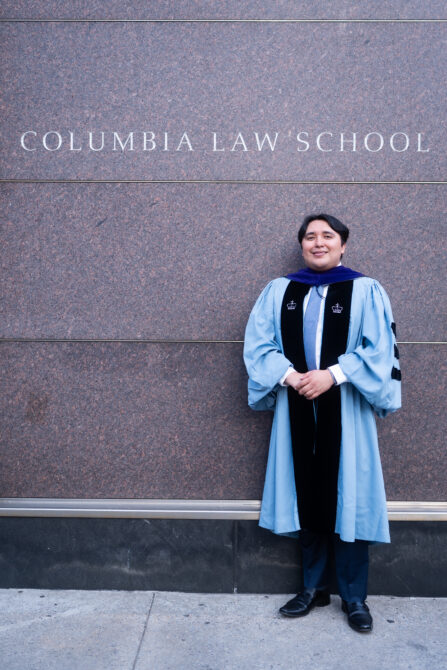
For Lesansee, his education is helping him to acquire skills that will benefit his community.
While studying abroad in Paris as an undergraduate at Stanford, he learned that sacred Hopi and Pueblo cultural items were being sold at European auction houses, often without the consent of the tribes to which they belonged. That experience led him to pursue a Fulbright scholarship focused on understanding how international and domestic law could be used to prevent the sale of sacred objects and support their return.
He now works as a litigator at a New York City firm, and he hopes to clerk for a judge and eventually return to the Southwest to focus on cultural property and federal Indian law.
Native Forward’s support, he says, made it possible to pursue that work without being overwhelmed by financial stress or isolation. Gatherings of Native students and professionals in New York helped him build community far from home, reinforcing the sense that he was not navigating law school alone.
“We’re always told to go get an education so you can help your people,” he says. “Native Forward really does allow and empower students to do just that.”
Native Forward’s second major inflection point came when MacKenzie Scott surprised the group with $20 million in 2020, followed by $50 million more in 2025.
Expansion With No Strings Attached
The gifts were transformational, not only because of their size but because of their flexibility and the trust they represented, Albert says.
“Most people in the nonprofit and social sector understand those things that they need to have a strong organization,” she says. “Sometimes they just don’t have the investment to be able to do that.”
She emphasized how rare it is for Native-led organizations especially to receive large, unrestricted investments. “MacKenzie Scott might be single-handedly moving that a little bit,” she says.
“I just can’t express what it feels like to have someone say, ‘I believe in your leadership. You know what’s best for your people.’”
Scott’s gifts helped accelerate a strategy that Native Forward had spent years building.
Her first gift allowed Native Forward to offer supportive services to every scholar it funds. The second gift arrived amid mounting pressure: cuts to campus-based support services, disruptions to federal funding streams during the second Trump administration, and a 35 percent increase in scholarship applications.
With part of the 2025 gift, Native Forward immediately funded 400 additional students, raising the total number of scholars supported annually to 2,000, a 60 percent increase over the previous year. The organization also expanded staff from 23 employees to 31, with plans to reach 42 later this year.
Roberts, with First Nations Development Institute, says Native Forward’s recent philanthropic success reflects a reality many Native-led organizations face: Private philanthropy often waits until a program already has a broad reach before it is willing to invest. “Scale sells in philanthropy,” he says. “There’s a threshold where philanthropy feels safer giving you money, and safety is the name of the game in private philanthropy.”
Native Forward, he says, has crossed that threshold. On its most recent tax filing, Native Forward reported about $15.6 million in annual revenue. The organization, along with his own group, the First Nations Development Institute, and another scholarship provider, the American Indian College Fund (all Scott grantees), “have hit that number where they start showing up on philanthropy’s radar where they never did before,” Roberts says — a milestone that is “damn near impossible for Indian organizations because of how little money goes there.”
He pointed to other organizations — like the American Indian Science and Engineering Society — that also do good work but are operating on a smaller scale and don’t have as long a track record.
The latest Scott funding accelerated a strategic shift the organization had already begun when Albert joined the organization nearly a decade ago: diversifying revenue to move away from reliance on large federal contracts. In the last fiscal year, just over half of the group’s revenue came from government grants and contracts, funds that support scholarships and operating expenses. Corporate supporters such as Wells Fargo, Nike, Accenture, and Morgan Stanley continue to support the organization, alongside grant makers like the M.J. Murdock Charitable Trust and the Johnson Scholarship Foundation. Now it is beginning to court major individual donors, too, who account for the majority of charitable giving nationwide.
Quietly Shaping Institutions
Native Forward’s scholars attend hundreds of institutions nationwide, from large public universities such as the University of New Mexico and Arizona State University to private campuses across the country. Only about 14 percent attend Tribal Colleges and Universities. The organization supports students wherever they choose to enroll.
That breadth presents a challenge: How do you maintain deeply personal support at a national scale?
While Native Forward does not fund institutions directly, the organization has developed deep expertise in supporting Native students at mainstream universities. Over time, that has allowed the organization not only to support individual students but also to help the colleges themselves find better ways to serve Native students.
In practice, that can mean working with campuses to move beyond transactional outreach and build real relationships with tribal governments, strengthening support systems so that financial aid is paired with mentorship and cultural connection, and helping colleges better understand and measure the barriers Native students face to improve retention.
The organization’s approach, Albert says, demonstrates that programs designed for individual needs can still drive broader institutional change.
Even with the influx of new philanthropic resources in recent years, Albert is candid about the scale of the challenge ahead. Reversing steep declines in enrollment and sustaining personalized support across hundreds of institutions will require long-term financial stability.
Native Forward’s leaders are now focused on building an endowment designed to support future generations of students.
“As Native people,” Albert says, “it’s important that I think about my grandchildren’s grandchildren.”
Reporting for this article was underwritten by a Lilly Endowment grant to enhance public understanding of philanthropy. The Chronicle is solely responsible for the content. See more about the Chronicle, the grant, how our foundation-supported journalism works, and our gift-acceptance policy.