
$4 Million Grant Will Promote Board Diversity at Museums

By NICOLE WALLACE
Features Editor
January 15, 2019 | Read Time: 3 minutes
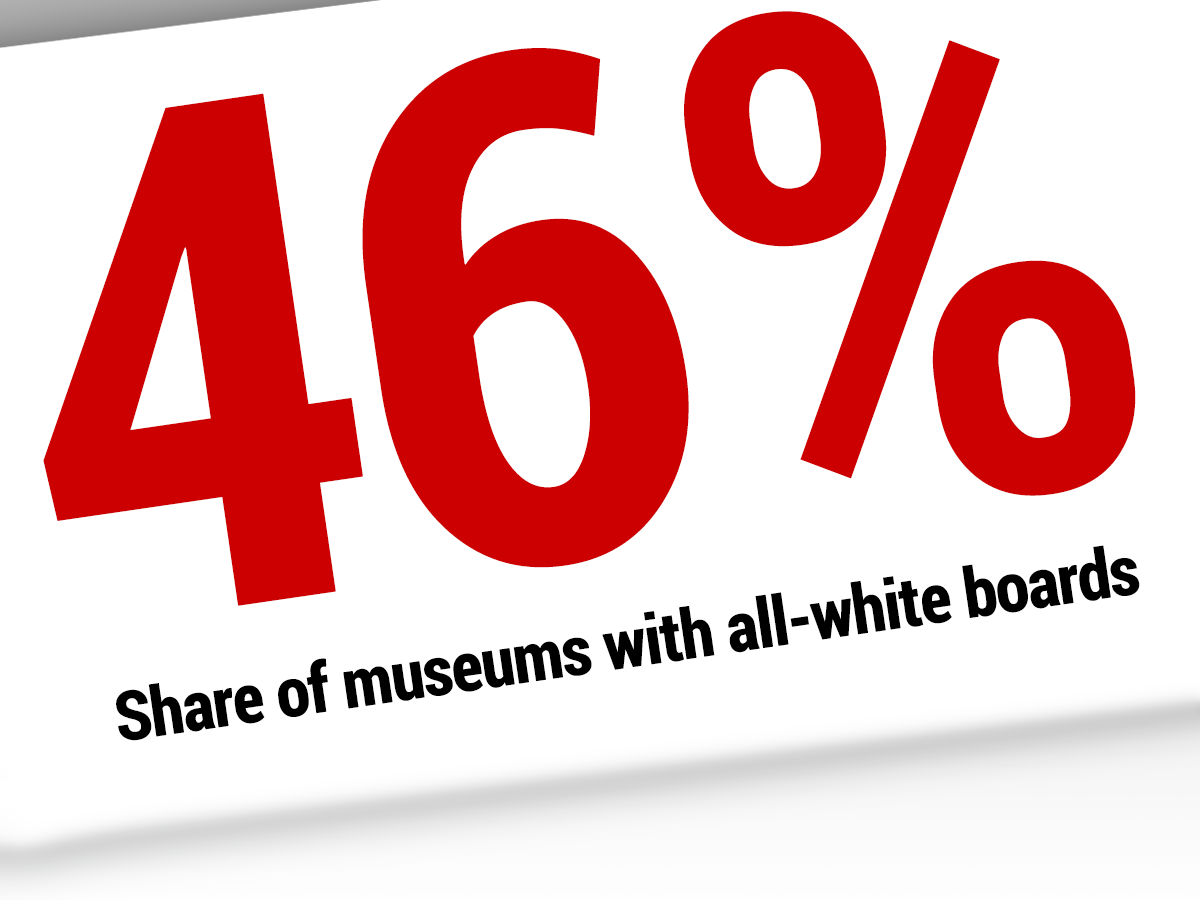
The last museum-board leadership survey conducted by the American Alliance of Museums uncovered a staggering statistic: About 46 percent of American museums have all-white boards of directors.
But the alliance hopes that figure will change for the better soon. Over the next three years, the alliance will receive $4 million to bolster board diversity in a push to make museums more accessible and inclusive. The Ford, Andrew W. Mellon, and Alice L. Walton foundations joined forces to award the grant.
In the more than 20 years that museums talked about the importance of diversity and inclusion, the number of people of color serving on boards has barely budged, says Laura Lott, the alliance’s chief executive. She says that’s a real problem.
“The tone of an institution, the priorities for each museum, the budgets, they’re all established at the board level,” she says. “Without that strong understanding and solid commitment by the board, this kind of work ends up being nice to have instead of need to have.”
The grant is designed so that the alliance can work closely with a group of 50 museums to improve diversity and inclusion at their institutions and at the same time develop resources to help all museums — and perhaps others in the nonprofit world — tackle the subject.
Board-Member Matching
The alliance will provide intensive training on topics such as how to recognize and curb implicit bias and promote organizational change. It will also aid 10 museums in each of five cities and regions so they can develop inclusion plans. Museums selected to take part will be announced in coming months.
Central to the program will be a board-matching service to identify candidates from diverse racial and ethnic backgrounds, train them in the duties of serving as a museum trustee, and assess museums’ readiness to engage board members from different backgrounds.
“It is really important for the boards to have made some headway,” Lott says. “Part of a successful match will be a board that is ready to receive people that may be from outside of their current network and who have different perspectives.”
To help increase diversity at museums across the country, the alliance will develop an online resource center for museum trustees, which will include case studies, sample documents, evaluation tools, and research on the topic. It will also gather museum leaders to determine the core characteristics of being an inclusive museum and develop a pledge for excellence in diversity, equity, accessibility, and inclusiveness, and the alliance will incorporate standards for inclusiveness into its accreditation process.
Widespread Problem
Museums are not the only nonprofit organizations with a board-diversity problem.
According to a 2017 BoardSource report, 24 percent of charities have all-white boards, with whites filling 90 percent of trustee seats and CEO positions. Last year, the organization found that foundation governance was even more homogenous: Four out of ten foundation boards were all-white.
If the alliance’s approach to increasing diversity is successful, its program could be an important model for other organizations in the arts, says Margaret Morton, director of creativity and free expression at the Ford Foundation.
“This is an attempt to do a really comprehensive kind of intervention, doing it in a big way, and doing it with enough of a cohort that we can really learn what’s working from this and what’s not working,” she says.
Lott is aiming her sights higher. She thinks her group’s plan could help the nonprofit world as a whole grapple with the need to appoint more people of color to board leadership.
“We’ve strategically built this initiative so that it will inform the nonprofit sector over all,” she says. “We face a lot of the same issues and challenges of the broader nonprofit sector.”





