December 1, 2015 | Read Time: 6 minutes
At a New York news conference in September that outlined the global movement to get institutions and individuals to divest from fossil-fuel stocks, the speakers painted a picture of exponential growth.
In just one year, the assets pledged to the movement had increased 50 times, to $2.6-trillion, driven by commitments from huge investors like the California Public Employees’ Retirement System and the Government Pension Fund of Norway. Leonardo DiCaprio was there to lend star power, stating that his foundation, like the others that had signed on, would ditch oil, gas, and coal stocks and invest in clean energy.
But missing from the news conference — and the divestment pledge — were nearly all of the largest foundations in the United States. The Rockefeller Brothers Fund signed on 14 months ago, but no others on the Foundation Center’s list of the 100 biggest grant makers by asset size has since joined the movement.
The lack of action by major foundations, particularly those that are aggressively addressing climate change through their grant making, has puzzled and at times infuriated advocates for the movement.

Marc Gunther, a veteran journalist who edits the “sustainable business” section of The Guardian newspaper, called out the William and Flora Hewlett Foundation and the David and Lucile Packard Foundation after their presidents jointly wrote an opinion piece in The Chronicle in April that described climate change as “the defining issue of the day” and “a problem that demands action now.” Neither foundation has divested its fossil-fuel stocks.
“Foundations remain reluctant to own up to what they own,” Mr. Gunther wrote.
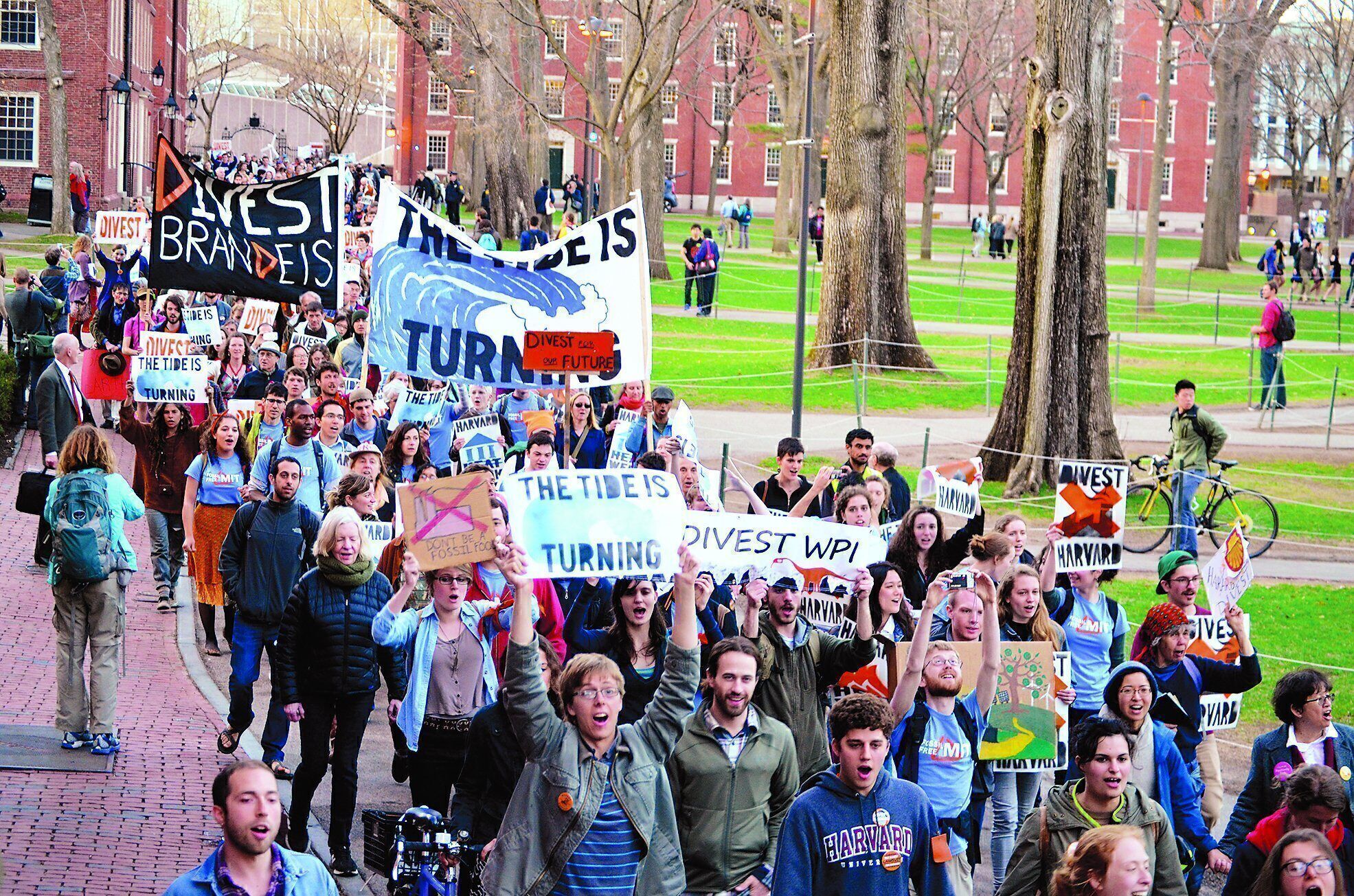
Foundations aren’t the only group giving the movement the cold shoulder. The biggest university endowments have also generally refused to budge — and they’ve had to deal with protesting students. Harvard students blocked access to President Drew Faust’s office in April to protest the university’s investments in fossil fuels. Harvard administrators took their laptops to coffee shops to do their work, but they didn’t make any changes to the $36-billion endowment.
The big endowments and foundations list plenty of reasons for not joining the movement. Some complain that they’re too entrenched with outside investment managers who are unwilling to narrow their pool of investment opportunities. A recent study by a visiting professor at the California Institute of Technology — albeit one financed by the Independent Petroleum Association of America — found that divestment at big endowments could be costly. Harvard would lose out on $100 million a year, he argued.
Critics of the research point out that Harvard has likely lost far more than that by holding on over the past year. Oil, natural gas, and coal stocks have plummeted.
Unintended Consequences
Other foundations argue that divestment is a sideshow that won’t make much real difference. The Bill & Melinda Gates Foundation quietly reduced its holdings in fossil-fuel stocks by two-thirds during 2014, The Seattle Times reported last month, but the foundation has downplayed divestment in public comments. In an interview in the November issue of The Atlantic, Bill Gates says that by pushing divestment, “you’re taking whatever desire people have to solve this problem and kind of using up their idealism and energy on something that won’t emit less carbon.”
William MacAskill, an expert on the extreme brand of philanthropy known as “effective altruism” and an associate professor of philosophy at Oxford University, argues that divestment could actually cause harm by artificially driving down prices of fossil-fuel stocks, presenting opportunities to people who don’t have ethical qualms about owning ExxonMobil. “Ethical” investors, he writes on The New Yorker’s website, may be transferring money to opportunists “who will likely spend it less responsibly.”
Some foundations have set an extremely high bar for divesting — one that the global threat of climate change doesn’t meet. The John D. and Catherine T. MacArthur Foundation, which in August pledged $50 million to climate change, posted a statement on its website this month that said divestment is “never to be entertained to assert policy preferences, censure, or political leverage.” The strategy should only be considered, the statement said, when “investment descends to the level of morally abhorrent activity,” such as genocide, apartheid, or slavery.
“Foundations remain reluctant to own up to what they own.”
Officials at Packard declined to comment on their reasons for not divesting, but a spokeswoman pointed to a statement about its investment philosophy that says the foundation is managed externally with no screens.
Hewlett also declined interview requests, but in a statement said that is has eliminated coal from its separately managed accounts. This year, “to reflect the foundation’s extraordinary commitment to mitigating climate change,” Hewlett decided that it would make no future investments in private partnerships primarily involved in oil and gas drilling.
Some foundations and endowments are committed to working with companies to make the transition to cleaner fuel technology. Massachusetts Institute of Technology rejected demands that it divest in October, calling the strategy “a dramatic public disengagement” that is incompatible with its plan to collaborate with companies on research.
Clara Miller, president of the F.B. Heron Foundation, says her foundation “is on the side” of the divest movement but has decided not to join for now, as it debates its strategy. For some fossil-fuel sectors, notably coal, the outlook is so bleak that divestment may no longer be the best strategy, she says. “It really is in need of transition plan rather than a punishment plan,” she says.
Heron is considering investment in reclamation companies in states like West Virginia and Ohio that might improve the environment while providing jobs to displaced miners.
“It’s an opportunity we’re looking at, but it’s not fully formed yet,” Ms. Miller says.
‘On the Right Side of History’
Ellen Dorsey, executive director of the Wallace Global Fund, is the founding force behind Divest-Invest Philanthropy, a network of foundations that have pledged to get out of fossil-fuel stocks within five years and put 5 percent of their assets into clean-fuel technology.
She dismisses the notion that the divest movement is failing in the United States, pointing to a total of 115 foundations that have signed on, up from 17 when the effort started nearly two years ago. “Collectively, this movement has accelerated at a pace and a scale that is unprecedented,” Ms. Dorsey says.
Ms. Dorsey points to recent wins, such as the $4.3-billion Children’s Investment Fund Foundation, based in London, which decided to join Divest-Invest in September. And she notes with pride that Peabody Energy, the world’s biggest private-sector coal company, has, under pressure from New York’s attorney general, listed the divest movement as a threat to its business.
She’s hopeful that more large U.S. foundations will eventually sign on. “We’re on the right side of history,” Ms. Dorsey says. “We’ll put money on the solutions, rather than drive the problems we’re asking our grantees to clean up.”