
Catholic Charities President Leaves Legacy of Antipoverty Advocacy

By Alex Daniels
Contributor
August 4, 2014 | Read Time: 3 minutes
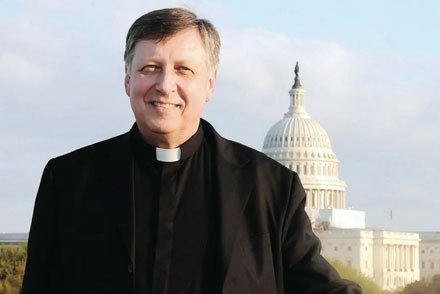
In 2007, two years after taking over as president of Catholic Charities USA, the Rev. Larry Snyder launched a moonshot. With the help of policy changes and a generous public, poverty in the United States, he proclaimed, would be cut in half by 2020. Now, as he prepares to leave Catholic Charities for a new job as vice president for mission at the University of St. Thomas, in St. Paul, Father Snyder has scaled down his expectations.
Working together, antipoverty groups can have a real impact, he says. But the challenges of solving systemic problems, like the need to create sustainable jobs and revive local economies, are especially knotty. Other efforts, he says, are achievable.
“We can take on something like hunger,” he says. “That’s doable.”
Father Snyder, who will stay at the social-services group through next January, says an uncooperative Congress and a stubborn economic recovery put his goal out of reach.
But his vigilance has made a difference, says John Carr, director of the Initiative on Catholic Social Thought and Public Life at Georgetown University and a board member of Bread for the World, a Christian group that has worked with Catholic Charities to help the poor.
“He broke the silence,” Mr. Carr says. “Larry is persistent and tenacious in reminding us that reducing poverty is a moral imperative.”
Tailored Solutions
Father Snyder’s approach at the social-service organization, which raised nearly $1.5-billion last year and coordinates the work of about 160 local Catholic Charities affiliates, was to move away from centrally-developed federal and nonprofit safety-net programs developed in the 1960s.
He’d like to replace those approaches, which he calls “poverty in a box” programs, with individualized care that is based on each recipient’s needs and talents.
“The safety net is critical,” he says. “It is saving lives. Maybe we should focus on helping people thrive.”
A cornerstone of his antipoverty effort was a piece of legislation Catholic Charities tried to persuade members of Congress to introduce and pass into law, a measure the group called the National Opportunity and Community Renewal Act. The bill, which went nowhere in Congress, sought to replace the safety net of federal benefits with different tiers of benefits aimed at promoting self-sufficiency, as well as “Individual Opportunity Plans” in which case workers would develop poverty-relief strategies tailored for each beneficiary.
“If we want to help, we can’t simply fit people into our mold,” he says. “We have to respond to people where they are.”
Critical Data
Stymied by Congress, Father Snyder worked at Catholic Charities offices throughout the country to prove the effectiveness of the approach. In 2012, he teamed with the economics department at Notre Dame University to open the Lab for Economic Opportunities, known as the “Poverty Lab.” Now the researchers are gathering data and testing programs at the social-service group’s affiliates.
For Father Snyder, capturing the data is crucial to discover which programs work and could be spread nationwide..
“That hasn’t been our strong point in the past, but we’re catching on,” he says.
Father Snyder has also attempted to engage other charities in the fight. To mark this year’s 50th anniversary of the War on Poverty, he brought together nine other groups, including the Salvation Army, and United Way Worldwide, which will meet throughout the year to share ideas.
As he prepares to return to his longtime home in Minnesota (he ran the Twin Cities’ chapter of Catholic Charities before assuming his current role), Father Snyder says the effort has been a partial success, simply because it has revived concern for the poor.
“Nobody was talking poverty,” he says. “We’ve tried to keep it on the forefront.”
[Editor’s Note: This story was updated on August 7, 2014 to include additional information.]







