
How the Anti-Defamation League Rallied Support After Charlottesville

By Timothy Sandoval
Contributor
August 24, 2017 | Read Time: 7 minutes
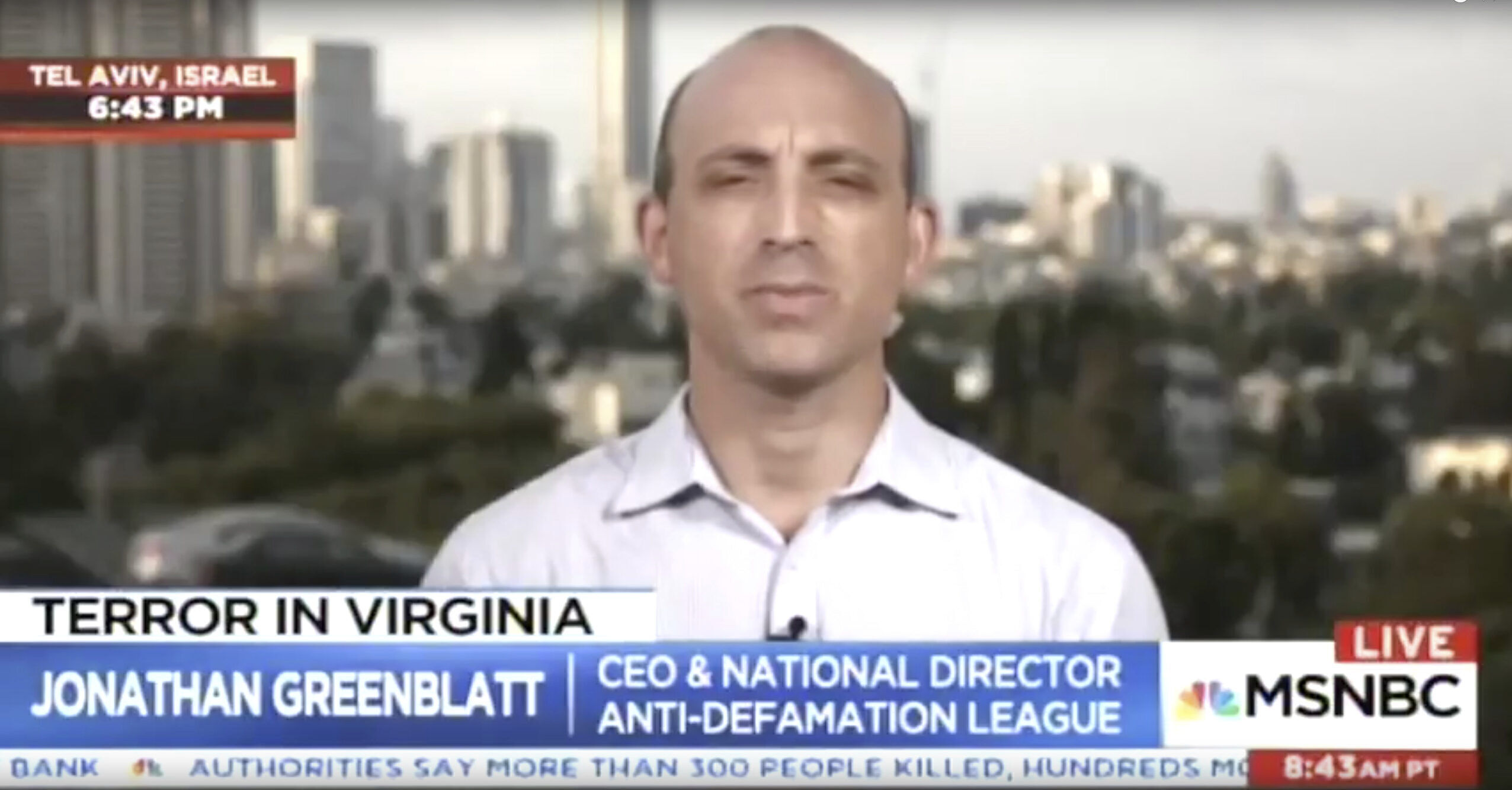
Jonathan Greenblatt, national director of the Anti-Defamation League, knew that a white-supremacist rally set for August 12 in Charlottesville, Va., was going to be bigger than most people expected.
But he didn’t anticipate what it would become: hundreds of white nationalists gathering, many attacking counterprotestors with clubs, flagpoles, and other weapons; one woman killed and at least 19 injured after a far-right demonstrator slammed into counterprotestors with his car.
Mr. Greenblatt, whose organization works to combat racism and anti-Semitism, was on a part-work, part-vacation trip in Israel during the rally that Saturday. It was Shabbat, the Jewish day of rest, which Mr. Greenblatt and many of his employees strictly observe.
On Saturday night, Mr. Greenblatt checked his email and turned on the television, which showed horrific images of the chaos that ensued. He says he was “pretty blown away.”
He knew that his organization, also known as the ADL, was going to have to act fast to respond, and it would require all hands on deck.
Leading After Violence
Thanks to its quick reflexes and aggressive media efforts, the Anti-Defamation League has emerged as a magnet for donors seeking to respond to the white-supremacist rally and President Trump’s tepid response to it — in which he blamed “many sides” for the violence and suggested some marching with neo-Nazis were “fine people.” Money raised in the week following the rally was 1,000 percent higher than an average week this summer — and both big and small donors contributed to the spike.
Nonprofits often emerge as “symbolic moral validators” for donors after a crisis, says Benjamin Soskis, research associate for the Center on Nonprofits and Philanthropy at the Urban Institute. For instance, after President Trump’s unexpected election win in November, many progressives and Democrats donated to the American Civil Liberties Union and Planned Parenthood — two groups that vowed to oppose the president’s agenda.
“It looks like the ADL and Southern Poverty Law Center are becoming something of that in response to Charlottesville and the general rise of neo-Nazis and the alt-right” — a new white-nationalist movement that’s grown along with Mr. Trump’s political rise, Mr. Soskis says.
Some gifts to the ADL have led to big headlines, including a $1 million pledge from James Murdoch, chief executive of 21st Century Fox, which owns the conservative Fox News Channel. James Murdoch is the son of Rupert Murdoch, a confidant of President Trump’s who has given to the ADL in the past and was honored with the group’s “International Leadership Award” in 2010.
Mr. Greenblatt said he had met James Murdoch before but had never discussed donations with him. “James reached out to me and told me what he and Kathryn [Mr. Murdoch’s wife] wanted to do,” he says.
Major companies also announced they would donate to the ADL, including Apple, Uber, MGM Resorts, JPMorgan Chase. The American Federation of State, County and Municipal Employees, a labor union, also gave. (Some companies also said they were also giving to the Southern Poverty Law Center, another group that tracks violent extremism.)
“It really was a spontaneous reaction,” says Frederic Bloch, senior vice president for growth at the ADL. The organization did not actively solicit any of the big gifts that came in, Mr. Bloch says.
The group’s 26 regional offices have been inundated with calls and emails from people inquiring about how they could support the organization through donations or volunteering, he adds.
A Wave of New Donors
About two-thirds of the contributions are from donors who had never previously supported the organization, Mr. Greenblatt says, many of them coming online. The average online gift since the rally has been about $100.
“We’re blessed with an opportunity to expand the base with a leap in these online donors,” Mr. Greenblatt says.
Fundraisers for the group are “probably a little more proactive” than they would typically be in late August — a traditionally slow period — in the wake of the rally, Mr. Bloch says.
He’s quick to stress that the organization is not trying to exploit the tragedy. “I think our supporters are actually wanting to hear from us, to know what we’re doing and how we’re doing it,” he says. “We’re obliging them by reaching out.”
In the year-end fundraising push, Mr. Bloch thinks that the ADL’s work on Charlottesville, and its efforts tracking the emboldened white-supremacist movement in general, will factor into its messages to donors. Charlottesville “will inform the narrative for September, October, November,” he says.
Out in Front
The spike in gifts is likely due in large part to the ADL’s media exposure and visibility as the events unfolded. Many news outlets relied on the organization’s research into hate groups and interviewed ADL officials. One recent issue of The New York Times cited the ADL in four stories, says Mr. Greenblatt, who is widely quoted in media outlets.
The ADL even collaborated with the Times to identify many of the white nationalists who attended the rally. As of Tuesday, the ADL says it has identified 140 of them.
Mr. Greenblatt did interviews with news outlets while he was in Tel-Aviv, including one with MSNBC on August 15, in which he explained that far-right extremists often target “disaffected young people” when recruiting people to their cause, not unlike Muslim extremists. The group is also active on social media, with Mr. Greenblatt flooding Twitter with demands for better policing of events involving right-wing extremists and a demand for President Trump to fire all White House staff members with white-nationalist sympathies.
A New Campaign
The Sunday after the melee in Charlottesville, nearly the entire ADL headquarters staff was working, Mr. Greenblatt says. Some crafted a program to help U.S. mayors address racism and combat extremists groups in their cities. On August 18, the Anti-Defamation League and the U.S. Conference of Mayors announced that 240 city leaders had signed on to a 10-point plan to fight hate that the groups had drafted together.
“Everybody worked that weekend, worked after hours, worked on vacation to try to pull it all together,” Mr. Greenblatt says. While in Tel Aviv, he remained in touch with staff at ADL’s New York headquarters, with local leaders in Virginia, and with the media.
Last week, the organization released numerous statements denouncing the rally and President Trump’s response to it and wrote blog posts with analysis. It also posted two petitions online, one calling for President Trump to “unequivocally disavow white supremacy and end the White House’s enabling and tolerating its rise.”
The group also sent an email to supporters on August 17 announcing a new “#StandAgainstHate” fundraising drive, with a goal of $5 million. “The extremists are not going away,” the email said. “Instead, they are aggressively inserting themselves into mainstream America and attempting to normalize their hateful rhetoric.”
Working Ahead
Even before the “Unite the Right” rally, as the white nationalist event was called, the ADL was sounding the alarm.
The group published a blog post and video a few days ahead of the Charlottesville gathering, predicting that it could be the largest hate rally in a decade.
ADL staff also shared its research on white-nationalists with law-enforcement officials and other community leaders and reached out in advance to many news outlets, telling them what to expect. “We anticipate events like the one in Charlottesville far in advance, because we’ve got a team of researchers in our headquarters in New York and distributed around the country,” Mr. Greenblatt says.
Mr. Greenblatt expects to see more white-nationalist demonstrations in the future, noting that ADL has documented increased recruitment online and on college campuses.
Charlottesville “did reaffirm what we know, which is that right-wing extremism is on the rise,” he says.
He was glad to see the donation spike to the ADL as well the wide range of business leaders and politicians taking a stand against the rally and Mr. Trump’s remarks.
“That was a heartening lesson from the week: that we have more that unites than divides us,” he says. “We just have work to do to lift that up at every opportunity.”




