Blue Meridian, a Big-Bet Funder, Promotes Jim Shelton to CEO
The philanthropic collaborative also is placing predecessor Nancy Roob in a new leadership role to grow its grant-making capacity.

By Alex Daniels
Senior Editor, Foundations
December 12, 2024 | Read Time: 5 minutes
Blue Meridian Partners — a nonprofit that has marshaled billions of dollars to philanthropic causes and attracted donations from nearly two dozen big donors including MacKenzie Scott, Steve and Connie Ballmer, and the Gates Foundation — announced Thursday a leadership change that will place two of its leaders in new roles.
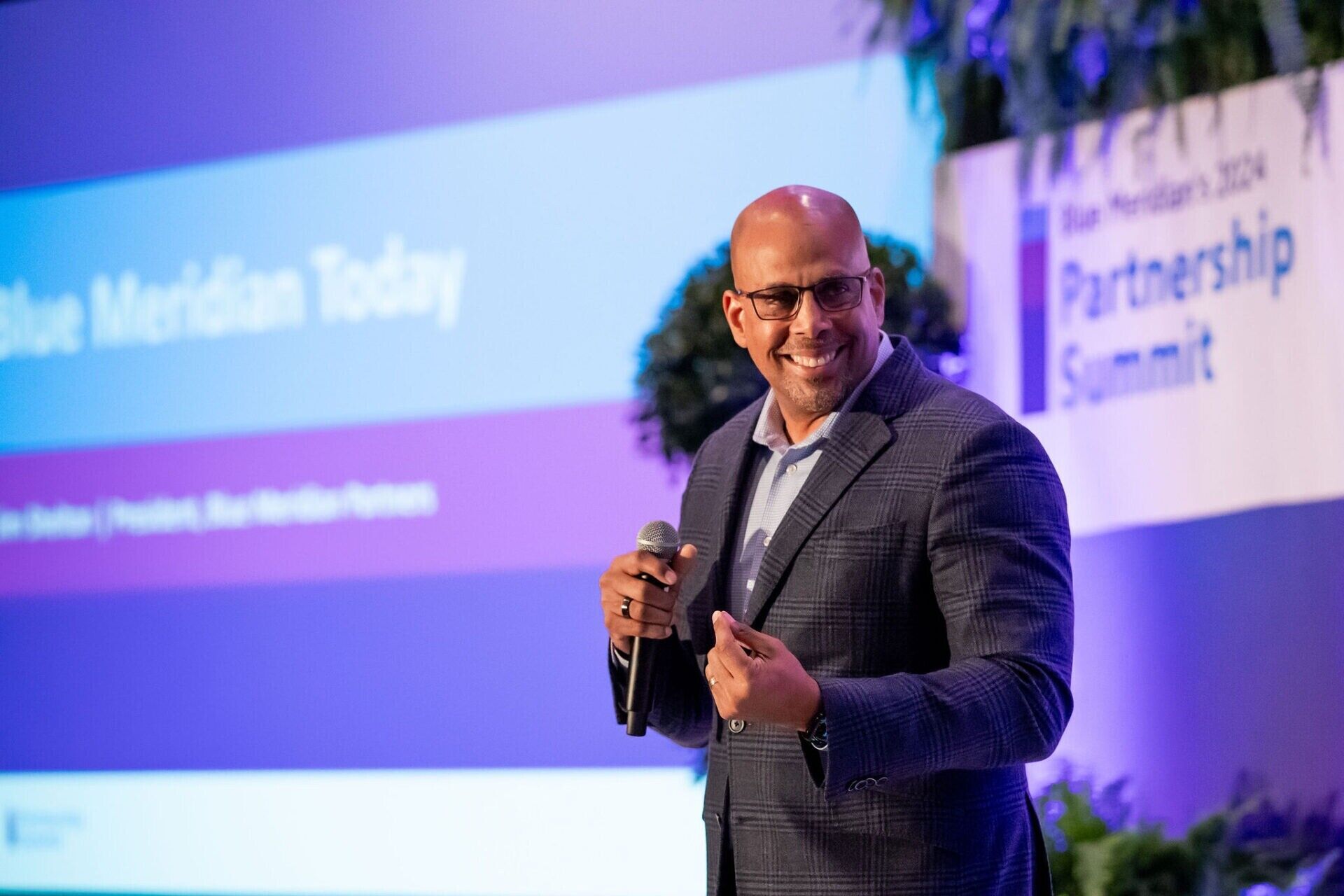
Jim Shelton, the fund’s president and chief investment and impact officer, is taking over as chief executive officer. Founding CEO Nancy Roob will move to the organization’s board to serve as executive chair.
Big Bet Philanthropy
-
Foundation Giving
$100 Million for Equity: MacArthur’s New Big Bet and Mandate
-
Rural Philanthropy
National Grant Makers Bet This Rural Education Program Can Scale
The change will allow Shelton to focus on strategy and operations, says Roob, while she can “double down on our capital aggregation strategies” by identifying new wealthy donors and connecting them to causes that interest them.
Roob co-founded Blue Meridian in 2017 as a spinoff from the Edna McConnell Clark Foundation. Its mission is to attract big donors who want to have a big impact by making grants of at least $100 million in areas ranging from foster care to helping low-income families build their savings. The donor group surpassed its initial hopes of raising $1 bllion, raising pledges of about $2.5 billion within four years. Blue Meridian has now collected more than $4.5 billion from donors interested in improving Americans’ economic mobility, concentrating investments in specific locations, and identifying and funding promising leaders of small but scaling nonprofits.
The “big bet” approach has attracted several fellow philanthropic travelers. For instance Co-Impact, a group co-founded by Bill Gates and Melinda French Gates in 2017, has raised nearly $1 billion in two funds. TED’s Audacious Project has attracted scores of investors, and Lever for Change is closing in on raising $2.5 billion since it spun off from the MacArthur Foundation in 2019.
By finding promising ideas and leaders, working to hone their plans, and providing staggered amounts of cash as they grow, Blue Meridian has helped finance nonprofits that have spread their work nationally, including Nurse-Family Partnership and Youth Villages. But even after raising nearly $5 billion, Blue Meridian’s assets are “massively subscale” compared with the problems it is trying to solve, said Roob.
The latest donation came Wednesday from Pivotal Ventures, Melinda French Gates’s social investment firm, which gave Blue Meridian an undisclosed portion of the $125 million she pledged to four collaborative funds.
Roob declined to provide an estimate for how much she’d like to grow Blue Meridian’s grant-making capacity.
“It’s less about funds under management; it’s more about impact,” said Roob. “We’re looking to really double down on impact.”
With greater philanthropic capital, Shelton said Blue Meridian’s goal will be to continue to take the sort of comprehensive approach necessary to scale nonprofit ideas that work to larger populations spread out across many geographic areas.
“Can we prioritize everything at one time? Can we push ourselves to really understand the landscape of things?” asked Shelton. “Yes, we do.”
Shelton said donors have responded to the metrics-driven approach favored by Blue Meridian’s staff of investment advisers to “solve the problem where the data takes them.”
Using that approach, Shelton and his team have identified pressing economic needs across race and geography and believe philanthropy must support people who come from different places.
Following a $2 million grant in 2023 from Blue Meridian, Partners for Rural Impact, a nonprofit dedicated to helping improve education in rural Kentucky, began working with groups including the Louisville Urban League and Save the Children to address K-12 education issues in cities and towns across the state.
In 2020, the groups jointly pressed for state funding to prevent learning loss through mentoring and tutoring programs and materials. The result was a $16 million grant from the state of Kentucky, which deployed half in Louisville and half in the Appalachian counties of eastern Kentucky.
Working ‘Both Sides of the Market’
Jeff Bradach, co-founder and partner of Bridgespan Consulting Group, which has worked extensively with Blue Meridian, said the new roles for Roob and Shelton will help the nonprofit work well “on both sides of the market.”
Shelton, who served as deputy secretary of the U.S. Department of Education in 2013-15 and as founding executive director of former President Obama’s My Brother’s Keeper, brings deep strategic experience, while Roob has an “amazing ability” to connect with high net worth individuals, Bradach said.
“The success of Blue Meridian hinges on its ability to drive impact in the world by supporting extraordinary leaders and initiatives,” he said, “and linking that with a group of high net worth individuals who are ambitious for impact.”
According to Bridgespan, the total amount of giving by families with assets greater than $500 million has grown in recent years, but the portion of their wealth they’ve given to charity has remained steady at about 1.2 percent.
Bradach said philanthropy is at a moment of “significant disruption.” Twenty years ago, opening a foundation used to be the norm for rich people wanting to give back to society.
“That’s not the standard answer anymore,” he said.
Increasingly, donors are choosing to spread their contributions among several mechanisms, including donor-advised funds, limited liability companies, and donor collaboratives like Blue Meridian. Many recent megadonors, including MacKenzie Scott and Melinda French Gates, have either sidestepped the creation of a private foundation or minimized the role of a fully staffed institution in their grant making.
Roob agreed that philanthropy is undergoing structural changes, with many donors choosing to join together to increase the chance that their gifts will make a difference.
“There are lots of variations of that starting to bubble up,” she said. “But I don’t think there’s one model that we can point to today and say, ‘That’s it.’”