Case Study: Why This Annual-Giving Leader Still Relies on the Phone-athon

By Drew Lindsay
Senior Editor, Special Projects
July 5, 2017 | Read Time: 3 minutes
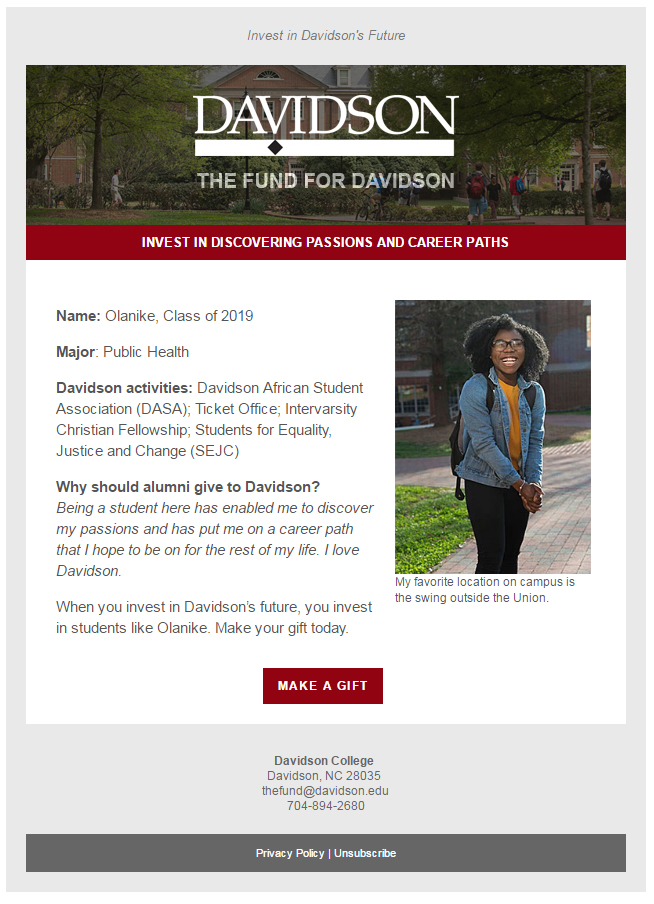
This spring, Davidson College sent 100 alumni an email solicitation with a profile of Olanike, a sophomore majoring in public health. It included a cute photo of Olanike and a rundown of her activities, among them the campus African student group and InterVarsity Christian Fellowship.
The email didn’t note that Olanike worked for the development office, but the alumni soon found out; within days, she phoned each of them to follow up. Hoping to spark a natural conversation in the cold call, development staff had carefully selected her call list because she shared something in common with each person — an academic interest, for instance, or a club.
This tailored approach was duplicated for each of the 20 or so students who work the phones for the college. It’s just one of the ways that Davidson — an annual-giving leader in higher education — invests in its phone-athon work. Even as colleges like Stanford abandon the telephone as a fundraising relic, Davidson continues to see returns. Officials say their phone campaigns are critical to keeping the college’s alumni-participation rate around 60 percent each year, one of the best in higher education.
Here are some of the ways the college invests in students — both for today and for tomorrow.
Hire for authenticity. With an enrollment of just 2,000 students, Davidson is a tightknit community where personal relationships matter. That carries over to the alumni, says Eileen Keeley, vice president for college relations. When students call, graduates want to find out about their Davidson experience, so the development office looks for students who can articulate their passion for the school. The head of the call center typically does 30-minute interviews with each candidate.
Pay well. Students get $10 an hour, which makes the job one of the highest-paying on campus, Ms. Keeley says. Students get a small bump-up — maybe 25 cents an hour — each semester they continue.
Promote the work as a career builder. The job looks good on a graduate’s resume, Ms. Keeley says. “If you can call somebody you’ve never met before and ask for money, a lot of employers will see that and say, “This person is a go-getter.’ ”
Use students as your guide to the hearts — and stomachs — of their peers. Davidson pulls its callers into planning for development efforts on campus and with students. For its #AllinForDavidson giving day, the students helped decide how to promote the event within the college, what prize giveaways to dangle before students, and even what snacks to offer.
Teach philanthropy. This year, Davidson introduced monthly meetings to show students about the impact of Davidson philanthropy as well as the nuts and bolts of fundraising. Typically, callers after graduation become the college’s best volunteers in the annual-giving drive. The college hopes they will become even better ambassadors after this inside look. “They will be advocates in a way that’s authentic, because they understand it,” Ms. Keeley says.
For the email-profile project, Davidson brought students into the planning so that they understood the strategy behind the idea. The callers also helped design the profiles.
Build loyalty: Each year, as the calendar flips to June and the college enters the last month of its fiscal year, the alumni-participation rate stands around 40 percent, according to Ms. Keeley. But staff and students hit the phones and push that toward the 60 percent mark. Classes have ended by then, but some students postpone summer jobs so they can man the phones in these critical days. “They drank the Kool-Aid,” jokes Ms. Keeley.