
Covid Erased an Estimated 1.6 Million U.S. Nonprofit Jobs From March Through May

By Michael Theis
Contributor
June 26, 2020 | Read Time: 2 minutes
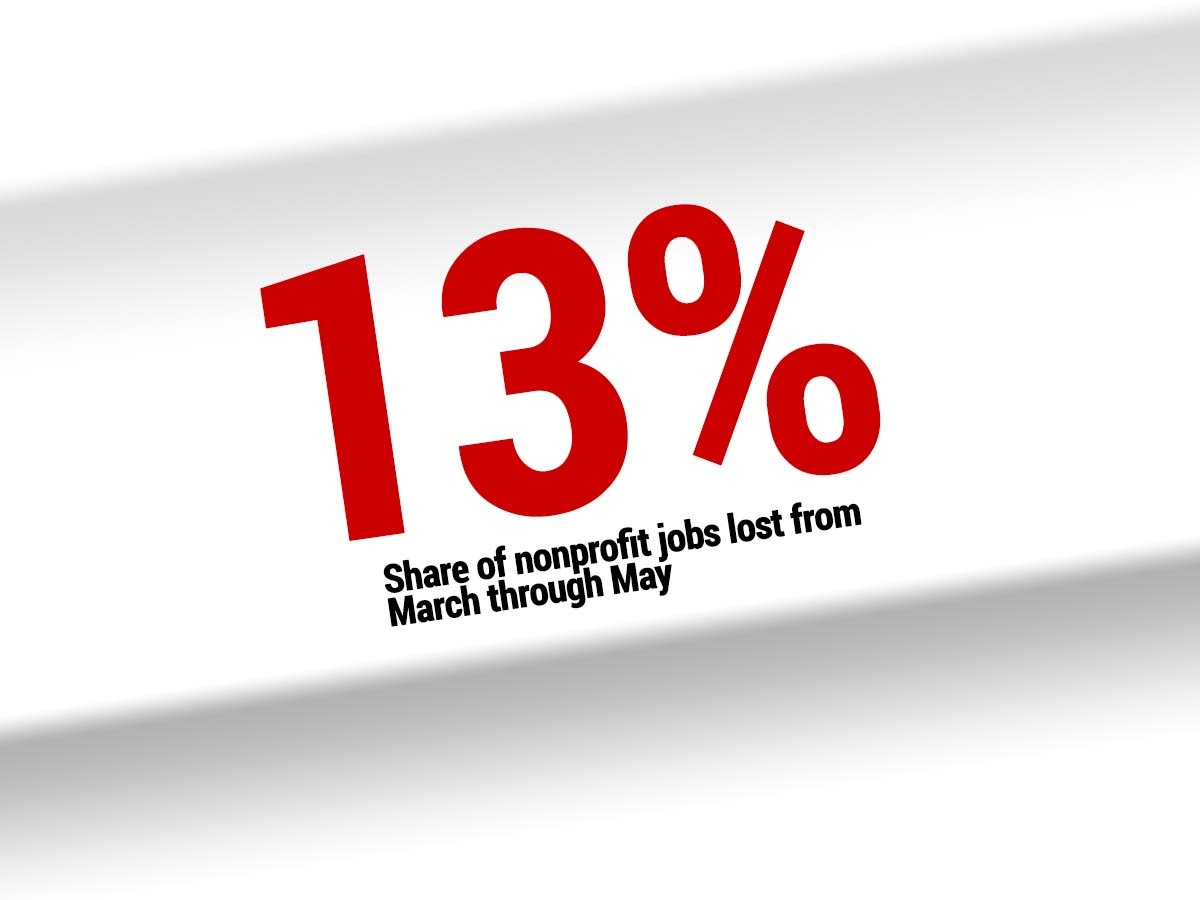
Nonprofits shed more than 1.6 million jobs from March through May, or 13 percent of all nonprofit jobs in America, according to estimates from Johns Hopkins University. That’s equivalent to 8.8 percent of an estimated 18.7 million job losses seen in that time across all nongovernment jobs.
The estimates were part of the Johns Hopkins Center for Civil Society Studies 2020 Nonprofit Employment Report.
The results are limited because they are not a direct measure of nonprofit job losses. Instead, researchers examined overall job losses by industry — data that encompasses both for-profit and nonprofit workers — and assumed that nonprofit job losses were proportional to the share of nonprofit jobs over all in each industry.
Private education nonprofits lost an estimated 323,201 jobs, while health care lost an estimated 574,530.
Not all subsectors of the health-care industry were affected the same way. Nonprofit ambulatory health-care service providers, such as physicians’ and dentists’ offices and outpatient facilities, shed thousands of jobs from March through May. Hospitals and nursing homes, however, have increased employment since the pandemic began.
Lester Salamon, director of the Johns Hopkins Center for Civil Society Studies, cautioned that the data was limited by several factors. The Bureau of Labor Statistics only details nonprofit employment figures every five years, which is why researchers had to extrapolate their findings from the broader pool of labor. The most recent update on nonprofit employment was in 2017, so the next update isn’t due for two years.
“It’s just a crime, and it deprives the nonprofit sector of information that is needed to anchor its claims on public policy,” said Salamon. “We need to know what’s happening in that sector because they’re the frontline workers, and here we are sitting here waiting until 2022.”
The estimates are also hampered by the fact that the May unemployment measurements did not differentiate between workers who truly had returned to work and those who were being paid a salary through the Payroll Protection Program but had not returned to work.






