How 59 Data Points Helped Foundations Spark Elusive Change
Big foundations behind a multicity project are trying to measure the intangibles of community building. In one Akron, Ohio, neighborhood, the numbers are adding up to something good.

By George Anders
Contributor
July 23, 2025 | Read Time: 10 minutes
AKRON, OHIO
How much can a retiree earning $15 an hour with an iPad shape a big philanthropic project? Grace Hudson has a story to share.
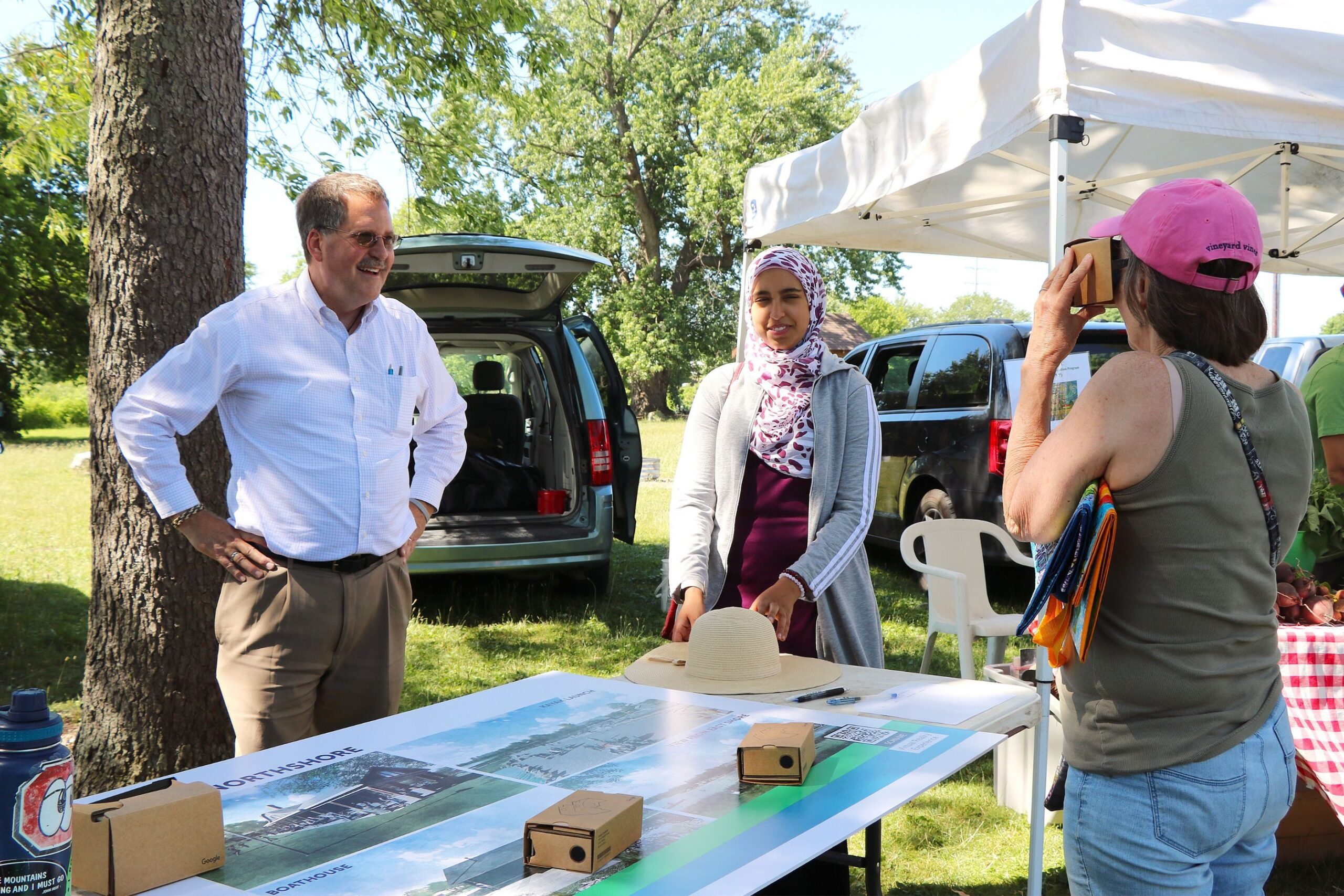
In 2018, two years after several big foundations linked arms to back a project known as Reimagining the Civic Commons, Hudson joined as a neighborhood canvasser, a role that was unusually pivotal for a philanthropy venture. She is a retired child-care worker who lives in the Summit Lake district of Akron, Ohio; the data she gathered helped fuel this long-running, multicity effort to spruce up parks, plazas, gardens, and riverside gathering places.
Grant makers — including the Freedom Together (formerly JPB), Knight, Kresge, Rockefeller, and William Penn foundations — have invested $39 million so far, with the largest commitments in Akron, Detroit, Memphis, and Philadelphia. The big goal: to upgrade public spaces in ways that inspire a city-by-city uplift in residents’ civic spirit, trust, and faith in their local government.
Hudson and scores of other iPad-wielding Reimagining canvassers are the tip of the spear in an unusual effort to measure the project’s impact. Thanks to their door-to-door work and neighbor-to-neighbor conversations, funders have a superabundance of metrics that speak to the intangibles — culture, attitudes, outlook for the future, sense of place — that are building blocks for anyone trying to strengthen communities.
The verdict so far: In places where Reimagining’s work is most concentrated, people usually (but not always) feel safer. They are more inclined to chat with their neighbors. They voice more optimism and trust in their local government. Over all, Reimagining’s approach “offers a promising solution to change agents across the country who are eager to create more vibrant, connected communities,” says Urban Institute researcher Gillian Gaynair, who has studied the project.
In Summit Lake, where many of the numbers are ticking up, Hudson has proved a valuable representative of big philanthropy. In the largely Black and Latino community, there’s long-seated distrust of outsiders with ideas about how to spruce up the neighborhood. Tensions date to a whites-only, 1920s Ferris-wheel park. But as a Black woman and a fixture of the area, Hudson has been welcomed on front porches and stoops.
“People were surprised and happy that someone was talking to them and asking them questions,” Hudson recalled. “For them to realize that someone’s listening was amazingly empowering.”
Early Jolt of Money
Reimagining’s origins trace to 2014, when Shawn McCaney, a longtime executive at Philadelphia’s William Penn Foundation, who’s now executive director, began exploring with other foundations what he called “the relationship between public space, community building, and democracy.” Their theory of change centered on a belief that bold spending on urban assets such as parks and plazas could dramatically reshape community dynamics. People would mingle more. Isolation and distrust would fade; social and economic diversity would grow.
Of the five foundations that started Reimagining in 2016, Freedom Together, Kresge, William Penn, and the the John S. and James L. Knight foundations remain active, having underwritten three rounds of funding. Rockefeller departed after several years amid a switch in priorities.
Rather than embark on isolated, single-city projects, funders decided to share expertise. Philadelphia’s grant makers knew the most about how to redesign public gardens for greater civic involvement. Memphis had unique insights about riverside parks. As the Reimagining project took shape, regular multicity meetings helped spread expertise across geographies.
Determined to gauge Reimagining’s impact in ways that went far beyond tracking park visitors, the program hired Interface Studio, a Philadelphia consulting firm, to create metrics that spoke to bigger goals such as civic engagement, environmental sustainability, and socioeconomic mixing. Voila! — Interface built an imaginative arsenal of 59 metrics that ranged from Zillow-based monitoring of home-valuation to satellite-photo surveys to calculate increases in tree canopies.
“We wanted to test what works and what doesn’t,” recalled urban innovator Carol Coletta, who served in leadership roles at both the Knight and Kresge foundations during Reimagining’s early years. “The more data you have, the more you can understand how to invest better on behalf of the public.” Coletta now is a fellow at the Bloomberg Center for Public Innovation.
Key to this metrics push was bold use of in-person surveys, including a proposal that canvassers approach residents in their homes and in public spaces — a tricky proposition given the survey’s questions about race and household income. It soon became clear, as Interface senior analyst Ben Bryant recalled, that “if you’re asking college students to stand around with a clipboard, glancing here and there to try to catch somebody — that’s an approach that people will avoid at all costs.
T-Shirts and Barbeque
The solution: Invite community members like Grace Hudson, the Summit Lake retiree, to do the surveying, both before and after Reimagining’s work. Trusted members of the community could elicit answers far more effectively than outsiders.
“Have you picked up any litter in the past week?” Hudson wanted to know. “How often do you socialize with neighbors?” “Does your neighborhood feel safe in the daytime? Does it feel safe at night?” For that matter: “Do you believe your local government can be trusted?”
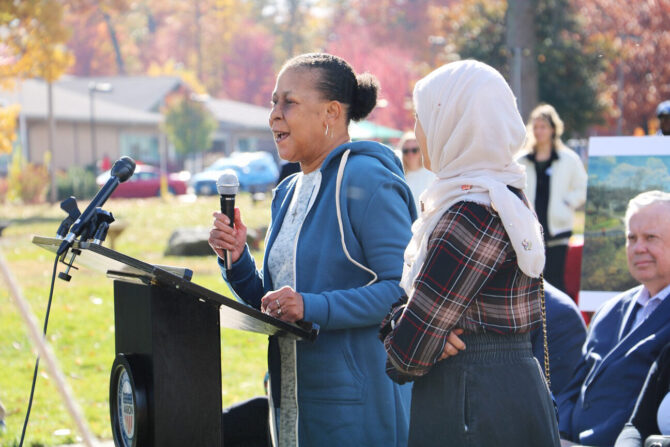
Akron’s canvassers were fitted out with cheery, pale-yellow T-shirts showing a happy child raising arms to form the “A” in Akron. In Detroit, survey-takers were offered tickets to a free barbecue. “Actually, everyone in the community could attend,” Bryant confided. “But it was a way of thanking folks for their time.”
Sandy Saulsberry, a retired home-health aide who lives in the Summit Lake district, said she was suspicious at first about Reimagining. When she heard that a longtime Akron area nonprofit leader, Dan Rice, would coordinate work in her neighborhood, “I thought he might be a rat,” she said. “I would stay up at night under the covers, Googling him. But he turned out to be squeaky clean.”
Rice recalled that it took nearly a year of steady neighborhood meetings to build trust with Summit Lake residents. He showed up in his usual suit and tie before realizing that everything went better when he left the tie at home. He also made it clear that local residents would call the shots. Reimagining would build out the lakeside improvements they wanted; it wouldn’t force its own agenda.
“Some of our partners said: ‘Why don’t we just re-create the amusement park?” Rice remembered. “But we pivoted pretty quickly away from that. The reaction from the neighborhood was: ‘You want to spend $7,500 to bring in a Ferris wheel, but I don’t even have a place to sit at the lake?’’’
“People wanted to fish. They wanted to rent bicycles, and they wanted a picnic area,” Rice recalled. “So that’s what we built. And we did a lot of prototyping, putting up a temporary tent and some $20 plastic Adirondack chairs from Home Depot to see if people would use them. The residents liked it. They said: ‘Let’s make it permanent.’”
More Kayaks; Less Litter
Surveyors found many signs of improvement In Akron’s Summit Lake district. After Reimagining added picnic benches, kayak rentals, and a nature center on the lakeshore, people’s sense of local stewardship — as measured by how often they said they picked up litter — nearly doubled. Residents’ likelihood of socializing with neighbors surged to 53 percent in any given week, up from 31 percent.
Meanwhile, Akron’s surveys found that Summit Lake attracted a much wider mix of visitors by income level in 2022, versus 2018’s heavy reliance on visitors earning $20,000 a year or less. Racial diversity increased, too. In 2018, more than 70 percent of Summit Lake’s visitors were Black; only about 27 percent were white. By 2022, the percentage of both Black and white visitors to the lake topped 40 percent. Asian visitors, who hardly ever came to the lake in 2018, were starting to become a more meaningful presence.
“Akron is on kind of a knife’s edge,” said the city’s mayor, Shammus Malik. Like many traditional hubs of Midwest manufacturing, Akron has endured a sizable population drop since its 1960s heyday. “My goal is to stabilize the population and to keep young people feeling that they have a future here — and philanthropy has really allowed Akron to punch above its weight,” he added.
Not everything got better in Akron — or in other cities. In Akron, hopes were high that a flurry of civic improvements in the Summit Lake district would help residents feel more secure. Any positive aura, however, was overwhelmed by anxiety and dismay related to a fatal police shooting of an unarmed Black man, Jayland Walker, in 2022. When canvassers asked Summit Lake residents if they felt most people could be trusted, only 10 percent said yes in the 2022 survey. That was down from 18 percent in 2017.
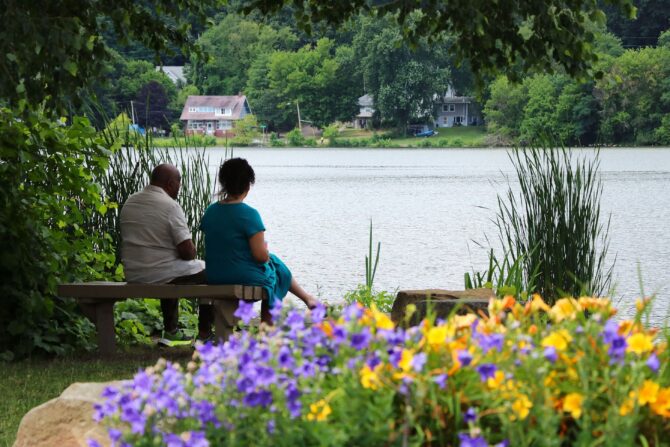
In Detroit, where Reimagining’s dollars helped transform an empty lot into Ella Fitzgerald Park, residents’ sense of personal safety increased substantially. Residential home values picked up, too, but some problems persisted — and perhaps got worse. The estimated vacancy rate of buildings in a nearby commercial corridor rose to 52 percent in 2023, well after the park project was complete. It had been just 43 percent before the park came into being.
Still, Reimagining project manager, Bridget Marquis, can point to examples of timely philanthropic spending that appears to have inspired add-on commitments from local governments and industry. In Memphis, city government spending on parks ramped up 85 percent after Reimagining got involved. In other cities, the prevalence of empty lots dropped as new businesses or residents moved into what had been abandoned areas.
A Lake Area Revived
The first iteration of Reimagining the Civic Commons completed its grant spending by the end of 2022. Four of the five original grant makers (all except Rockefeller) judged the program successful enough that they committed to a second round of grants, known as Reimagining 2.0. Five more cities were added to the program. Last October, funders announced a third round, with $10 million in expected grants.
On a recent weekday afternoon in Akron, Dan Rice led a visitor on a bike ride from his downtown office to Summit Lake. Evidence of Reimagining’s impact was bountiful along the four-mile trail. A disused canal lock has been refashioned into an outdoor music arena. Picnickers clustered near the lake. Rice frowned for a moment at the sight of overgrown weeds crowding a brief stretch of trail and then declared: “I think we can get the city to come take care of this.”
Today, years after philanthropy completed its spending on Summit Lake, former canvasser Grace Hudson believes those outlays will bring enduring benefits. After all the grant money was spent, she recalled, “some people thought [the improvements] were going to get torn up and destroyed. But that never happened.”
“People got what they asked for,” she explained. “Watching the barbecue grills and the tables get developed, it instilled a sense of pride. I mean, to this day, that area gets used.”
The Commons is financed in part with philanthropic support from the Arthur M. Blank Family Foundation, Einhorn Collaborative, and the Walton Family Foundation. None of our supporters have any control over or input into story selection, reporting, or editing, and they do not review articles before publication. See more about the Chronicle, the grants, how our foundation-supported journalism works, and our gift-acceptance policy.
Reporting for this article was underwritten by a Lilly Endowment grant to enhance public understanding of philanthropy. The Chronicle is solely responsible for the content.