How an Artist Translated Science and Tragedy to Help a Town Fight Toxic Pollution

By Drew Lindsay
Senior Editor, Special Projects
November 30, 2021 | Read Time: 6 minutes
Sometime in the next few years, crews dispatched by the Environmental Protection Agency will roll into Ashland, Mass., population 19,000, and begin a $20.5 million cleanup of groundwater contaminated by waste from a chemical dye plant. Cancer deaths were linked to toxins from the factory, which closed in 1978, and the town has been advocating such action for many years. Among those buried and mourned are teens and young adults who grew up playing in puddles and ponds turned blue, purple, and other candy colors by the plant’s discharges.
ArtPlace America played a small but significant role in Ashland’s persuasion campaign. Visual artist Dan Borelli, who counted friends among those who died, received a $75,000 grant from the philanthropic venture to dig deeply into his hometown’s history of loss and grief — and illustrate through art the clear and present danger from the plant.
As the big national foundations came together in 2010 to launch ArtPlace, Borelli was at work on his master’s thesis, an examination of the history of color, at Harvard’s Graduate School of Design. One of America’s first dye manufacturers, he discovered, had opened in Ashland in 1917.
This surprised him. He knew the EPA had made an abandoned factory in Ashland a Superfund site in the early 1980s, when he was in third grade. But he didn’t know the plant had manufactured the dyes used to make goods from Twinkies to blue jeans. Nor had he ever considered the potential hazards of the synthetic production of color. Some 45,000 tons of toxic sludge had been buried on the site over a half century. A close friend of his, Kevin Kane, had died in 1998 of angiosarcoma; eight years later, state health officials tied his death to toxins from the plant and found elevated cancer rates in Ashland linked to the site.
Borelli abandoned his study of color as a cultural influencer and began to examine it as a carcinogen. The only record of the plant and the lives lost were a few shelves in the town’s library with binders of EPA reports. “That was a history of the contaminants,” Borelli says. “I wanted to do a history of the contaminated.”
Blue Snow and Pink Clouds
Digging into the history of the plant, which was last owned by a company called Nyanza, Borelli discovered that once in the 1960s, a pink cloud had enshrouded homes, prompting residents to call police. Another time, snow fell that was blue.
Most residents believed that federal remediation following the Superfund designation had removed all the contamination from the site. “It’s clean,” they told him, pointing to the “cap,” a 12-acre landfill intended to bury and contain the pollutants. Borelli, however, found EPA data showing contaminated groundwater beneath the town. Agency officials assured him there was no danger, he says, but he was unpersuaded.
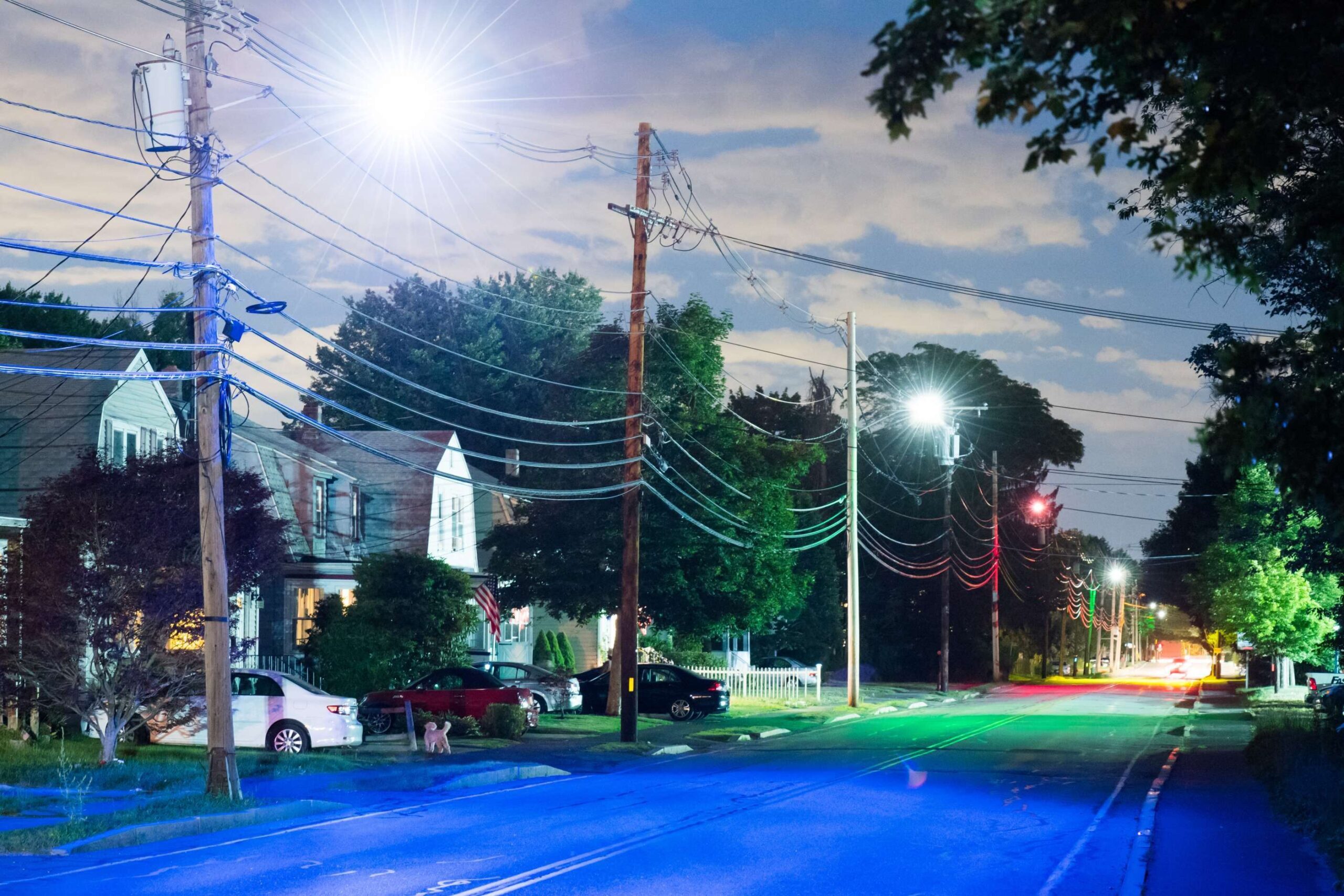
Borelli, who’s director of exhibitions at the graduate school, set out to create public art that would translate the EPA data and create a visual counterpoint to the cap, something that would call into question the consensus that Nyanza was no longer a problem. He settled on an experiential art display. Town public-works staff would affix filters to street lights, with colors corresponding to the EPA’s map of groundwater pollution — red for parts of town with the densest concentrations of contaminants, then orange, yellow, green, blue, and purple.
Borelli went before a meeting of the town’s select committee to secure approval for the project. He also aimed to build a healing garden as a place where residents could remember Kane and other cancer victims. And he wanted to create a multimedia exhibit in the library to tell the plant’s history.
These ideas weren’t exactly welcomed, says Michael Herbert, then the assistant town manager. Town officials, real-estate agents, businesses, and others wanted to highlight good things about Ashland and its history. The first Boston Marathon, in 1897, had started in Ashland at a line drawn in the dirt on Pleasant Street. The inventor of electric clocks was a native son who ran a factory for 50 years.
Many were eager to shed Ashland’s stigma as a dirty town where kids had died, Herbert says. “I had some of those initial thoughts, too. Do we really want to go down this road?”
When Borelli spoke at the meeting, family members of cancer victims stood with him. He announced he had secured ArtPlace funds; the town wouldn’t have to pay for anything. “It was like, ‘Checkmate!’”
Street-Lights Display
Borelli’s street-lights display, “What Lies Beneath the Surface,” opened June 18, 2016, and ran for a month. Most nights, Borelli led tours and talked about the plant’s history and the reach of the groundwater plume. Residents and curious outsiders walked past the 160-year wood-frame town hall, bathed in a pale green, and down Pearl Street, portions of which featured all the colors.
“It was very powerful for people to see it and know what it meant — that people have died,” says Cara Tirrell, who grew up with Borelli. Town residents new to Ashland didn’t really know about Nyanza, she adds.
A ceremony to dedicate the healing garden, built near the middle-school baseball field, was held the same day as the opening. Borelli’s library exhibition, which included oral-history interviews with relatives of his late friend Kevin Kane, had been installed earlier in the year.
The three projects raised questions about Nyanza at a critical time. A developer had been approved to build a new apartment complex on land adjacent to the site, and a small group of residents had banded together to question whether construction would disturb the cap. Borelli became a leader with Tirrell in the newly launched Ashland Citizens Action Committee, which promoted his research and art as it demanded that the EPA do more.
“People had just forgotten” about Nyanza, says Herbert, now Ashland’s manager. “The really cool thing about Dan’s work is that it prompted people to ask questions.” It also changed Herbert’s communications’ approach; he says he now focuses less on statistics and tries to tell stories with town residents at the center, as Dan did in the library exhibition.
The EPA eventually agreed to a study to consider whether to expand remediation. In January 2020, it said additional cleanup was needed and announced its $20.5 million remediation plan. A start date has not been announced, but Borelli and Ashland won’t let the agency forget.