LGBTQ Activists and Grant Makers Push for Equality Act Drawing on Lessons From Marriage Drive

By Jim Rendon
Executive Editor
April 13, 2021 | Read Time: 7 minutes
From the beginning of the year, more than 80 bills designed to limit the rights of transgender people were introduced in state legislatures across the country — more than were introduced in all of 2019. That seems like the makings of a disastrous year for LGBTQ rights.
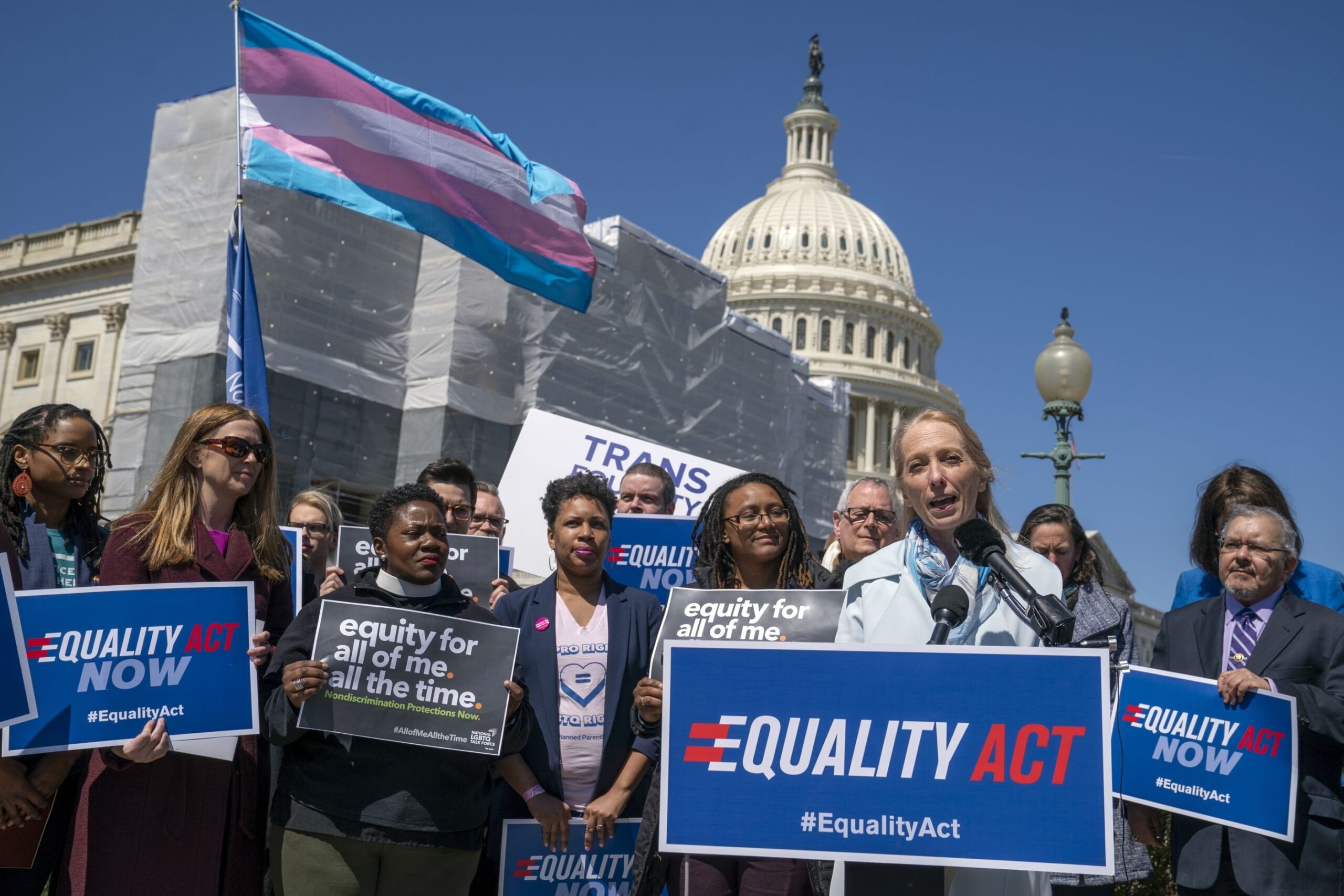
But at the same time, a federal bill to extend civil-rights protections to LGBTQ people across the country has already passed the House. If it passes in the Senate and is signed by the president, all of the statewide attacks would be eliminated in one fell swoop.
The stakes are as high as they have ever been, activists and grant makers say.
“There’s actually a real shot for the first time in two generations to get a federal bill over the line,” says Kasey Suffredini, CEO of the Freedom for All Americans Education Fund, an advocacy group that is leading the effort to educate moderate and conservative U.S. senators about the inequities LGBTQ people face. “We’re focusing all of our time and energy into seizing this opportunity that our movement has never had before.”
Suffredini’s group is able to focus on that singular goal, thanks in part to the $6.5 million that Freedom for All Americans and its partners have received from a coalition of donors since the election of President Biden. The Evelyn & Walter Haas Jr. Fund contributed $3.2 million, and the Gill Foundation gave $1 million. Both philanthropies have long supported LGBTQ rights.
To help get the bill passed, Freedom for All Americans and the donors are turning to the playbook they forged in the successful decade-long effort to secure the right for gay people to marry, Suffredini says. “We’re lucky that we have prior experiences working together on big efforts like the marriage effort to bring those lessons to the table, to make sure that we take full advantage of this moment.”
‘Bolder Together’
Freedom for All Americans was founded in 2015 right after the Supreme Court decision legalizing gay marriage. The push for marriage equality was successful in part because it was led by Freedom to Marry, a single organization focused entirely on the issue with lots of help at the state level, says Matt Foreman, senior program director at the Evelyn & Walter Haas Jr. Fund, who also worked on marriage equality.
Freedom for All Americans became that point group for LGBTQ civil rights.
For grant makers, having a single group leading the effort helped to focus funding, Foreman says. “There weren’t any free-floating grants hanging out there; It was all part of a coordinated campaign.”
During the fight for marriage equality, donors and activist groups learned to collaborate, and the small and tightly connected group of donors worked well together, says Cathy Cha, the Haas Fund CEO. “We’ve all benefited from a fundamental concept that we can be stronger, more transformative, bolder together than any of us in our narrow lane,” she says. “The coming together of ideas and money in concert with movement leaders has been a bit of a culture for LGBT funders that I think many other sectors could learn from.”
By cooperating, grant makers can identify and fill gaps in funding and avoid duplicating efforts, says Scott Miller, co-chair of the Gill Foundation. “Philanthropy isn’t necessarily known for being nimble,” he wrote in an email. “But we’ve overcome that through building trust, communication, and strength in numbers.”
Different Conversations
Activists have been pushing for LGBTQ protection from discrimination for decades. The first federal bill that would have added sexual orientation to the Civil Rights Act of 1964 was introduced in 1974. More than a decade ago, many activists thought that they would obtain civil rights before the right to marry, Foreman says.
The effort to win marriage equality wasn’t smooth. Activists lost many state-level battles. In 2008, Proposition 8 in California, which defined marriage as between a man and a woman, was approved — perhaps the movement’s highest-profile failure. That was soon followed by another loss in a ballot initiative in Maine in 2009 that repealed a new law granting same-sex couples the right to marry. But three years later, Maine voters approved marriage equality in a ballot initiative.
The key difference between the losing and winning efforts is who the advocates were communicating with, says Fran Hutchins, executive director of the Equality Federation, which works with a network of 40 state groups to advocate for LGTBQ rights. In California in 2008, they tried to win by only firing up the people who were already on their side — but they found out those voters were not enough to help them win.
Hutchins says that when they went to Maine, they started talking to different people. “After Prop 8, the marriage movement changed,” she says. “The entire 2012 campaign in Maine was based around having conversations with folks who were not with us.”
That lesson is proving particularly valuable now. With an evenly divided Senate, talking only to supportive law makers won’t be enough to get legislation passed. “We’ve got to have conversations with people in the Senate who have concerns,” she says.
The act has already received support from some groups that traditionally back conservative causes, including the U.S. Chamber of Commerce and the National Association of Manufacturers. Three Republican lawmakers — along with every Democrat — supported it in the House, although that is down from the eight Republicans who supported it in 2019.
Human Approach
Activists also learned important lessons about how to talk about their issue and what messages resonate with people who may not know any transgender people, for example. Initially, gay-marriage activists talked about the rights that people lose if they cannot marry, Suffredini says. But those messages failed to resonate with people who were not ardent supporters. Eventually advocates realized the message was wrong.
“This is about people, right? This is about your neighbor, your friend, your family member, your co-worker, the people who pray with you. These are real human beings. Some themselves are Democrats, some Republicans. Some themselves are people of faith. Some are not. And when we get people to just think about their neighbors, then they want to see their neighbor treated the way they want to be treated,” Suffredini says. “That’s the number-one lesson.”
Advocates working on the Equality Act are taking the same approach. They are jettisoning wonky rights arguments for something more human that they feel will resonate with lawmakers of both parties, but particularly moderate Republicans. “Do we or do we not as a country believe that LGBTQ people are human and should be treated with basic dignity and respect?” Suffredini says. “This issue is about values. It’s not about the policy or the politics.”
Taking a long-term approach has also been helpful, says Hutchins with the Equality Federation. The state-level groups she works with have already had more than 150 meetings with lawmakers over the past few years. That has helped to lay a foundation for the work that is happening today. Activists have developed skills working at the state level that they can apply to work with federal lawmakers — something that has allowed them to quickly pivot to pushing for this issue in the Senate now.
“The philanthropic sector can create that runway where we are building support up until the point where we have an actual piece of legislation to tack onto,” Hutchins says.
The Gill Foundation takes a long-term perspective to funding for LGBTQ rights but assesses progress often so it can adjust course quickly, Miller says. The foundation funds in six- to 18-month increments and evaluates what is successful and what is not. “It’s how we learn and iterate to hone our strategies, cut any losses early, and find the success factors to scale,” he says.
Foreman with the Haas Fund says he is optimistic that the effort to advance the Equality Act will be successful.
“We’re following a playbook that worked very well for us with marriage equality,” he says. “There is a window of opportunity here, a very short, a very narrow window of opportunity that we all feel needs to be seized.”