More Than 75% of Voters Want Charities to Get a Bigger Say in Policy Making, Poll Finds

By Alex Daniels
Senior Editor, Foundations
September 22, 2016 | Read Time: 4 minutes
Washington
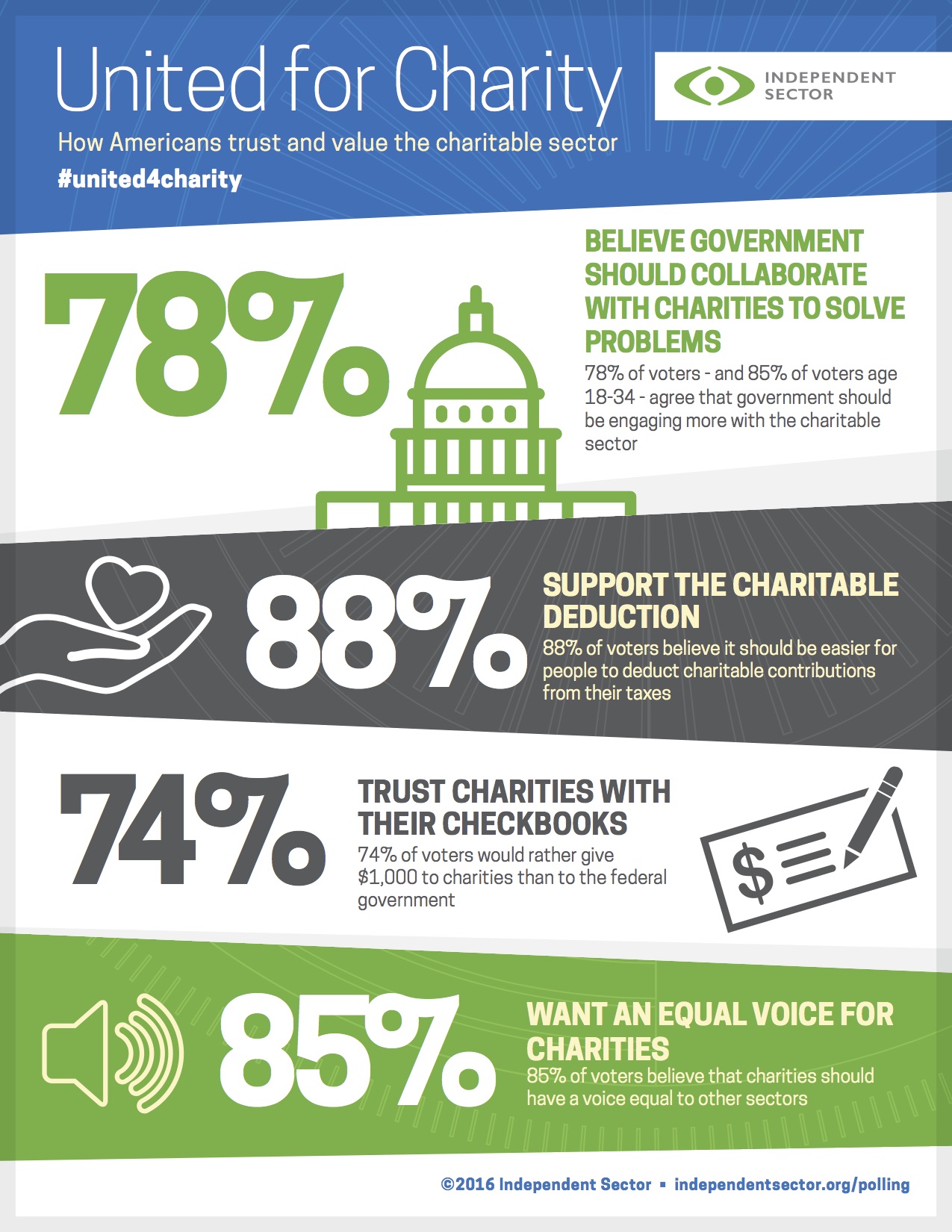
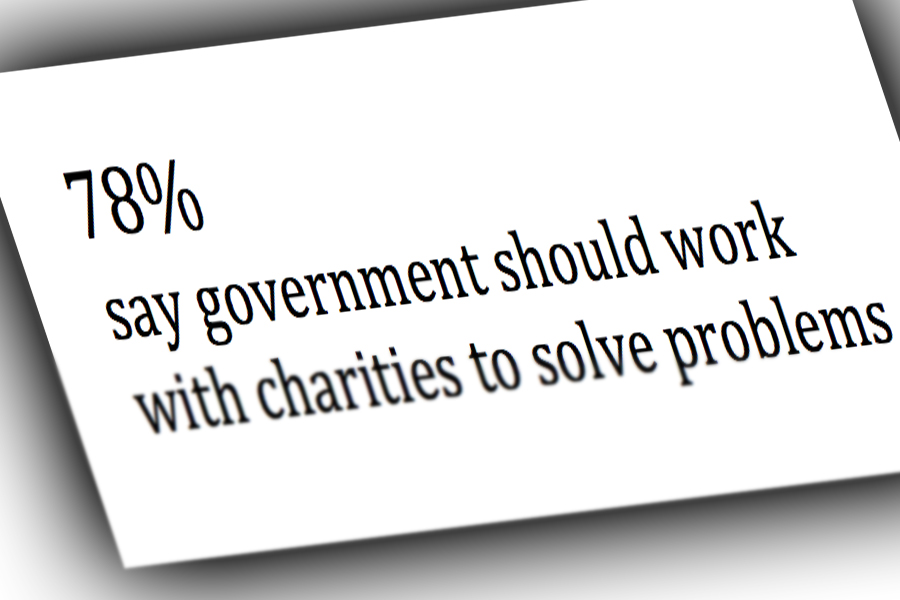
More than three-quarters of American voters believe charities and foundations should have more sway in the policy making process, according to a poll released today by Independent Sector, a coalition of charities and foundations.
The group hopes the poll will persuade candidates for office to broaden tax incentives for charitable giving and relax lobbying rules for nonprofits, so they have as much access to lawmakers as businesses. “We shouldn’t have a discounted role,” said Daniel Cardinali, president of Independent Sector. “There’s a very clear mandate that says nonprofits should be on equal footing as business.”
The poll of 1,300 voters was conducted in March and included 500 voters in “battleground” states in the presidential election. It found that 74 percent of voters trust charities with their money more than they do governments and want to expand access to charitable giving. Seventy percent said they were more likely to vote for a candidate who supports policies that allow nonprofits to get more involved in policy making.
About 88 percent said it should be easier for people to deduct charitable contributions from their taxes.
Mr. Cardinali said members of Democratic presidential nominee Hillary Clinton’s campaign were “quite receptive” to the polling data. Republican nominee Donald Trump’s campaign has not responded, Mr. Cardinali said.
He said he hopes both candidates, as well as candidates for other federal and state offices, heed the poll results and listen more closely to nonprofits.
“Often in our experience, we are brought in after polices are determined and asked to be a mouthpiece to support them,” said Mr. Cardinali. “We really hope it influences how they think about governing,” he said.
New Policies
Mr. Cardinali said Independent Sector will use the results to push for several policies:
- Allow taxpayers who do not itemize their tax returns to claim a deduction for charitable gifts.
- Clarify rules to encourage more lobbying by nonprofits. Nonprofits can advocate for causes, but they may spend only a small part of their budgets lobbying for specific pieces of legislation.
- Create a “presidential community systems solutions challenge” so charities can compete to develop ways to work with government agencies to achieve social progress.
Currently only about 30 percent of taxpayers — mostly those in higher income brackets — itemize their tax returns, allowing them to claim deductions for gifts to charity. In addition to allowing people who don’t itemize to claim a write-off for charitable contributions beyond the standard deduction, Independent Sector would like to create “charitable-giving accounts” where taxpayers could set aside some income on a pre-tax basis that they would use to make charitable gifts. Earmarking money for an account could provide an incentive to give, according to Independent Sector, and would reduce a taxpayer’s adjusted gross income and resulting tax levy.
From 1982 to 1986, taxpayers who did not itemize their returns were allowed to claim a deduction for charitable gifts. According to a 1999 study published in National Tax Journal, 45 percent of people who didn’t itemize claimed the deduction in 1986, when gifts were 100 percent deductible. As a result, the federal government lost more than $13 billion in tax revenue.
More recently, in 2013, the Committee for a Responsible Federal Budget estimated that allowing everybody to deduct charitable gifts would result in a $70 billion loss to the U.S. Treasury. But if deductions for those who don’t itemize were only allowed for donations that exceeded 2 percent of a taxpayer’s adjusted gross income, the government would add about $175 billion in tax revenue, the committee estimated.
Mr. Cardinali played down the impact of the proposal on tax revenues, saying all taxpayers should benefit from the charitable deduction.
“Our goal is to incentivize as many citizens as possible,” he said.
Candidates’ Plans
Independent Sector’s push for an expanded charitable tax incentive comes as the presidential candidates flesh out their plans in anticipation of a broad tax debate early in the next administration.
The Alliance for Charitable Reform, of which Independent Sector is a member, said it was “disappointed” in a cap on all deductions, including charitable deductions, that was included in details of the tax plan Mr. Trump released last week. Ms. Clinton would exclude the charitable tax deduction from a cap.
Mr. Cardinali stressed, however, that each candidate’s tax proposals should be looked at in their entirety. He said Independent Sector will release an evaluation as soon as next week.
Independent Sector will urge its members to use the poll when they talk to federal and state lawmakers to “aggressively campaign for a seat at the table” during policy discussions, said Jatrice Martel Gaiter, executive vice president for external affairs at Volunteers of America.
Ms. Gaiter, who serves on Independent Sector’s policy committee, pointed to the creation this year of the federal Commission on Evidence-Based Policymaking. The commission does not have a requirement that any of its 15 members represent nonprofits, yet it is poised to recommend procedures for data collection for nonprofits that work with the federal government, Ms. Gaiter said.
“We don’t want to be handed a set of rules and guidelines without our input,” she said. “If we’re going to be ruled by this, we’re going to need more money to be able to train our staff, to collect data, and to interpret data.”