July 14, 2014 | Read Time: 4 minutes
At most corporations, an $800,000 grant would be heavily vetted and reviewed by any number of committees and executives.
But at VMware, a Silicon Valley software company, one or two of the company’s top engineers each year get to direct $800,000 to endow a scholarship, at the university of their choosing. The CEO chooses the winning employees, who become “VMware fellows”—the company’s highest honor for technical achievement.
The program is just one example of how some Silicon Valley companies are revamping corporate giving by including employees in the decision-making process.
Maeve Miccio, vice president for corporate responsibility for the Silicon Valley Community Foundation, says that handing the grant-making checkbook over to employees is a way for companies to stand out as they try to attract the most talented job applicants.
“They see employee engagement as a tool to attract and retain top talent, and a lot of the companies here are taking that engagement to the next level,” she says.
Many Chances to Give
The foundation has a team of 15 people who help companies, including VMware and LinkedIn, carry out their giving programs.
On their first day of work, VMware employees get to make a $25 donation to the charity of their choice. After a year, they get another $50 to give away, and after 12 years of service, they’re allowed to designate a $12,000 grant.
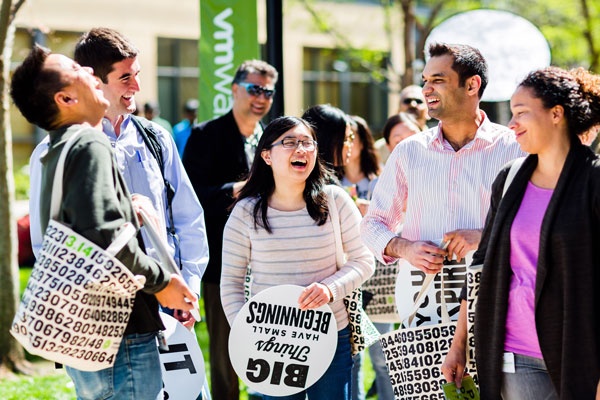
On Pi Day, March 14, the company hosts a service-learning fair where employees can connect with participating charities. VMware caps off the day by donating $31,415.92 to local nonprofits. Employee votes determine how the company “slices the pi.”
The company gave each of its 14,000 employees a $100 gift card during the holiday season to use on GlobalGiving, a nonprofit website that connects donors with grass-roots projects around the world.
And every year, employees get a 40-hour week of paid time off to volunteer.
“Our ethos is about flipping the model upside down,” says Nicola J. Acutt, vice president for global community affairs at VMware’s foundation. “It’s not the typical approach with senior executives reviewing the grants that come in. We’re giving our people the platform and the permission to express what they care about.”
In the company’s flagship grant-making program, Kernel & Cache, a VMware employee teams with a nonprofit to write an application for money and volunteerism and, if appropriate, a software donation. (VMware specializes in virtualization, a critical part of cloud computing.)
In one project, in Australia, a team of 11 VMware employees helped Sydney Metropolitan Wildlife Services upgrade its data-management systems to improve local planning and animal research.
A new effort, called Group Gigs and Grants, will deploy teams of employees to developing countries to tackle technology projects. In a pilot project in Vietnam, seven engineers ran an afterschool information-technology program for orphans, designed to give them concrete job skills.
Innovation Grants
LinkedIn also allows employees to steer much of its grant-making. Fourteen employees, none of them senior executives, oversee the grants distributed through a donor-advised fund that LinkedIn maintains at the Silicon Valley Community Foundation.
Employees with favorite nonprofits can help them apply to the fund for Innovation Grants, which provide $10,000 to each of 50 charities a year that are trying something new. Shreya Oswal had been volunteering at the Boy & Girls Clubs of the Peninsula for three years when she began working with the head of the organization to try to obtain a grant from LinkedIn.
The clubs won one of the $10,000 grants, which was used to support an after-school program that mimics a design studio. In the program, students took on challenges, like designing a shoe for walking on the moon, and got a taste of what a job in design might be like.
“I thought it was the perfect opportunity for LinkedIn, since the company is all about career development and career success,” Ms. Oswal says.
Meg Garlinghouse, the head of LinkedIn for Good, which connects employees and members with volunteerism and giving opportunities, says the innovation grants are intended to motivate employees while benefiting nonprofits. “It’s a way for the employee to feel proud and impactful and hopefully inspire them to stay involved,” she says.
Gifts to Employees
LinkedIn also offers $3,000 awards directly to employees who are trying to transform themselves, their families, their communities, or their world. Anand Dave, a Chicago employee, used one of the awards, called a Transformation Grant, to travel to parts of India where cameras are uncommon and give people a first picture of themselves and their families.
“It’s not straight-up philanthropy, but it’s definitely creating good in the world,” Ms. Garlinghouse says. (Neither LinkedIn nor VMware agreed to disclose the full financial details of their corporate giving.)
LinkedIn employees have also started some of the company’s signature volunteer programs. A Dublin employee started Calling for a Cause, which taps sales team members to call former donors to a charity to request more support. The first effort raised 20,000 euros for Plan Ireland, a community-development group. The company has since held similar events for 20 charities, raising more than $1-million, Ms. Garlinghouse says.
Another effort, Recruiters for Good, has used LinkedIn employees to help “crowdsource” individuals to fill open executive positions at nonprofits. The program has helped fill 17 positions, including that of manager of Chicago operations for Playworks, which works to improve school-recess programs.
“Employees love participating in this,” Ms. Garlinghouse says. “And the nonprofits are over the moon.”