27% of Groups Scored by Charity Navigator Will See Ratings Change

By Eden Stiffman
Senior Editor
May 27, 2016 | Read Time: 4 minutes
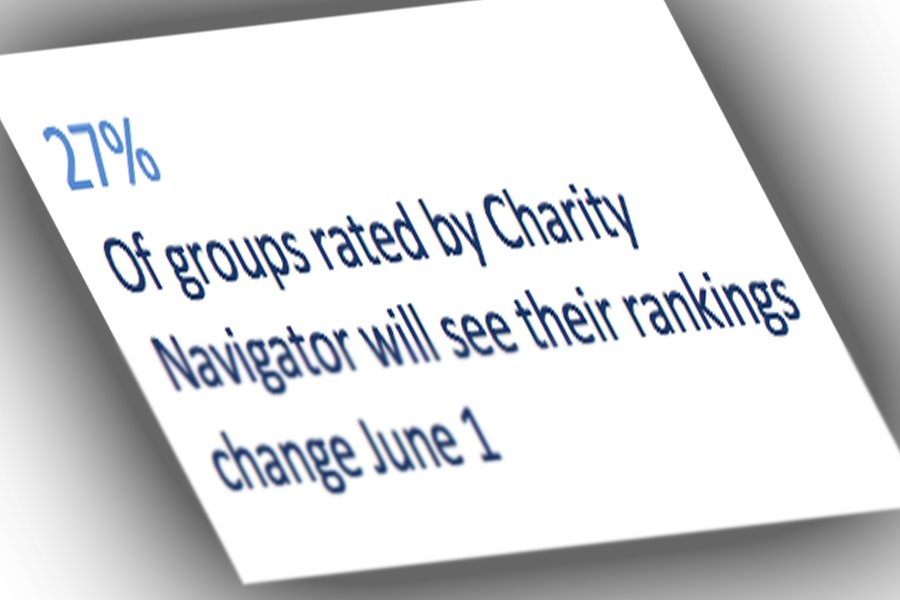
More than one in four nonprofit organizations rated by Charity Navigator will see their rankings change Wednesday.
In an effort to better evaluate charities’ financial health, the influential and controversial watchdog group revised its system, adding new criteria and changing several others.
Charities can earn up to four stars on the ratings site. Of the 8,000 groups Charity Navigator rates, 19 percent will earn an additional star; 8 percent will lose one.
The five changes include:
- Giving more leeway for non-program costs. Charities were previously unable to earn a perfect score if they reported any administrative or fundraising costs. Now, charities can report some overhead spending and still earn the maximum 10 points for that measure if they spend 85 percent of their budgets on programs.
- A new measure of financial capacity. The new criterion is intended to assess an organization’s long-term sustainability and signal to donors if it presents a greater financial risk. The “solvency ratio” measures total liabilities divided by total assets, looking only at the charity’s most recent Form 990 data.
- An effort to provide donors a better sense of charities’ financial performance over time. In the new system, scores for five of Charity Navigator’s seven financial criteria will be based on three-year averages. Previously, financial ratings took into account one year of data for percentage of budget spent on programs, administrative costs, fundraising, the fundraising-efficiency ratio, and working capital. Under the new system, if a charity needs to buy a new donor database at a significant one-time cost, for example, that one year will have a lesser impact on a group’s rating.
- Eliminating consideration of revenue growth. Because charities have to recognize pledges and grants in the year in which they’re promised, this measure could create the appearance of large swings in revenue, unfairly rewarding or penalizing a charity that may have actually received the money in installments over several years.
- Eliminating the “deficit adjustment” measure. Previously, Charity Navigator would reduce a charity’s percentage of spending on programs if the charity ran a deficit over time. That measure will no longer be used because donors and charities found it confusing and inconsistent.
‘A Great Start’
Charity Navigator’s leader, Michael Thatcher, is optimistic about the changes’ impact. “There is more to do but this is a great start,” he said.
For the first time, the evaluation criteria will enable charities to earn a perfect 100-point score — and 49 charities have done so.
Fourteen charities will see their ratings increase by two stars and two organizations, the Law Enforcement Legal Defense Fund and the National Police Defense Foundation, will see their ratings decline by two stars due to a low program-expense ratio.
Mr. Thatcher says his goal was to take a collaborative approach in adapting the ratings. “CN 2.1,” as it’s called, comes after a long-term review of Charity Navigator’s financial rating system. The process involved collecting feedback from rated charities and the guidance of financial and general advisory panels.
In early May, Charity Navigator sent an email to each nonprofit it evaluates, notifying them of the impending changes. A webinar explains each of the moves in more detail.
‘Makes No Sense’
So far, the response has been positive, Mr. Thatcher says: “A lot of people are saying thank you for doing this.” But some groups that were recently awarded a four-star rating are disappointed to lose it thanks to the new system. Such groups will get a note on their profile alerting donors that the downgrade was due to the watchdog’s rating changes. Historical ratings will remain unchanged.
JDRF International, a grant-making group aiming to find a cure for Type 1 diabetes, will see its star rating decrease from three to two. The charity’s staff members are concerned that the new “solvency ratio” measure rewards nonprofits with large endowments while penalizing those that make grants.
Gary Curto, the organization’s tax and regulatory compliance manager, says the new metric “makes no sense whatsoever.”
“The ratios really benefit groups that get a lot of money, hold it on the books, and invest it,” he said. “When people give us donation money, they want it put to work.”
Because Charity Navigator got rid of its revenue-growth measure, Mr. Thatcher felt it was important to add another sort of criterion to gauge organizations’ financial fitness. He acknowledged that the new ratio is limited by the information charities provide on the Form 990.
Ken Berger, who led Charity Navigator prior to Mr. Thatcher and was involved in updating the rating methodology, says the changes are “a step in the right direction.” Still, the watchdog group remains focused on what he calls “secondary measures” of charity effectiveness.
Charity Navigator continues to develop “CN 3.0,” its results-reporting effort that was put on hold in January. Staff members will continue to review results data reported by the charities the group rates, Mr. Thatcher said. The goal is to launch a version of the watchdog’s ratings that incorporate impact evaluations by July 2017.