

May 25, 2016 | Read Time: 8 minutes
OAKLAND, Calif.
In February 2015, Jackie Downing received a telephone call that made her jaw drop.
The director of donor relations at the San Francisco Foundation, Ms. Downing was on the line with a philanthropist who described a grand vision. The East Bay resident hoped to give $34 million anonymously to Oakland charities that serve struggling communities.
The deadline to select recipients and announce the gift? Three months.
The proposal came at a tenuous time for Oakland. For decades a cultural and political enclave for African-Americans, Latinos, and Asians, the city is in the throes of big changes. The Bay Area’s flourishing technology sector has delivered a flush of new money and development but has also driven up costs, creating “two worlds within one city,” Ms. Downing says. Oakland ranks on top-10 lists for best restaurants and highest rates of violence. White children born in its hills have a life expectancy that’s 15 years longer than their black counterparts born on its west side, according to the Alameda County Public Health Department. Census figures show the city has lost tens of thousands of black residents in the last 15 years.
Against this backdrop, the donor wanted the gift to help all community members benefit from new economic opportunities.
For Ms. Downing, an Oakland resident herself, the proposal was “exhilarating.”
“This was bold and different and very exciting,” she says.
For grantees, it had the potential to be transformative. Nearly a year after the gift was announced, nonprofits and government agencies are putting those dollars to work to lift up Oakland communities before they’re left behind.
Donor Shuns Limelight
As soon as Ms. Downing hung up the phone, she ran to share the news with foundation chief executive Fred Blackwell.
“My initial reaction was to go back and ask Jackie to make sure what she said was correct,” he says.
It was. Ms. Downing met with the donor soon thereafter to learn more about what inspired the large gift. The essential questions: Why Oakland? Why the tight deadline? Why the anonymity? And why $34 million?
With tech wealth creeping north from Silicon Valley and east across the bay from San Francisco, the donor feared that the disparities that plague Oakland would widen. “A large infusion of capital at this moment in the city’s history could make a difference for the city’s residents,” Ms. Downing says of the donor’s thinking — especially for “families that have struggled with poverty for generations.”
The philanthropist “didn’t have a personal need for recognition and wanted to set the nonprofit leaders in the limelight,” Ms. Downing says, and also “felt that mystery would create excitement.” (The donor declined, through Ms. Downing, to be interviewed or to provide a statement.)
As for the generous, specific sum, “That was the amount chosen by the donor,” she says simply. “That’s all I think I should say.”
Philanthropic Matchmaking
Finding the right nonprofits to accomplish the donor’s goals was a challenge that suited Ms. Downing. She had previously worked as co-director of World Bridges, which cultivates leadership skills among young, low-income minorities throughout the Bay Area, and as head of the individual donor program at the Gay-Straight Alliance Network. At the San Francisco Foundation, she sees herself as a “philanthropic matchmaker” who pairs high-net-worth donors — she calls them “clients” — with like-minded charities.
To help Ms. Downing distribute $34 million, foundation executives assembled experienced staff members from various departments as well as a few former employees.
They sought outside advice, too. The donor wanted to hear about City Hall’s priorities. So Mr. Blackwell put in a call to Oakland Mayor Libby Schaaf to ask what was on her wish list — without revealing how much money was on the line.
“We wanted the early phases of this to be really quiet without the anxiousness of whether a grant was coming to somebody,” he says.
The foundation team cross-checked the mayor’s priorities with those of other grant makers to identify urgent causes. To narrow the list of potential recipients, the foundation used guidelines set by the donor, whom Ms. Downing says wanted to support nonprofits and public programs with long track records of success and “strong, visionary leaders who truly know the community and know what it takes to get work done.”
Because the donor planned this as a one-time gift, the foundation looked for organizations that would benefit from a single, large grant, such as those purchasing real estate, or those that could use the money — sure to be highly publicized after it was announced — to attract dollars from other sources.
The foundation also hired a financial consultant to analyze the fiscal health of potential recipients, and to assess how a large influx of cash would affect them. When they’d come up with a list of finalists, including both nonprofits and government agencies, Ms. Downing and her colleagues contacted each and invited them to apply for a specific amount of money.
The charities were instructed to keep the invitation secret.
“The secrecy was both exciting and scary,” says Regina Jackson, chief executive of the East Oakland Youth Development Center. “We have never been invited to apply for a grant in this way.”
Ms. Downing was impressed by how quickly potential grantees responded.
“It was a very tight turnaround, and they understood it was a big opportunity worth their time,” she says. “The nonprofit leaders were amazing, and they dropped everything to provide large amounts of information.”
The foundation staff was also pressed by the donor’s tight deadline. For months, Ms. Downing worked until midnight most nights — “happily,” she says.
To make final decisions, Ms. Downing and Mr. Blackwell presented the donor with binders full of profiles of the possible nonprofit recipients.
“We presented every project to the donor in detail,” she says. “The donor just got so excited and trusted us so much.”
Day of Surprises
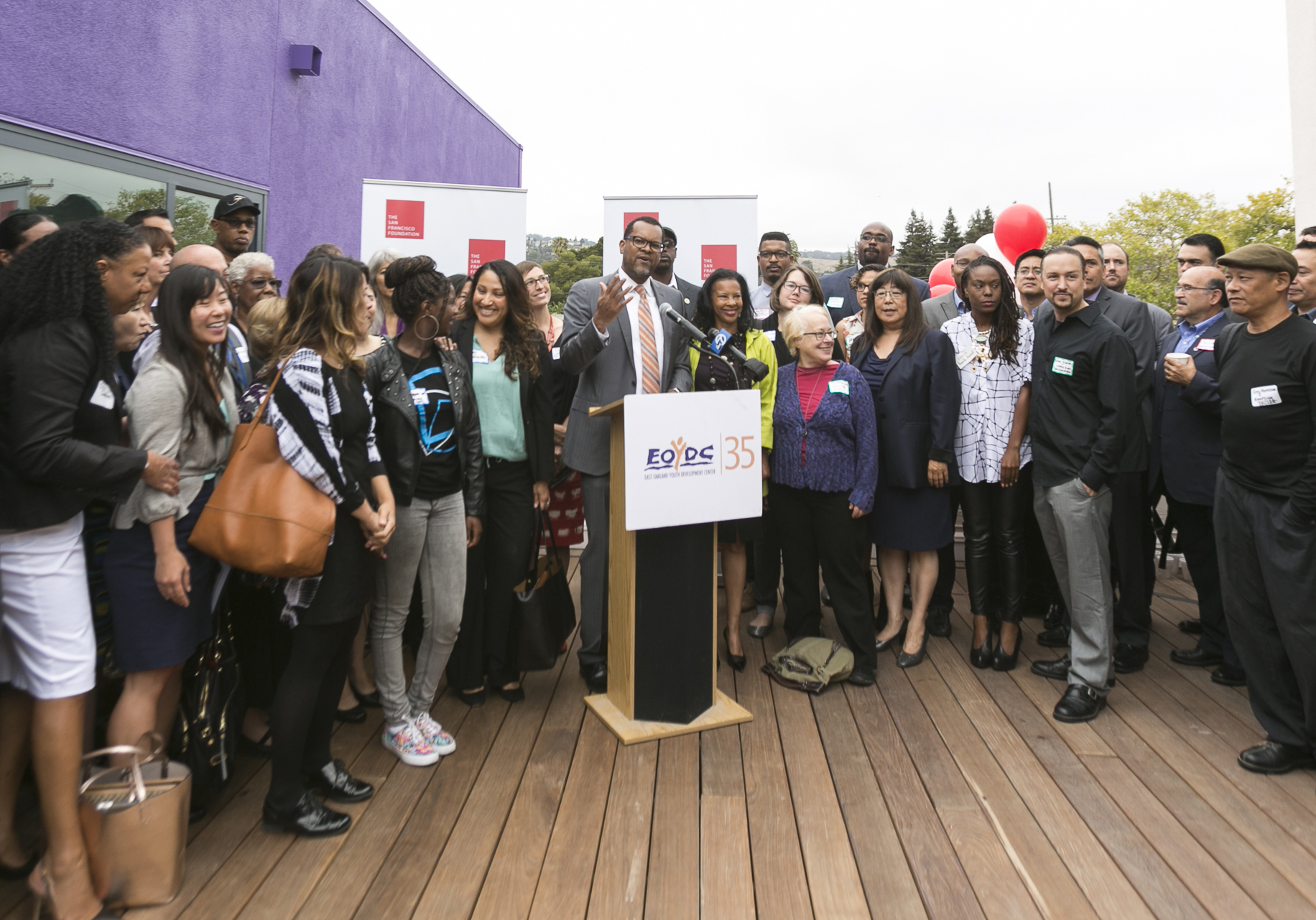
After three months, the foundation was ready to unveil the big donation. It told the applicants to show up at the East Oakland Youth Development Center on July 14 but provided no other details.
Representatives from each organization arrived to find, to their surprise, a gathering of colleagues and friends.
A much bigger shock was yet to come. Mr. Blackwell announced to the audience that an anonymous donor was investing $34 million in groups and projects that serve Oakland.
They included the development center, which received $1 million to renovate and expand its facilities; Restore Oakland, a project of the Ella Baker Center and Restaurant Opportunities Centers United, which got $1 million to build a center to host a conflict-resolution program that’s an alternative to the court system and a food-service career-training program, both designed to provide opportunities and keep people out of prison; California School-Based Health Alliance, which received $2 million to support trauma-care programs at school health centers; and Oakland Codes, a coalition of seven Oakland nonprofits that got $4 million for its members’ work on technology education.
“It was like a dream come true,” Ms. Jackson says. “It is tough enough to raise capital dollars for a campaign such as ours, but when a donor falls out of the sky, or instantly appears, it is an indescribable sensation.”
Later, Ms. Downing and the donor watched a video of the news conference.
“It made the donor so happy to see the city so happy,” she says.
Serving a New Oakland
What will $34 million do for Oakland? The San Francisco Foundation projects it will serve 62,570 people, support the construction of 731 new affordable-housing units, and help create more than 2,500 jobs.
The $1 million given to Restore Oakland came at an “opportune time,” says Zachary Norris, executive director of the Ella Baker Center. The money paid for a feasibility study and will help purchase a building to house the project.
“I’ve seen Oakland change in the last five years in ways I haven’t seen my whole life,” Mr. Norris says. “As there is new economic development in the Bay Area, we want to make sure that there is equal access to the fine dining jobs.”
And there are indications that the anonymous gift did indeed spur further funding.
Getting the grant helped the California School-Based Health Alliance vie for a federal grant from the Office of Juvenile Justice and Delinquency Prevention, says Juan Taizan, the group’s associate director for programs.
“We felt better positioned to go after that funding because of the funds and the work that we started” through the San Francisco Foundation grant, he says.
The foundation also earmarked money from the gift to pay for program assessments that might help grantees win money from other grant makers. For example, $50,000 of the $500,000 received by the Hidden Genius Project — one of the Oakland Codes groups — was designated for hiring an external evaluator.
As for the gift’s effect on the San Francisco Foundation, several new clients have opened accounts since the announcement last year. And it challenged Ms. Downing and other staff members to make the most of an opportunity to help a city they care about.
“The donor was on fire about these issues,” Ms. Downing says. “Honestly, I feel the exact same way.”





