
A Chain of Nonprofits Lends Volunteers the Tools They Need to Lend a Hand

By Michelle Gienow
Contributor
September 16, 2012 | Read Time: 5 minutes
For the past 20 years, the Atlanta Community ToolBank has regularly provided equipment for massive service projects for local charities. Whether power tools or pliers, wheelbarrows or wire snips, the ToolBank rents equipment to any charity, church, school, or other group with a project in mind and volunteer labor lined up to swing the hammers.
The tools come in handy during volunteerism events, such as those held by companies like Delta and Coca-Cola, that involve a thousand or more participants. The Atlanta ToolBank can, and frequently does, supply a dozen projects of that size in a single weekend; in 2011, the organization equipped 46,401 volunteers working on 1,750 projects.
Back in 2007, the Atlanta group’s chief executive, Mark Brodbeck, began to notice that mobilization of such massive volunteer projects was the exception rather than the rule.
When he spoke with companies in other cities about their service days, he says, “they would proudly say, ‘We had 75 people turn out. It was huge!’ It had never occurred to me until then that these very large-scale volunteer projects were not happening elsewhere.”
A ‘Force Multiplier’
Atlanta’s ability to mobilize so many volunteers, Mr. Brodbeck realized, boiled down to one factor: the availability of equipment. So he and his organization decided to do something about it.
He persuaded his group’s corporate sponsors to create an affiliated network of nonprofit tool-lending programs across the nation. In 2008, the Home Depot Foundation gave a two-year, $250,000 grant to start the nonprofit ToolBank USA.
Starting in 2011, the organization has duplicated the Atlanta model with new ToolBank chapters in three other cities; four more affiliates are set to open in the coming months.
“We’ve all been on volunteer projects, standing around waiting for someone else to finish with the hammer so you can drive a nail,” Mr. Brodbeck says. “The advent of ToolBanks around the country will put that to rest forever. ToolBank has force multiplier for any charity that comes through our door.”
Franchise Approach
The program takes a franchise approach to spreading its operations to other regions.
“We provide new cities with a turnkey ToolBank operating system,” says Mr. Brodbeck, including the ability to incorporate immediately as a nonprofit charity under ToolBank USA’s group tax exemption.
New affiliates are provided with the organization’s custom system for tracking tools online, Web hosting for registering member charities, and introductions to potential corporate donors. Even so, each new affiliate must assemble its own board and hire its own staff.
ToolBank USA has a full-time staff of five, and the group’s annual operating budget is just under $1-million. A third of that figure is earmarked as start-up funds for new ToolBanks.
“We provide initial seed money, but once they become incorporated it’s incumbent on them to raise their own funds,” Mr. Brodbeck says.
In 2011, ToolBank USA opened its first affiliate in Charlotte, N.C., as a test of its approach. Things went smoothly, and in June, chapters opened in Baltimore and Cincinnati. Two more—in Houston and Portland, Ore.—are set to open by the end of the year.
ToolBank affiliates in Phoenix and Richmond, Va., have begun the process of forming local boards and incorporating, and they should be ready to open in 2013.
The idea of opening two chapters a year is deliberate, because working to create two at a time is more efficient than starting one after another, says Mr. Brodbeck. And as more ToolBanks open, they create ever more potential benefits for the whole system.
“As we open the door on 10 and then 25 affiliates, we will have new scaling opportunities—for example, the opportunity to offer health insurance to ToolBank employees or maybe we do the accounting for all our ToolBanks,” says Mr. Brodbeck.
Many Benefits
For charities seeking to gain access to tools, the ToolBank system works like this: A nonprofit applies online for a free membership at [cityname].toolbank.org. It doesn’t need tax-exempt status with the Internal Revenue Service, but having it helps streamline the approval process. Once accepted, the group can reserve equipment up to 120 days in advance.
Tools are offered on loan for up to eight weeks, with a fee of 3 percent of the item’s cost for each week the item is borrowed. Thus, a $200 extension ladder can be borrowed for $6 a week, or $24 per month.
For charities, the initial benefit of a nearby ToolBank is affordable access to tools on an as-needed basis without having to buy or store them. But the far greater payoff is achieving greater volunteerism.
Maryland Therapeutic Riding, in Crownsville, Md., used volunteers from the Pat Tillman Foundation—and plenty of equipment from the newly opened Baltimore Community ToolBank—to build a new horse trail at the center, with outdoor stations that engage children with autism and other disorders in sensory-stimulating activities, like banging on a giant wind chime.
Without the easy availability of the tools, the project would not have been possible, says Marilyn Baker, the riding group’s executive director.
“Before the Baltimore ToolBank opened, we would not have been able to take advantage of this volunteer opportunity—we just couldn’t afford to equip them,” she says. “ToolBank is an incredibly valuable resource that makes it possible to do projects we always dreamed of, as well as maintain our facility in a cost-effective manner.”
As director of volunteers at United Way of Central Carolinas, Leslie Rink witnessed firsthand the multiplier effect a ToolBank can generate.
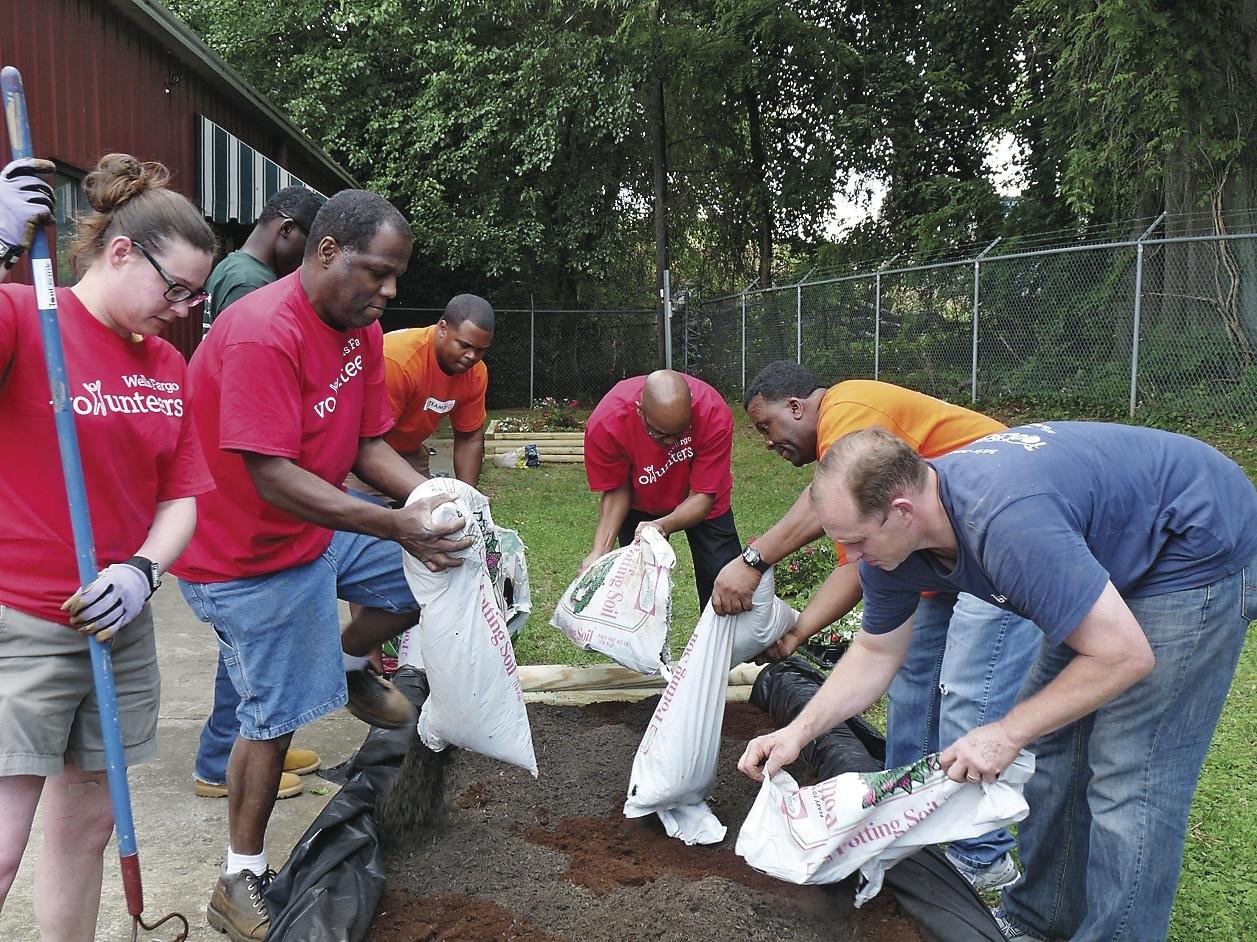
Ms. Rink works with Wells Fargo on the company’s “Annual Day of Caring.” In 2011, she says, 800 volunteers worked on nearly 50 projects.
A year later, however, the bank partnered with the Charlotte ToolBank, and Wells Fargo was able to involve nearly its entire Charlotte staff in the event, with more than 2,200 people volunteering for 100 projects.
“ToolBank just entirely removes one of the major challenges of coordinating a large volunteer project,” says Ms. Rink, now a board member for the Charlotte Community ToolBank. “The time, money, and effort we used to need just to get ready to do the work can now go directly into the work itself.”




