A Charity’s Move Into an Old Brewery Taps Hope for a Gritty Neighborhood

By BRENNEN JENSEN
Contributor
March 20, 2011 | Read Time: 6 minutes
Baltimore
On a dank winter afternoon, two leaders of Humanim, a social-services charity in suburban Columbia, Md., got lost driving around gritty East Baltimore. They were looking for office space to lease, but found so much more. They discovered their charity’s future in a hunk of the past.
It was six years ago, and Humanim had recently merged with a smaller job-training charity in Baltimore, an event that sent Henry Posko, the chief execuitive, and Cindy Plavier Truitt, the chief development officer, looking for a building to house the combined operations.
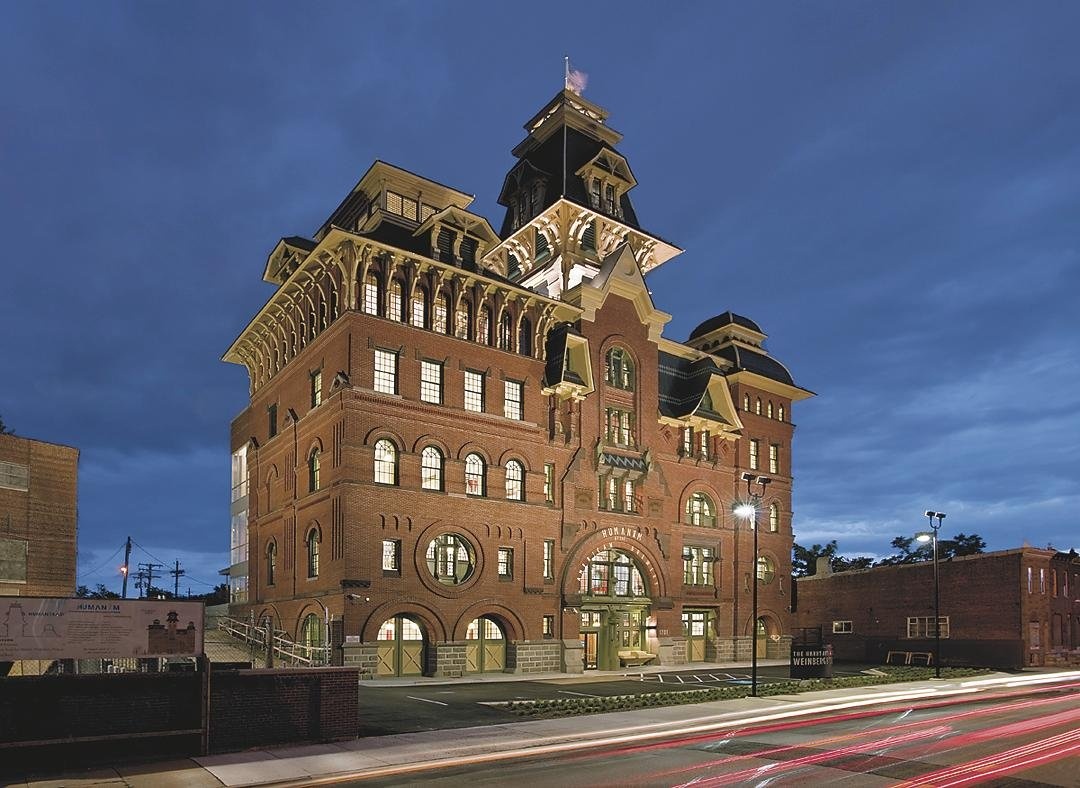
A few wrong turns lead them deep into a poverty-stricken area with blocks of battered row houses. Here they didn’t find an office building, but a ghost: a decaying and abandoned five-story brick edifice of exuberant Victorian design. It was the remains of a brewery built in 1887 and locally referred to as the American Brewery, after a brand of beer once produced there. It had been closed and boarded up since 1973.
“We were just in awe of the building,” says Ms. Plavier Truitt, describing how they ultimately pulled over and slipped inside the vacant structure through an unsecured plywood door. “It was dark and we were walking over debris and into inches of pigeon waste. But the more we got into the filth, the more we realized this was an amazing gem of an opportunity. The neighborhood around the building was just devastated, and we were intrigued by what restoring the building could mean for the community.”
Thus, an act of trespassing began what Ms. Plavier Truitt calls Humanim’s “roller-coaster ride”: —a three-year, $24-million effort to restore the brewery, which that came to fruition two years ago, when the charity moved about some 200 of its staff members from Columbia into the erstwhile home of American Beer. Here, the charity’s employees provide job training, outpatient mental-health and developmental- disabilities counseling, services for the deaf, and other functions.
The move has not only given those workers an unusual office, but also raised Humanim’s profile among both donors and the people it seeks to serve. It has also provided jobs in a struggling part of the city, and raised hopes for more neighborhood revival.
Award-Winning Design
The sweeping redesign, which was done by the Baltimore architecture firm Cho Benn Holback Associates, playfully preserves vestiges of the building’s brewing days, with a dismembered metal beer tank providing an impromptu cubicle, and various grain hoppers and conveyer systems retained as striking artifacts. The project has won more than a dozen awards from preservationist and architectural groups, including the American Institute of Architects, which named it “public building of the year” in 2009.
“The American Brewery is an iconic building that represents the best of Baltimore architecture and history,” says Johns Hopkins, executive director of Baltimore Heritage, which also honored the Humanim project last year. “Many of us in the preservation community had given up hope that it could be saved. Neighborhood kids literally crossed the street to avoid walking by the building because they swore bats the size of pit bulls inhabited it.”
The rush of design accolades caught the charity’s leaders a little off guard. “Humanim has received more notoriety in the last three years than we did in our first 30, and it’s all because of this project,” says Mr. Posko.
‘More Energy Now’
While the building’s many design awards are proudly displayed in the lobby, of greater importance is how Humanim’s high-profile new home has helped broadened the charity’s mission and enmeshed it in broader efforts to alleviate poverty. When housed solely in a leafy suburban office park, the charity was a “low-profile, under-the-radar” organization, says Mr. Posko. Those days are over, now that Humanim literally looms large over a deeply impoverished neighborhood.
“There’s just a lot more energy now, greater urgency,” Mr. Posko says. “We’ve had a unending stream of conversations with other nonprofits about how we might collaborate or form partnerships.”
For instance, Humanim has hosted meetings with Habitat for Humanity of the Chesapeake, a local branch of the housing charity, and other nonprofit housing developers about how they might work together to tackle the blighted housing stock in the shadow of the brewery. On some nearby blocks, nearly every house is boarded up.
“I think Habitat and other developers would love to do work around there,” says Mike Mitchell, head of Habitat for Humanity of the Chesapeake. “What Humanim has done is very dramatic and can be a way to propel a neighborhood toward transformation. They can be a catalyst, and Habitat wants to support that.”
Mr. Posko says he wasn’t totally unaware that moving into the brewery would thrust his charity into a community-development role. But he didn’t fully appreciate how that role would appeal to grant makers.
“Some funding sources could care less that it was a historic building,” he says. “Their focus was what we were going to do in terms of services from a location within a neighborhood that had seen such disinvestment.”
‘Bavarian Pagoda’
The first financial hurdle to rehabbing the brewery was perhaps the easiest. Humanim purchased the crumbling 30,000-square-foot brewery from Baltimore City for a mere $2,500. But the price tag to restore the building—a structure nicknamed the “Bavarian pagoda” because of its trio of slate-roofed towers and elaborate windows and brickwork—was initially pegged at $10-million. That figure more than doubled once the full architectural analysis was completed.
Because the building was listed on the National Register of Historic Places, it qualified for $14-million in state and federal historic tax credits. These funds, together with other government loans and grants, were an integral part of a complex financing package that also required nearly $7-million in philanthropic support. The grant makers that provided assistance included Baltimore’s the Annie E. Casey Foundation and the France-Merrick Foundation, both based in Baltimore, and the Kresge Foundation, in Troy, Mich. The Harry and Jeanette Weinberg Foundation, also in the Baltimore area, gave the largest single grant, of $2.75-million.
That generous gift led to the Weinbergs’ name being placed on the historic building. But Donn Weinberg, chairman of the group’s board, says his family’s foundation was not interested primarily in the brewery’s history or fanciful architecture.
“That it involved historic preservation was gravy, but not the meat, of the project,” Mr. Weinberg says. “We thought that Humanim’s leaving the comfortable confines of Columbia and consolidating operations within an economically devastated area was a good thing. You like to locate services where the poor people are.”
Humanim has hired more than 40 people from the neighborhoods around the brewery, many for its iScan division, a for-profit unit that trains and employs people to digitize paper records for businesses and government.
The economic downturn has dampened, but not stopped, Humanim’s efforts to improve its hardscrabble surroundings. The next building project is a 60,000-square-foot former bottling plant adjacent to the brewery. Humanim has talked with a nonprofit education group about opening a charter school in the space. Another idea is to convert it into a business incubator for start-up firms that pledge to hire workers from the neighborhood.
“We didn’t have any illusions that we were going to bring back the neighborhood overnight, or that people were going to move back just because we were here,” Mr. Posko says. “But the energy and buzz around this neighborhood has increased 10-fold. Moving forward, we can see using this as model of rehabilitation—taking iconic buildings in tough urban areas and saying, ‘It can be done.’ ”