
A Congresswoman Uses Lessons From Her Nonprofit Career to Build Support in Washington

By SUZANNE PERRY
Contributor
August 21, 2011 | Read Time: 8 minutes
Washington
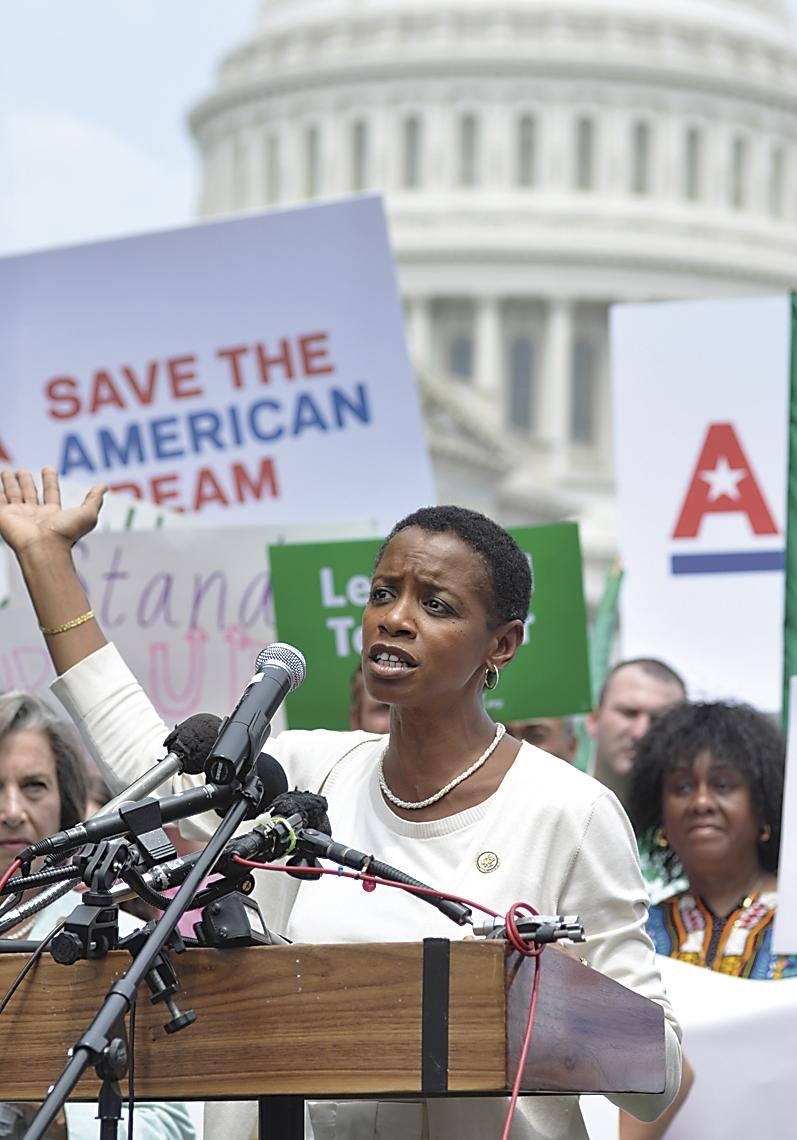
Donna Edwards is rushing toward the sound of cheers and jeers on a sizzling July day. The Maryland congresswoman, a former nonprofit leader who is now a prominent liberal voice on Capitol Hill, is about to address a protest rally on the topic that has consumed Washington this summer—the country’s growing debt.
Representative Edwards—an outspoken opponent of proposals to cut Social Security, Medicare, or Medicaid to reduce the federal deficit—tells a story as she walks.
“A mother and daughter visited me in my office,” she says. “And the little girl had fairly significant physical limitations and she needed a device so that she could speak. She didn’t have the ability to speak or to move her arms. She’s in a wheelchair, and the device allows her to use her pupils to project onto the screen so she can talk, she can communicate,” she says. “You run the risk with somebody like that that they won’t even be able to do those simple things to be slightly independent because you’ve cut back on Medicaid.”
When Ms. Edwards reaches the rally, she is ushered to the front of the crowd, where she is surrounded by signs that say “Don’t Destroy the American Dream” and “Ask the Millionaires and Billionaires if the Bush Tax Cuts Are Good for the Country.”
At the microphone, she attempts to stir the partisan crowd with a sharp attack on her Republican opponents.
“We cannot allow America to default on its obligations while we say to our Social Security recipients, women, our seniors, those who are on disability, children who’ve lost their parents, veterans, ‘We’re going to reach into your pockets instead of into the deep pockets of those who’ve gotten away with everything.’”
Early Years at Nonprofits
For Donna Edwards, 53, the path to Congress was paved by a nearly 20-year career in the nonprofit world. And the passion she had for working for others has carried over from her work as executive director of the Arca Foundation, a Washington grant maker.
Before joining Arca in 2000, Ms. Edwards, who has a law degree from Franklin Pierce Law Center (now the University of New Hampshire School of Law), worked as a lobbyist for Public Citizen, a consumer-advocacy group; executive director of the Center for a New Democracy, a now-shuttered nonprofit that worked for tighter campaign-finance laws; and co-founder and executive director of the National Network to End Domestic Violence, which led the effort to pass the Violence Against Women Act of 1994.
She plunged into politics in 2006, taking a leave of absence from Arca to vie for the Democratic nomination in a Maryland district that borders Washington. She was a political novice but says she was unhappy with the longtime Democratic incumbent, Albert R. Wynn—among other things, for supporting President Bush’s decision to invade Iraq—and could find no one else to challenge him.
She failed to get the nomination, but the vote was so close that she “became much more organized” and tried to win the seat again in 2008. This time she won handily and went on to win a special election after Mr. Wynn unexpectedly resigned before his term ended. She was the first black woman elected to represent Maryland in Congress.
During the primary contest, Ms. Edwards had to fend off charges connected to her work at Arca, which awards grants to social-justice and other liberal groups.
Mr. Wynn’s campaign filed a complaint with the Federal Election Commission alleging that the Edwards campaign had improperly coordinated with some Arca grantees that had endorsed her, including the League of Conservation Voters and Friends of the Earth. Ms. Edwards told the commission that she had no vote in the grant-making decisions made by Arca’s board and never recommended a group for personal or political gain. The panel ruled that the complaint had no merit.
Power of Political Office
Ms. Edwards says she loved working for nonprofits but appreciates “the power of the voice and the office” that she now enjoys as a lawmaker.
“Being a member of Congress is like a big bully pulpit for the things you feel passionate about,” she says, recalling that two decades ago she worked with a group that was pushing to overhaul the health-care system. “Then I get to come to Congress,” she adds, “and I preside over the health-care debate and [help] pass what is probably the most significant legislation we’re going to have in a generation that’s really going to make a difference in people’s lives.”
Steve Gunderson, the president of the Council on Foundations and a former Republican congressman, says Ms. Edwards brings to Congress some much-needed expertise about the philanthropic world, an area most lawmakers know little about. That, in turn, gives her some political power, he says: “Members of Congress by nature are generalists. When you are an expert in any area, you have an appropriate overabundance of influence in that particular area.”
Ms. Edwards says the skills that she cultivated during her nonprofit career have proven invaluable in her new role.
“The ability to digest a whole range of different issues at a time—a lot of that comes from reading proposals and being able to assess public policy and know what organizations to depend on for information,” she says.
Sometimes she turns to groups that she knows because they were Arca grantees—for example, the Center for Economic and Policy Research, which she says is doing “some of the best economic analysis around.”
The congresswoman, a regular guest on television news programs, is often asked how she developed her media skills, which she traces back to her early days as a nonprofit advocate.
“My first national interview was on ‘Nightline’ when I worked at Public Citizen,” she says. “It was a week after I started the job and it was talking about campaign-finance reform and I was debating Mitch McConnell” (who is now the Senate minority leader).
Dramatic Gestures
Ms. Edwards regularly attracts the spotlight with dramatic gestures.
She was arrested in 2009 for crossing a police line at the Sudanese Embassy to protest that country’s decision to expel relief charities from Darfur.
Last January she jumped into the icy Potomac River to help a Maryland advocacy group highlight the need for government action to fight climate change.
In April she joined 13 other congresswomen in a fast to protest proposed budget cuts they said would disproportionately hurt the poor and the hungry.
She has proposed a constitutional amendment to overturn the Supreme Court’s Citizens United ruling, which removed restrictions on corporate campaign spending.
As a relatively junior member of Congress, Ms. Edwards has not yet gotten any major legislation passed (though she has sponsored more than 20 bills).
She was named one of the “10 best members of Congress” by Esquire magazine, however, for successfully pushing for an amendment to last year’s health-care-overhaul bill to set up a mechanism for excluding insurance companies with excessive premium increases from participating in the new “exchanges” that will offer insurance to people without employer plans.
Personal Connections
But she also does more mundane work as a member of the Transportation and Infrastructure Committee and the Science, Space, and Technology Committee. On the day that she spoke at the debt rally, Ms. Edwards attended a meeting of the science committee and offered two amendments to a bill to authorize activities to combat “algal bloom,” harmful algae in aquatic systems.
Even in that work, she sees a lesson for nonprofit advocates: They should make sure that Congress understands how even seemingly arcane issues affect their communities. “You’re saying to yourself, ‘Algal blooms, huh? What are they?’” she says. “Then you realize it’s actually about whether people are going to be able to eat fish, whether the [Chesapeake] Bay is going to survive and thrive, and how we protect our environment.”
She adds: “We need those stories.”
She shows a flare for making personal connections following her speech at the July rally.
As she makes her way back to her office, Ms. Edwards stops every few feet.
She sympathizes with a pair of union women who ask about Federal Aviation Administration workers who at the time were furloughed because of a Congressional budget impasse. She is interviewed by Howard University Radio about the budget wrangling in Congress. She chats with a resident of Hyattsville, Md., who thanks her for “calling my house the other night.” (Ms. Edwards says she was referring to a telephone “town hall” about Social Security that drew 7,000 people from her district.)
And she tells a video crew from Campus Progress, a group that trains young liberal activists, that their viewers should follow the advice she gives her 23-year-old son: “This is not a time for sitting on your hands. It’s a time to be involved and be active and to care about what’s happening, not just in your community, but what’s happening in our country.”
Career Highlights of U.S. Rep. Donna Edwards
Donna Edwards was elected in 2008 as a Democrat to represent Maryland’s fourth district in the House of Representatives. Most of her previous experience was in the nonprofit world, including jobs as:
• Lobbyist, Public Citizen’s Congress Watch project, 1992-94
• Executive director, Center for a New Democracy, 1994-96
• Co-founder and executive director, National Network to End Domestic Violence, 1996-99
• Executive director, Arca Foundation, 2000-8




