December 4, 2011 | Read Time: 7 minutes
Detroit
A shopping cart nestles high in the branches of a tree. Piles of mismatched shoes litter the ground. A weathered piano sits on a street corner. Such items are common along a section of Detroit’s Heidelberg Street, in the heart of one of the nation’s poorest ZIP codes. But none of it is junk.
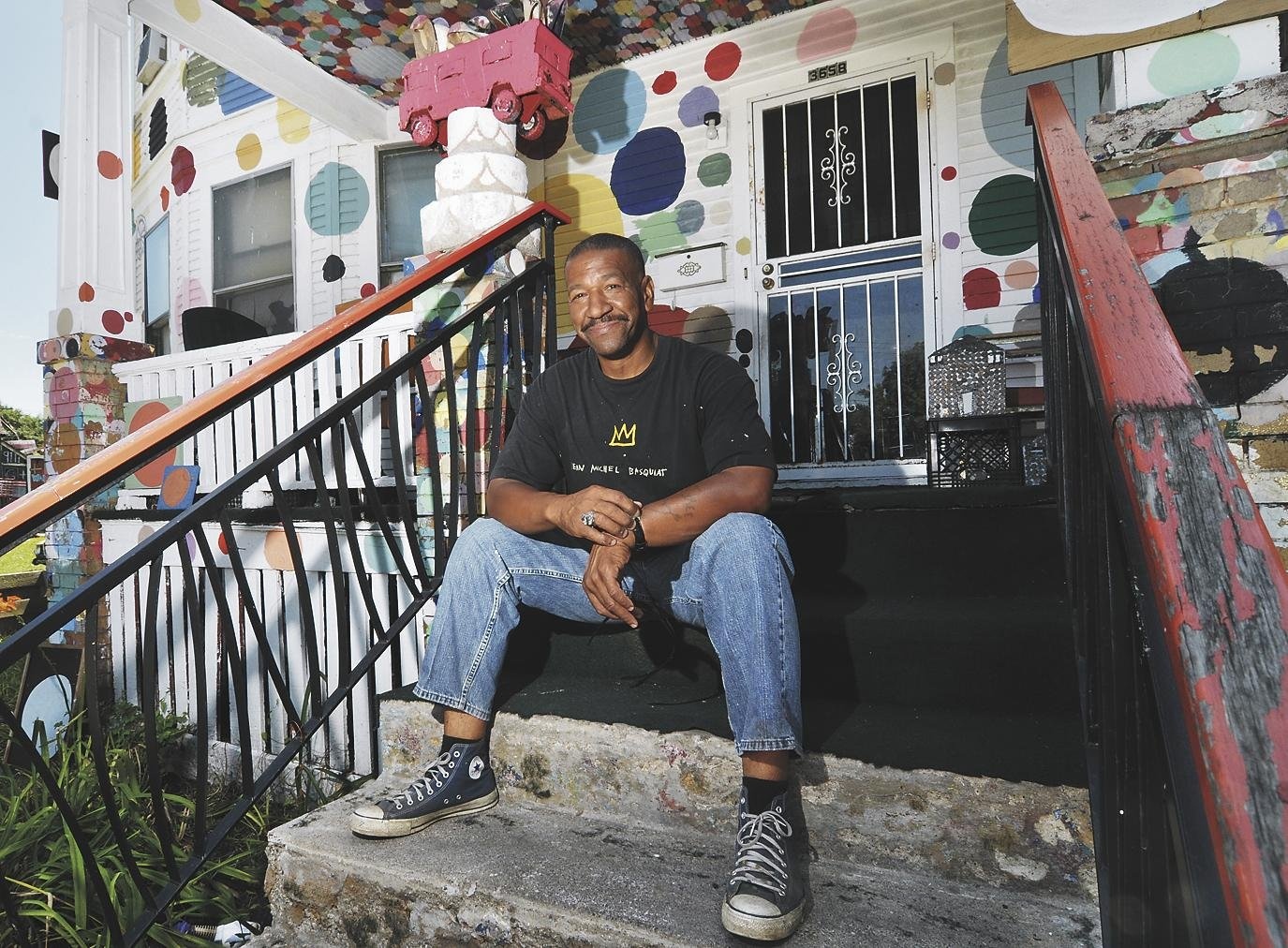
It all belongs to a neighborhood-size art exhibit created by Tyree Guyton, who grew up on the once-dynamic street and has spent the past quarter century reviving it with his art. In 1986, frustrated with the crime, drugs, and poverty that had taken over his neighborhood, Mr. Guyton, who is now 56, decided to take action.
He started by painting a dot on the side of a three-story clapboard home. One dot became two, and soon the house was covered with a kaleidoscope of colorful circles. He then turned to the sidewalks, the lawns, and the surrounding homes, working until he filled one rectangular block with striking art that includes paintings, sculpture, and found objects.
His creation eventually inspired the Heidelberg Project, a nonprofit that works to bring 275,000 visitors a year to inner-city Detroit. The charity provides art programs for schoolchildren, publishes books, and runs a small art gallery in its administrative offices in downtown Detroit. In June, it plans to announce its first capital campaign, which seeks to raise $5-million to build a community arts center.
Not an Easy Sell
But while the Heidelberg Project is thriving today, it has faced a long road to acceptance.
Until 2009, the nonprofit had been able to attract only small grants. That all changed when the Fred A. and Barbara M. Erb Family Foundation, in Bloomfield Hills, Mich., gave the Heidelberg Project a two-year, $100,000 grant that allowed it to hire a development director.
Jenenne Whitfield, the Heidelberg Project’s executive director, says the grant marked a turning point for an organization that had struggled for recognition. It helped that the foundation’s vice president for programs, Jodee Raines, took time to learn about the project, Ms. Whitfield says.
“Rather than just sit in the office and flip through an application, Ms. Raines came down to see firsthand what we were doing,” Ms. Whitfield says. “She was not necessarily an easy sell, but she was open and she asked lots of questions.”
‘Leap of Faith’
Those questions were important because it helped the foundation move past some stereotypes about Heidelberg, which had long been portrayed in Detroit as an eyesore, when it wanted to be seen as living art project that was renewing a struggling community.
Twice, in 1991 and 1999, the city of Detroit partially demolished the project after some neighbors complained that the installation was a blight.
“Originally Tyree was in the news because the city was knocking down these art installations,” says John Erb, the foundation’s president. “It almost seemed like it was just junk that was being demolished. But when you get down there—I can tell you that people I recommend to see it have had very emotional experiences.”
Heidelberg won the foundation’s support because it collaborated with local nonprofits and was able to show how its work was helping the community, Mr. Erb says.
The neighborhood, in fact, has seen no serious crimes since Mr. Guyton began his project. The nonprofit employs neighborhood residents for short-term work. It also holds arts education programs with local schoolchildren and gives internships to college students.
The organization had also completed its first financial audit and showed it was serious about managing its finances, Ms. Raines adds.
But even after months of trying to prove that it deserved the money, the foundation ultimately had to take a “leap of faith” when it wrote that first big check, Ms. Raines says, because Heidelberg had never received a big donation or shown its ability to handle a large cash infusion.
Thinking Bigger
The Heidelberg Project has used the Erb grant as a springboard. It has since received $300,000 from the Annenberg Foundation and $25,000 from the Kresge Foundation.
In 2010, the Community Foundation for Southeast Michigan also awarded the project a two-year, $50,000 grant. Heidelberg had unsuccessfully sought money from the fund in the past. But it was never organized enough to earn the foundation’s support, says Randy Ross, the foundation’s manager of philanthropic services.
“They got to a point where they had some institutional infrastructure in place and had engaged others in the process,” Mr. Ross says. “That really made it a big fit for us.”
Now that it has raised significant sums from grant makers, Heidelberg is thinking bigger. The $5-million capital drive is geared toward raising the money for an arts center that would sit on a corner of the installation. It hopes to begin construction in September.
Ms. Whitfield says the center could help attract investors and businesses to the neighborhood.
“With an art center in the community, you have a sense of permanency, and that’s what other small businesses will gravitate to,” Ms. Whitfield says. “People are going to be looking for a place to eat and a place to get gas. It would be great if the community members opened a café, or a soul-food restaurant.”
The Artists’ Drive
Even as the nonprofit blossoms, Mr. Guyton remains the Heidelberg Project’s most prominent caretaker—beginning every morning with a broom in his hands, sweeping the streets.
“It’s my ritual,” he says in front of the polka-dot house that started it all, as classical music plays from a worn-out stereo.
Heidelberg is always changing as Mr. Guyton finds new inspiration. His presence and creativity make the Heidelberg Project an experience in planned chaos. Hundreds of stuffed animals are nailed to the outside of one house, for example, an homage to the home’s former occupants—who routinely threw loud parties and were known as the party animals.
Paintings of taxis hang on the sides of homes and all over the street, showing destinations like Detroit and New York City. The artist says he hopes those images help visitors think about where they want to go in life.
One sign reads, “Meet me halfway.” “The War” is painted on the screen of an unplugged television. A woman’s picture is accompanied by a more recent event: “Fukushima global crime scene, somebody needs to go to jail.” A small wooden sign buried in the ground reads: “The Wizard of Oz Presents: There’s No Place Like Detroit.”
Some objects are loud, such as paintings of grinning faces on sidewalks and home fronts. And some are quiet, like a small album of family pictures that rests on a chair.
Mr. Guyton says that he built Heidelberg to show people that art exists everywhere.
“My neighbors have the notion that art is only for a certain class of people,” he says. “If I can’t get my neighbors to go to a show, how do you educate them? You take it to the people. And at the same time, you get people who wouldn’t come here to come.”
A Refreshing Difference
David Goldberg, an assistant professor of history at Wayne State University, frequently visits Heidelberg and says he feels an intimacy here that he doesn’t experience at other art museums. One reason, he says, is that the art and its messages were created by someone who grew up on the very street where the installation sits.
And in a city like Detroit, where “ruin porn” or visiting dilapidated and abandoned building has become a hip tourist attraction for affluent suburbanites, Mr. Guyton’s reflections on life and growth, as opposed to decay and decline, is refreshing, he says.
“This is different. This is creative. This isn’t something that was destroyed; it was something that was created. It’s not for decay but for rebirth,” Mr. Goldberg said on a recent visit.
And now that it has financial support, Heidelberg Street can thrive: Even its creator thinks it can operate without him.
In October, Mr. Guyton accepted a one-year fellowship in Basel, Switzerland, where he will write a series of short essays that will be part of a dissertation. He received an honorary doctorate from Detroit’s College for Creative Studies in 2009 but decided that he wanted to do the work to earn the degree.
His topic: What is art today?
Part of that answer will come from examining his last 25 years at Heidelberg.
“If they took it away tomorrow, it’s going to live on in the minds of millions of people. It’s going to do what it’s going to do,” Mr. Guyton says. “I’m not afraid to let go. Don’t be surprised if I polka-dot Switzerland.”