A Foundation Creates a Community Hub, Anchored by Its Headquarters
The century-old Cleveland Foundation is betting that music, food, and open doors can rebuild trust — and a neighborhood.

By Drew Lindsay
Senior Editor, Special Projects
February 26, 2026 | Read Time: 11 minutes
In the 1960s, the nightclub Leo’s Casino put Cleveland’s Hough neighborhood on the map for Motown music. Stars like Marvin Gaye headlined its shows, and a Supremes performance packed in an interracial crowd shortly after riots hit the neighborhood in 1966.
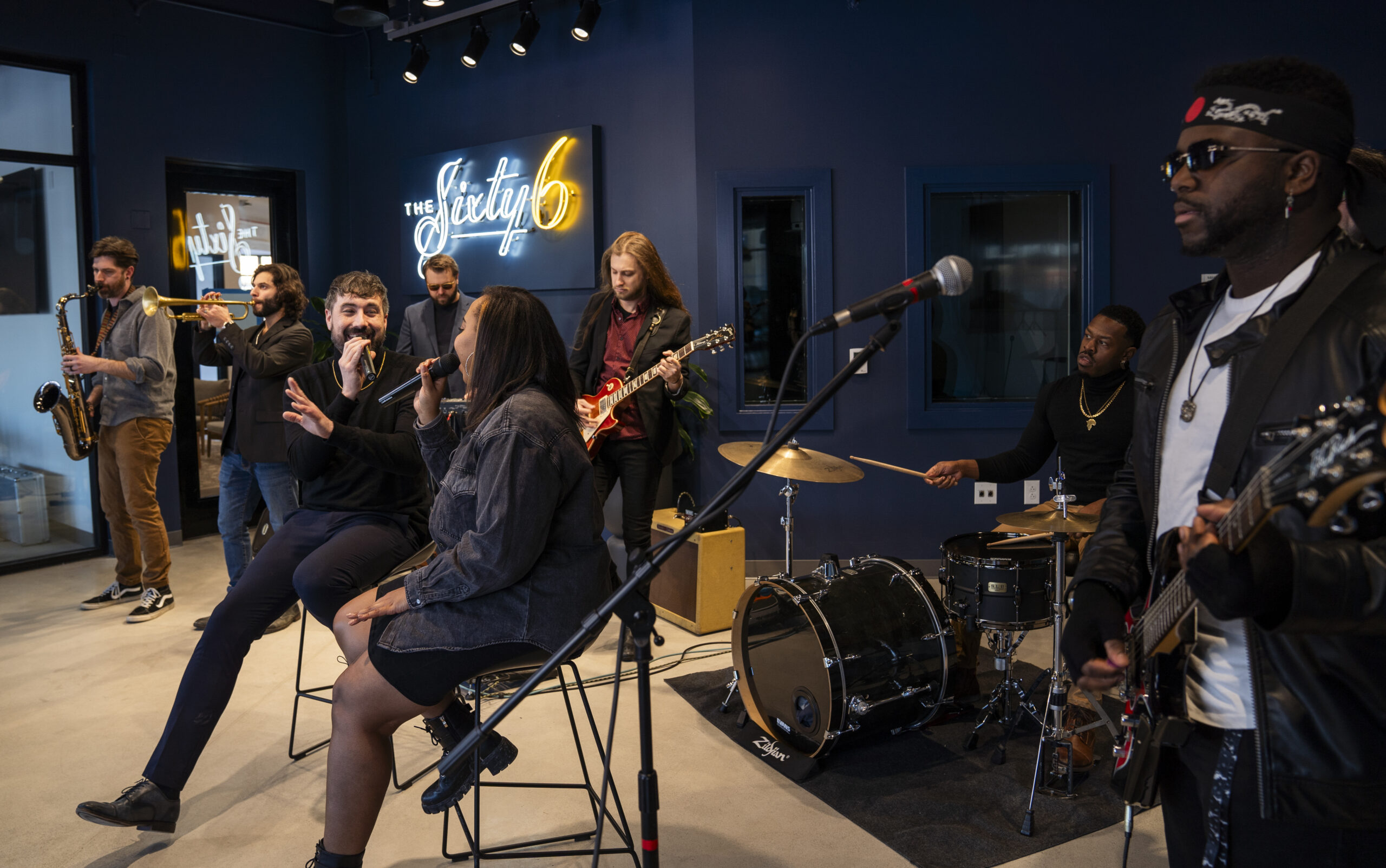
Leo’s closed in the 1970s, but last year, a new music venue opened just blocks away, courtesy of the Cleveland Foundation. The Sixty6 — owned and operated by the grant maker — hosts blues, jazz, R&B, and soul acts, many of them Cleveland locals. The schedule also features karaoke, D.J.s, Sunday gospel, and line dancing.
The club reflects a new strategy for the century-old grant maker as well as for other foundations trying to break down the walls between everyday people and what can feel like stuffy, moneyed philanthropy. Long known for neighborhood revitalization and economic development, the Cleveland Foundation is using its recently built headquarters and campus to create what academics call “third spaces” — places where neighbors can gather to do everything from drink a beer to build their community’s future.
The foundation’s office building, which opened in Hough in 2023, feels more like a community center than a $4 billion philanthropy. The first floor — more than half of the building’s square footage — is open to the public and features a gallery for local art, a cafe, and a studio for dance, yoga, and other creative-arts events.
“We felt we needed to be more warm and welcoming, more open and transparent,” says CEO Lillian Kuri, a former chair of the Cleveland Planning Commission who holds a master’s in urban design. In the grant maker’s old space — leased space in a downtown high-rise — “it felt like philanthropy happened behind a curtain.”
Last year, across the street from its headquarters, the foundation cut the ribbon on its $32 million, 98,000-square-foot MidTown Collaboration Center, or MCC. The building is home to nonprofits and businesses that are key to its economic-development strategy, but alongside these are the Sixty6 as well as Black Frog Brewery, a craft-beer taproom, and Pearl’s Kitchen, a comfort-food eatery.
The foundation opted for these unusual offerings after it invited Hough and MidTown residents to contribute to the design of its new campus. About 30 members of the community joined foundation officials on a trip to Memphis, Tenn., to scout one of its neighborhoods with a rich music history.
“Our voices are getting heard in terms of what we want,” says Jason Carter, a member of the Memphis trip who has lived in Hough for almost a decade.
The impact of the foundation’s relocation won’t be clear for years, but there are signs it’s helping to spark change, says Molly Schnoke, an economic development and community planning expert at Cleveland State University. After years as a food desert, the area recently saw its first grocery store open.
“All that civic infrastructure is what makes a vibrant neighborhood,” Schnoke says.
HQ as Public Amenity
It’s not uncommon for grant makers to use their physical footprint to help partners in their mission. The Ewing Marion Kauffman Foundation makes a 40,000-square-foot conference center on its Kansas City, Mo., campus — roughly a third of its building — available to grantees, other organizations, and government agencies working on its two chief priorities: education and entrepreneurialism. The California Endowment rents at no charge conference centers it has built adjacent to its offices in Los Angeles, Oakland, and Sacramento.
More recently, community foundations and regional funders have begun designing new construction to help the surrounding communities, not just nonprofits. Many of these philanthropies “are trying to fully live into what it means to be place-based organizations,” says Rip Rapson, CEO of the Kresge Foundation, a national grant maker that invests heavily in Detroit.
In 2027, the California Endowment plans to break ground on a mixed-use campus that will include 124 affordable housing units as well 66,000 square feet of space for organizations providing counseling, a community kitchen, work-force development, and other services.
The following year, Kresge is scheduled to complete its move from its fairly remote suburban Detroit campus on an old farm to the Livernois-McNichols area in the northwest quadrant of the city, where it has invested about $200 million over the past decade. It will build its headquarters on the former campus of Marygrove College.
Early plans for its new building, Rapson says, call for a “very public” first floor that could include a recording studio, a maker space, and an art gallery. Its main offices will feature lots of meeting spaces available to the community.
Rapson, whose father was an internationally renowned architect, also hopes to turn Marygrove’s 53 acres into open space where residents picnic and hold special events such as graduation ceremonies. The college, Rapson says, “has traditionally been gated and sort of an island to itself. We want to open up that campus and make it a public amenity.”
Vacant Space to Gathering Place
In 2024, the Greater Milwaukee Foundation opened a new headquarters north of downtown. Its offices are part of a $100 million redevelopment of a former Gimbels and Schuster’s department store completed in partnership with a local developer and the Medical College of Wisconsin, which also has offices in the building.
The foundation believes this remake of a vacant space represents a catalytic investment in a neglected part of the city. The new complex, for instance, features 90 mixed-income apartments, and a new college-prep charter school recently opened across the street.
But the grant maker wants to go beyond community and economic development to make itself a neighborhood gathering place. The 40,000-square-foot first floor is given over to a “community hub” that features a cafe, a blood donation center, a children’s early-learning center, and a job-placement nonprofit, among other groups. A quarter of the floor is set aside as meeting space.
Residents have used it for Black History Month and Juneteenth celebrations as well as for memorial events for community leaders. Altogether, the foundation hosted 1,000 community events and gatherings last year.
“People from all walks of life are coming in,” says CEO Greg Wesley.
When the Pittsburgh Foundation began to plan its 2025 move to new offices, officials sought a space to help the grant maker flex its convening power. At the time, their sole large meeting area was a board room. “It was a little bit old school and clunky,” says communications director Matthew Minczeski.
In its new headquarters, the grant maker gave over one of its two floors to meeting and event space. Its name is blazoned on the building’s facade to make the foundation a more visible community presence.
“This is a hunger now for people to get out and go somewhere where they feel like they’re part of something,” Minczeski says. “So we’re intentionally trying to have the Pittsburgh Foundation fill that need.”
A Theater Revival
The Cleveland Foundation moved to the Hough and MidTown area in 2023 after decades in Playhouse Square, the city’s theater district. Beginning in the 1970s, the grant maker helped resuscitate that neighborhood after four of its five venues — all opulent products of the 1920s Jazz Age — had shuttered. A nonprofit organized and funded by the foundation reopened the theaters, ran capital campaigns to renovate them, and developed a master plan for the area. Notably, the foundation borrowed from its endowment to purchase key property — what it believes were the first program-related investments by a community foundation.
The neighborhood now boasts 12 venues that draw more than a million patrons each year.
In the 2010s, as the lease on the foundation’s office space neared its end, then-CEO Ronn Richard and his team looked to relocate somewhere the grant maker could have similar impact. “We weren’t just moving from the 13th floor of a building to another space,” says Kuri, who’s been with the foundation since 2007. “We wanted to do something with the potential for that kind of long-lens, catalytic change.”
The grant maker was already investing in Hough, a high-poverty, predominantly Black neighborhood, and it believed that relocating could accelerate change. Like in the theater district, the foundation is borrowing from its endowment to pay for the new campus.
At the MidTown Collaboration Center, it has brought under one roof key sources of capital, including the O.H.I.O. Fund, a private firm investing in businesses and entrepreneurs, and the LISC Cleveland, which is raising $100 million for affordable housing. Other tenants include nonprofits backing start-ups; a diabetes clinic operated by the University Hospitals system; and Cleveland Art Institute Interactive Media Lab.
‘A Bigger Tent’
But as the foundation sought to lift the area’s economic fortunes, it also considered how its brick-and-mortar could build community. ‘We’re a community foundation, not a private foundation,’” Kuri says. “‘So we asked ourselves questions like: How can we feel more like a community space? How can we be a bigger tent?’”
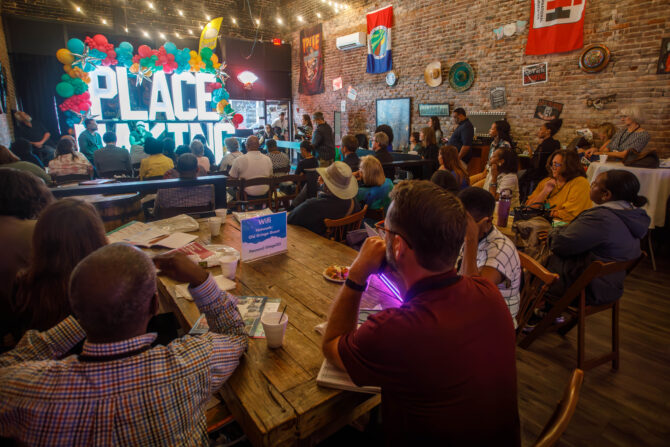
To gather community input, the foundation paid stipends to the Hough Resident Council and the Hough Youth Council, resident-led groups that met regularly to discuss plans and projects in their neighborhood, including the foundation’s headquarters. After an early meeting between residents and the architect of the new offices, the foundation scrapped preliminary drawings and created the open-to-the-public first floor.
Early conversations also turned to Leo’s Casino and the area’s music history. From the first meeting, “it was clear we needed more places to eat, somewhere to drink, somewhere to go listen to live music,” says Hough resident Carter, who now hosts D.J. nights at the Sixty6.
Carter joined Kuri, other foundation officials, and a couple dozen of his neighbors on the trip to Memphis, where they explored Soulsville, home to the Stax recording studio that produced music legends Otis Redding and Isaac Hayes. The group came back with ideas and lessons from a Soulsville revitalization plan that’s building on the neighborhood’s Black cultural history.
One direct result of this trip and other community engagement: the installation in the MCC of Sixty6, the Black Frog brewery, and Pearl’s Kitchen. While the foundation owns and manages Sixty6, the proprietors of the other two spots are Black entrepreneurs with local roots: Chris Harris, who started brewing in his garage and opened the first Black Frog in Toledo, and Cleveland native Tiwanna Scott-Williams, who for many years ran a catering business and food truck while working as a nurse.
Music and food aren’t the only means by which the foundation engages residents. Its lead MCC tenant, the nonprofit JumpStart, organizes a speaker series on topics like financial planning and starting a small business. The Cleveland Community Police Commission has chosen the MCC as its venue for regular citywide forums.
The foundation counts as a success its WinterLand, a daylong festival modeled after a holiday event in Public Square, Cleveland’s downtown park. Events this year included a breakfast with Santa, a vendor market, reindeer petting, and live music at the Sixty6.
“The goal is to keep that going every year and grow bigger,” says Lauren Jordan, one of six JumpStart employees dedicated to running the MCC and planning events. “Eventually, Midtown will get to experience what they do down at the Public Square.”
Gentrification Concerns
Gentrification is a concern, particularly if Hough becomes a hot neighborhood for professionals working at University Circle institutions, including the nearby Cleveland Clinic. CEO Kuri says the foundation aims to head it off early. It has given $1 million to a community-run land trust that’s acquiring and developing land to benefit the community, and Kuri says it’s investing in other anti-displacement strategies to ensure residents aren’t priced out of the neighborhood.
The foundation is also trying to keep its ear to the ground in the neighborhood. It organizes a bimonthly forum to hear concerns and to talk about how to fix issues cropping up. Foundation staff join residents and others going door-to-door to invite residents.
“The thing I’ve learned over three or four years with this move is that community engagement isn’t one and done, says Kuri. “It’s the consistency in showing up again and again.”
In the long run, the foundation plans to create a small park as a neighborhood amenity but also as a destination for everyone in the city. The grant maker now operates in an area of the city midway between two nodes of activity and prosperity in Cleveland: the city’s core downtown business district, and the East Side neighborhood of University Circle, home to universities, hospitals, and museums.
“We believe we can create one connected city,” Kuri says.
Correction: The original version of this article incorrectly suggested that the Greater Milwaukee Foundation hosted a meeting of an Ohio state legislature committee.
The Commons is financed in part with philanthropic support from the Arthur M. Blank Family Foundation, Einhorn Collaborative, and the Walton Family Foundation. None of our supporters have any control over or input into story selection, reporting, or editing, and they do not review articles before publication. See more about the Chronicle, the grants, how our foundation-supported journalism works, and our gift-acceptance policy.