A Grant Maker Pulls La.’s Coast Together to Fight Erosion

By NICOLE WALLACE
Features Editor
May 1, 2011 | Read Time: 8 minutes
Grand Bayou, La.
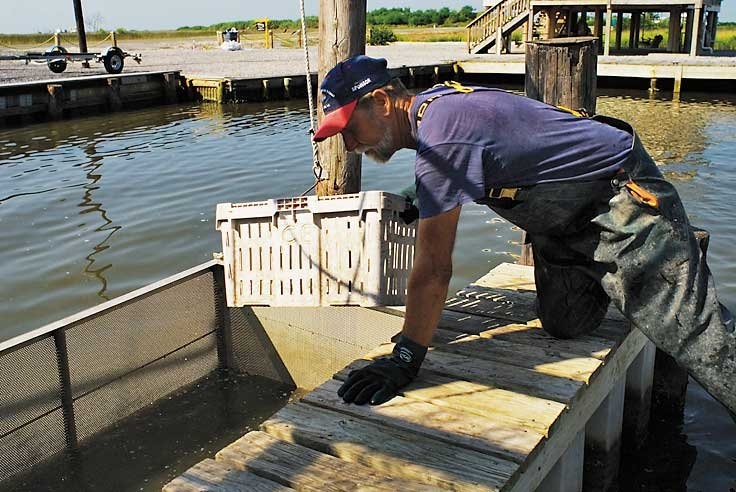
The GPS device on Patrick Dickinson’s boat shows just how quickly southeast Louisiana is losing its wetlands.
A charter-boat captain in Plaquemines Parish, he marks the location of good fishing spots electronically so he can return again with his customers. But when Mr. Dickinson calls up the sites he’s marked on his GPS, many appear to be on land, because the marsh that used to be there has since washed away.
Mr. Dickinson, 34, followed his father into the charter-fishing business, but he’s not sure that will be an option for his children.
“I hope this is still here,” he says, motioning to nearby marsh from the wheel of his boat. “But who knows what it’s going to look like 10 or 20 years from now.”
Louisiana is losing wetlands at a rate of more than 25 square miles a year, which threatens the existence of coastal communities, the seafood industry, and the livelihoods of many of the state’s residents.
Some of state’s most unusual enclaves, including fishing hamlets populated by African-Americans, Cajuns, Croatians, Native Americans, Vietnamese, and the descendents of Canary Islanders who came during the Spanish colonial period, may be lost to the Gulf of Mexico in a matter of decades if something isn’t done, say environmental experts.
Last year’s oil-drilling catastrophe in the Gulf accelerated the loss of wetlands. And the devastation caused by Hurricanes Katrina and Rita in 2005 heightened awareness both in the region and nationally that the loss of marshes—a natural speed bump for hurricanes and tropical storms—has made the entire area, including New Orleans, more vulnerable to natural disasters.
Now, on the anniversary of the explosion that caused the oil spill, the Greater New Orleans Foundation is starting a new effort, the Coastal 5+1 Initiative, designed to help the region develop a cohesive approach to protecting and restoring the wetlands that can be saved and adapting to the environmental changes that cannot be amended. The goal is to get civic and political leaders in five coastal parishes—St. Bernard, Plaquemines, Jefferson, Terrebonne, and Lafourche—talking and working with one another and with leaders in the city of New Orleans—the “plus one” in the program’s title. The foundation hopes that if southeast Louisiana can get a handle on issues like coastal planning and water management, the expertise it gains will help seed new industries in the region.
“Our coastal parishes cannot save themselves alone,” says Marco Cocito-Monoc, director of regional initiatives at the foundation and head of the new project. “We realized that the solution lay in a simple exercise of addition, a hopeful act of solidarity that joins our city with our coastal parishes in a union that can save each and all.”
Early Fund Raising
The first phase of the project, say organizers, will focus on getting local residents to think about potential solutions to the problems caused by land loss and helping them plug into local planning efforts. Later stages will test new ideas to restore the wetlands and help the region adapt to environmental change.
The foundation has set an initial fund-raising goal of $5-million for the Coastal 5+1 Initiative, which it hopes to raise largely from national grant makers, and it is starting off by contributing $200,000 of its own money.
Compared with the scope of the problem, $5-million isn’t a lot of money, acknowledges Mr. Cocito-Monoc. He hopes that if early efforts prove successful, the foundation will be able to raise more. But even so, he says, the project plans to finance pilot programs in the hopes that government will pick up and expand the promising ones.
“There’s no way that we can fund all of the effort, no matter how much money we raise,” says Mr. Cocito-Monoc.
Rapid Erosion
South Louisiana is a river delta, its marshes and wetlands built up over roughly 6,000 years by soil and other sediment deposited by the Mississippi River as it runs into the Gulf of Mexico. Deltas are dynamic regions with sedimentation in a constant battle with erosion by the sea.
But after a disastrous flood in 1927, the balance between those forces was sharply altered when the Army Corps of Engineers constructed a series of levees, channels for excess water flow, and other structures along the river that protected riverside towns from flooding—but also cut off the flow of sediment that replenished the wetlands.
Canals cut through the marsh in later decades for shipping and to transport oil and gas drilled offshore to the Port of New Orleans exacerbated land loss. In recent years, the 2005 hurricanes and last year’s oil spill battered the already fragile coast.
“You can just see huge chunks of these areas that are gone in a week’s time,” says P.J. Hahn, director of coastal zone management for Plaquemines Parish. “I have never seen the acceleration of the loss of marshes that we’re experiencing right now because of this oil spill.”
Banding Together
From a lookout above the levee at the edge of the Lower Ninth Ward in New Orleans, Bayou Bienvenue doesn’t look very impressive. The murky open water is covered in algae blooms near the shore. The dead stumps that dot the water are the only indication that the area was once a thriving cypress grove.
Fifty years ago, the huge cypress trees provided storm protection for the Lower Ninth Ward, slowing down wave action before storm surges struck the levees protecting the neighborhood. But the Mississippi River-Gulf Outlet, a shipping channel built in the 1960s, changed tidal patterns in the area, which led to an increase in the amount of salt in the water that killed the cypress.
Today the Sewerage and Water Board of New Orleans, neighboring St. Bernard Parish, and others are in the early stages of a project to restore 28,000 acres of the cypress swamp. If the jurisdictions secure the money they need to pay for the full project, plans call for treated waste water, which is largely fresh and nutrient-rich, from a nearby plant to be released into Bayou Bienvenue to lower its salinity, making it possible to grow cypress trees there again.
The effort to restore the cypress stand shows both the ingenuity being applied to coastal restoration but also the deep divisions the Coastal 5+1 Initiative is up against.
The Bayou Bienvenue project marks the first time that Orleans Parish and St. Bernard Parish have worked together on a project since 1927.
The coastal parishes have often felt alone as they advocated in Baton Rouge and Washington for coastal restoration, while their more powerful neighbor, the City of New Orleans, didn’t take the problem seriously. “For a long time, coastal parishes have thought—and I think rightly, to a certain degree—that the fight for coastal restoration has been theirs alone,” says Mr. Cocito-Monoc, of the Greater New Orleans Foundation.
Without significant policy changes, coastal communities in southeast Louisiana are almost certainly doomed, says Mark S. Davis, director of the Tulane Institute on Water Resources Law and Policy. He says changing that prognosis will require active participation by citizens.
“This is the time for a civics revolution in Louisiana and the Gulf Coast, because if you do not know how to influence decisions, you will be the victim of decisions,” says Mr. Davis.
Residents’ Participation
But while land loss and the future of southeast Louisiana are constant topics of debate in the coastal parishes, residents aren’t always sure how to get involved in decision making. The Greater New Orleans Foundation has awarded the first Coastal 5+1 grant—more than $136,000 over a year—to the Center for Hazards Assessment, Response, and Technology at the University of New Orleans. The center will conduct a series of both formal and informal meetings for residents to talk about their ideas for restoring the coast and help them plug into local planning efforts.
Area residents have valuable knowledge about the cycles of the estuaries gained from years of living and working within the ecosystem, says Kristina Peterson, who has led the center’s work in the coastal parishes. And maybe most important, she says, they care deeply about its protection.
“You could know everything about restoration, but if you don’t have that passion with it, you’re not going to make sure that it happens,” she says.
Spreading Ideas
Finding solutions to the region’s erosion problems has implications that spread far beyond Louisiana, says Paul Harrison, senior director for Mississippi River and East Coast at the Center for Rivers and Deltas, a program of the Environmental Defense Fund. He says that roughly 350 million people around the world live in river deltas that are threatened by rising sea levels caused by climate change.
Environmental Defense is working with the Van Alen Institute, a nonprofit design group, to create a new organization to bring the best minds in science, engineering, and adaptation together to help solve Louisiana’s land-loss challenge.
“If we can’t do it here, then it’s going to be very hard to do it in all these other places,” says Mr. Harrison.
The Greater New Orleans Foundation hopes that over time, efforts to deal with the region’s water and erosion problems will lead to new industries that will reinvigorate the area’s struggling economy. Post-Katrina rebuilding projects have shielded the state from the worst of the recession. For example, Louisiana’s unemployment rate in March was 8.1 percent, below the national rate of 8.8 percent. But many of the industries that make up the area’s economic base—such as oil and gas, shipping, and shipbuilding—are in decline.
“If we can master coastal planning and things like water management within urban and semi-urban areas, we think we can start to not only save our own homes and places but actually invigorate our economy, which has been infamously moribund for a long time,” says Mr. Cocito-Monoc.
But he knows that for that to happen, coastal communities will need to have some wrenching conversations about what can and can’t be saved and will have to do a lot of hard, complex work.
Says Mr. Cocito-Monoc: “These are times of both trepidation and hope.”