A Hollywood Director Tells How He Built a Rom-Com Around Political Strife

By GEORGE ANDERS
Editor-at-Large
October 3, 2024 | Read Time: 21 minutes
Keep up with everything happening in The Commons by signing up for our Philanthropy Today newsletter and joining our Commons LinkedIn group.
What does Hollywood make of the current climate of polarization on so many issues? For many directors and producers, tackling such challenges on screen is the last thing they would ever want to do. But not every movie maker is backing away.
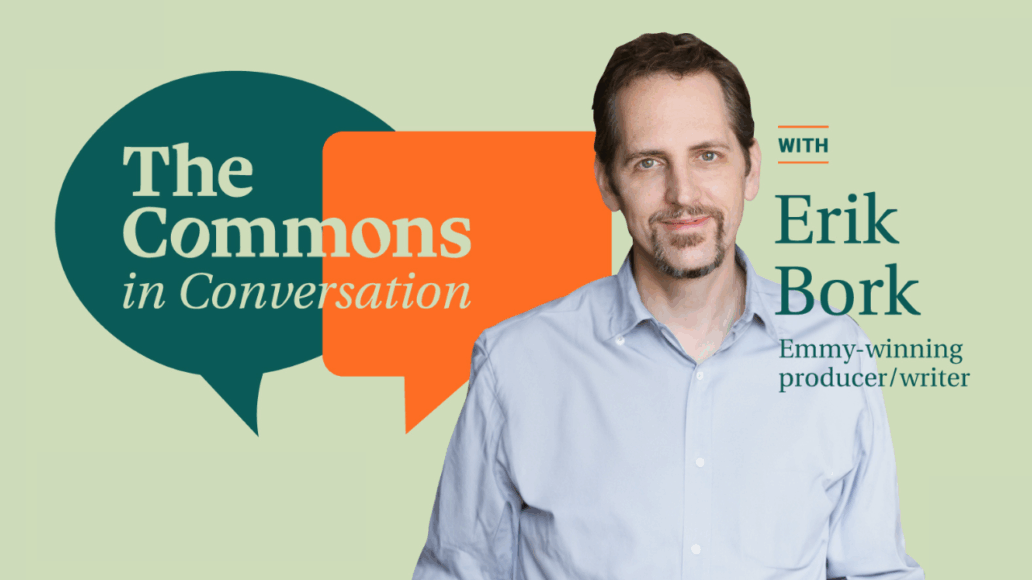
Meet Erik Bork, a Hollywood veteran whose credits so far include popular, mainstream fare such as Band of Brothers. Now Bork is about to launch a stereotype-defying film called The Elephant in the Room. It’s an exploration of the turbulent national mood surrounding the 2020 presidential election as seen through the eyes of two people in their 20s, wondering if they dare pursue a romance in spite of their clashing political views.
In a LinkedIn Live interview with Chronicle of Philanthropy editor-at-large George Anders, Bork opened up about the reasons he made the film, what he learned along the way, and why he thinks it could be a positive force in helping viewers “think about relationships they might have with people on the other side.”
Bork says he started with the essence of the rom-com formula and then turned it inside out. “The thing about romantic comedies is that you always need to think about the relationship,” he says. In his film, Leah is a social-media specialist with strong left-of-center political views. Vincent is an aspiring chef who’s a steady Trump supporter.
They meet “cute” in Los Angeles and take an interest in each other. But there’s a lot to argue about, too. And as they get to know their differences, gradually they come to understand each other.
“A really cool thing happened in this process,” Bork says. “I had written a draft of the script, and I was still working on it and I was fundraising. I discovered that there are a number of nonprofits in this space, ‘bridging organizations,’ as they call themselves. Some of them came on as funders and helpers to the movie.” Their feedback helped him find more nuanced ways of telling the story, he says.
Could more of Hollywood attempt similar films? “It’s hard to say,” Bork says. “I don’t have my finger on the pulse of all of Hollywood in that way. But I do think the traditional view is you stay away from that stuff because you’re going to alienate people and they’re going to be distracted by the politics.”
Even so, Bork hopes that audiences will find his approach to be more like “candy” than “medicine.” A limited in-theater release is likely early in 2025, followed by whatever streaming-service distribution can be negotiated. Watch the trailer.
The conversation took place on LinkedIn; free registration is required to watch. You also can watch a recording of the interview on the Chronicle’s YouTube channel. Below is a transcript of the conversation, lightly edited for clarity.
GEORGE ANDERS: Hello. Welcome to another edition of the Commons In Conversation. Listeners may already know this is a new series that the Chronicle of Philanthropy is launching. It’s part of our focus on the way that nonprofits and philanthropy can mend the nation’s many divides. These are big topics. It’s serious stuff. And that invites the question: Is there any way that Hollywood can tackle these topics?
Yes, there is. And today we’re going to go to the movies. My guest today is Erik Bork. He is the writer, director, and producer of a new film called The Elephant in the Room. Welcome, Erik.
ERIK BORK: Thank you, George. Great to be here.
GEORGE: I’ll just summarize for a moment and then we’ll get rolling with the questions. So the movie’s The Elephant in the Room. And on one level, it’s a romantic comedy. It’s got to 20-somethings in L.A. sorting out all the hazards of modern dating. But the energy and the genius of the movie comes from the tensions in the background.
It’s taking place when the U.S. is arguing about what really happened in the 2020 presidential election — Trump versus Biden — and our two heroes are on opposite sides of the divide.
Erik, start with a thumbnail sketch of the movie’s central characters. Tell us about Leah and Vincent.
ERIK: Leah is a progressive. It’s December 2020, so it’s still COVID. She’s horrified by the election denialism, as she would call it, and kind of lives in a bubble of people who share similar views to her. She’s in a life transition and is very lonely. She recently went through a breakup. She’s housesitting at someone’s house where a guy she doesn’t know is also staying who becomes her friend. But it’s kind of a difficult friendship for her to forge with him.
Meanwhile, she meets this guy, Vincent, who you see in the picture. He’s a cute guy and they have a fun dynamic. He asks her to coffee and she’s interested. But she finds out that he voted for Trump both times and doesn’t share her views about the election denialism being so terrible. He’s still not sure what he thinks about what happened in the election.
And so they begin to hang out some. He’s very open to her opinion and doesn’t see that it’s a problem that they have different views. But she’s horrified by his views and doesn’t feel like she could continue to see him or date him. She starts to give him a chance, hoping she might be able to impact his views in some way, which of course, is easier said than done.
GEORGE: It’s a wonderful movie. I never would have guessed it, but the politics and the romantic comedy format fit together very tightly and very engagingly. Tell me how you hit on this idea. A bunch of movies are derivative, like, “I’ve seen that 20 times before.” This is in a category by itself. How’d you come up with it.
ERIK: Well, the thing about romantic comedies is you always need to think about the relationship. That’s the key to that kind of movie. And I’ve written a few. I haven’t produced any, but I’ve written a few, and I’ve always liked that genre. When I’m considering writing something in that realm, it’s always about the thing that’s in the way of the couple.
Like a lot of people, political polarization has seemed like a growing problem to me. When Trump was first elected, I turned my attention to polarization as a thing that I thought was the problem behind other problems that were going on in our country politically.
It just struck me that that is a good complication in the way of a relationship in today’s world. Things have gotten so polarized that the idea of dating someone with opposite views is kind of unthinkable for some people. It’s a real deal breaker.
It became a thing in my life. I had friends who had opposite views of me on all of this. And we try to hear each other out and so forth. Everyone has had relationships during this time with people of opposite views and experienced the difficulties of that.
It became more and more clear to me that it could potentially work as the main inhibitor of a romance.
GEORGE: As you were writing the screenplay, was there a temptation to give one side the better argument? How did you keep it balanced, to the degree that it’s possible to keep it balanced?
ERIK: Full disclosure, I come more from the left, so I share her views more and live in her bubble. So as I was writing his character, it was a little more difficult for me to imagine the Trump voter. Her views, I fully identified with and his views I had to try to figure out.
A really cool thing happened in this process: I had written a draft of the script and I was still working on it and I was fundraising. I discovered that there are a number of nonprofits in this space, “bridging organizations,” as they call themselves. Some of them came on as funders and helpers to the movie.
And then I started to learn more about their world and that movement and started to become much more committed and zealous about that as an issue. It wasn’t just the topic I’m using in a movie anymore. It became a thing I really believe more and more strongly. And as I met these people in that world, some of them offered to give feedback on the script.
Not that I had to take the feedback, but I was eager to. And some of the comments they gave, some of the most crucial ones had to do with the Trump voter. The thing with polarization is you assume people with opposite views have the most extreme version of those views and that they’re all in lockstep with everything that you associate with those views, as opposed to people being complicated and having a mix of opinions and views and beliefs.
Some they hold stronger than others. Some are more flexible than others. And so I started writing him in a way that was more complicated and didn’t just fit a stereotype that a left winger would have of a Trump voter.
They also gave me advice on just how to make it a less polarizing film in general so that people on the left or the right could watch it and hopefully identify with people on both sides, like the people on both sides, and feel that they seem like accurate representations of people on both sides.
But these are unique individuals. They aren’t types that can stand in for every person. That’s the whole point. Everyone’s a unique individual with a unique mix of views. So that’s what I was trying to accomplish and they definitely helped with that.
GEORGE: Give me an example of something you did with the Vincent character to make him more human or more nuanced so that he wasn’t just a trope.
ERIK: Initially I had him January 6th-curious. He wanted to go to that rally. I thought of him as a full-on MAGA Republican that would have the red hat and everything. And over time, I decided to give him a grandma character who he lived with who was the more MAGA person. Whereas he was a little bit more moderate, although in that camp generally, but not super passionate about all the issues. It’s not a defining thing for him that he wakes up thinking about every day.
That’s unlike the female character in this movie who’s thinking about this all the time. So I softened all of that. And I gave him some views that some people might think that someone on the right might not have. He’s pro-choice and pro-gay marriage and doesn’t like certain things Trump has said or done and is pretty vocal about that.
But he did still vote for him despite those things. With the January 6th rally, he’s skeptical about going. When he sees the violence, he’s horrified and he starts to believe the election wasn’t stolen in the end.
He wasn’t really sure prior to that. But then he started researching it and going outside the normal things he would use to look at politics. That’s one way she influences him in the end. In that one issue, he changes, although not really on other issues.
GEORGE: Does she change at all?
ERIK: She changes but not in her political views. She begins to change on the question of whether she can accept him as he is. That’s a bigger theme of the movie: accepting people as they are versus trying to change them, and whether it’s helpful to try to change someone and make them better,
Or is it better to let people be exactly who they are? So that’s a thing that’s being explored throughout the movie, with a couple of different relationships. She becomes more open to getting to know him despite finding a lot of his views unacceptable. That’s the change that she’s challenged to make, whereas he’s already open to other people’s views and he’s more challenged to change his view.
GEORGE: You mentioned a moment ago that some nonprofits provided support and also some extra perspective for you. Give me an example of a suggestion you got from them or an element of input that was useful. And then maybe one where you said, actually, that’s not how we make movies.
ERIK: Not having that character go to the January 6th rally. One note I got on the script was about if he goes and he actually gets injured. Originally, he gets injured, not because he was trying to break in. He was with a large group that just kind of walked in and didn’t see any cops. But in the crowd he got knocked down and injured.
There was a FaceTime call with her where he’s got blood on his face. And one of the things somebody said was that image of him having been there and being bloody could trigger the people on the left so much that they will not accept her dating him beyond that or giving him another chance beyond that.
So that was one example that just came to the top of my mind. Other examples were of things that would soften his character. I’m trying to think of ones where I just rejected it. I’m sure there were some but none are coming to mind where I was like, “I disagree.”
There were probably some that I didn’t do for sure, but they all came from a place of, okay, these make sense and these potentially could help. And I think the majority of them I worked with and tried to integrate.
GEORGE There’s the classic “give them a puppy” approach. But I think you were fairly moderate in your use of the animals on this one.
ERIK: Well, I gave him a grandma that he lives with and he loves. I mean, I definitely did stuff to make him as cuddly as possible so that people would root for the relationship. In a romantic comedy, you need to like both people and like them as a couple. I did a lot to make him lovable so that people on the left could say, “I disagree with him voting for Trump twice, but he’s a great guy. I am almost impatient with her for not giving him more of a chance, even though I agree with her politics.” Some people who’ve seen the movie definitely said that.
GEORGE: I had the same thing, too, that she was getting a little precious. That’s all part of the art of bringing up three dimensional characters.
As you think about Hollywood more broadly, how much of a willingness is there to explore political themes? How much is the feeling that no matter what you do, you lose half your audience? What’s the appetite?
ERIK: I mean, it’s hard to say. I don’t have my finger on the pulse of all of Hollywood in that way. But I do think the traditional view is you stay away from that stuff because you’re going to alienate people and they’re going to be distracted by the politics and not get involved in the story and the characters or not like what you’re doing because of your obvious political bias.
Also it’s a downer of a topic. It’s not an escapist fun topic. It’s a thing that we’re bothered by and so we don’t really want to go to entertainment to see those issues be argued about. We’ll watch the news for that kind of thing.
I don’t know that there’s a large appetite to explore people on opposite sides of this political moment or the recent political moment and arguing the two sides.
You see it slipping in here and there. But I don’t think anybody thinks, “Yeah, we should do more of those. Audiences are dying to see that in a movie.” That’s how Hollywood thinks: “Are people wanting to see it? Are they going to pay to see it? Are they going to pay to subscribe to this service if this is our featured show this month?”
Hollywood rightly tends to think audiences are looking more to escape and to have candy and not medicine, not something that’s more about politics or life during COVID.
I think the standard feeling is people don’t want to see that. And we’re in a business where we make things that we think people want to see. That’s my opinion anyway.
GEORGE: That makes a lot of sense. One of the things we’re doing with the Commons is exploring polarization in a lot of areas. And that takes us into race, that takes us into urban/rural, that takes us into gender. Are some of those themes easier for Hollywood to get through or do you run into the same problem everywhere that it’s a downer and it’s medicine instead of candy?
ERIK: I don’t know. Hollywood, I think, does have a liberal bent. Their main thing is underrepresented groups being better represented both in the creative process and in the stories and characters being depicted. Because Hollywood’s been called out many times over not doing that enough.
There’s a big appetite to try to do more of that, which I think is very laudable and important. I think that’s more the focus as opposed to bridging divides between opposite groups.
GEORGE: Yeah, that would square with my lay impression as well. We all have backstories and I think we had an interesting conversation the first time we spoke about your own encounters with polarization and opposing views. As you think about your growing up years or before you came into the movie industry, did you encounter people on different sides and feel a desire to see if there was a way to bridge it?
ERIK: I grew up a left winger with a Republican dad who had voted for Nixon and Reagan. So there was a little bit of that growing up, but I wouldn’t say it was a big issue for me until around the time that Trump got elected. I had a close friend who was an avid Trump supporter, but had very — and this has inspired the movie and character in some ways — different views than what I expected a Trump voter would have.
He didn’t like Trump as a person. He didn’t respect him so much as a person, but he liked the policies. Although there were a few key ones he completely disagreed with. But he was willing to overlook those because he liked the other ones so much, whether it was immigration or China or trade policy, or more isolationism.
He actually saw Trump as an anti-war-type of figure because of the whole America first isolationism — not be involved in NATO as much, not be involved in foreign wars. That surprised me because I didn’t think of him as the peace candidate, so to speak.
So it was interesting to get to know somebody who had pretty educated and well-informed views and justified Trump’s positions. Which I still didn’t agree with, but I could see his point on certain things, or at least see how he got there. It made it a more nuanced conversation. It was interesting trying to keep a friendship going when that was such a core element of conversation that we generally didn’t agree on.
GEORGE: For viewers who want to see the Elephant in the Room, tell me about the rollout strategy and when and where people will be able to see it.
ERIK: We’re in the final negotiations on a distribution deal that I’m really excited about with a company that’s going to do a limited theatrical release in early 2025, probably February-ish in select cities. It’s TBD what those cities are. But we will probably do one-night-only special events in different cities where there’s an additional element beyond just screening the movie.
We might have representatives from bridging organizations leading discussions after the movie, for instance. The cast and crew might be present at some screenings. We’ll probably do a premiere in Washington D.C., and we might try to get some influencers there because some of our executive producers are very tied in with some very high level people in both the political world and the nonprofit bridging world.
We will try to get the buzz and awareness of the movie out there through having a theatrical run and having that premiere and doing what we can to loop in our partners in the bridging world to talk about the movie as much as possible as it kind of tours around and plays in theaters in different cities.
Eventually we’ll have a full digital release where it’s available online for rent and purchase and maybe on a streaming platform, maybe not. These days, the big streamers don’t tend to take independent movies that don’t have big stars. So that’s an uphill battle in the marketplace. I don’t know that it will ever be on Netflix or Hulu or HBO Max, but it will definitely be available on other platforms.
Eventually, that includes the platforms that are free but you have watch ads, which is where most independent films eventually can be seen, like Tubi. So it’s a lengthy run on these different platforms, but probably beginning around February of next year. And we’re still raising money to fund the whole publicity and promotion and marketing side of that so that we can really get the word out and have the movie reach as many people as we can.
GEORGE: Terrific. And what would your takeaway be for people watching the movie? What would you expect them to know or feel or believe afterward that maybe they didn’t coming in?
ERIK: The main thing it seeks to do is — in a light-hearted, soft, not in-your-face way, in a pleasurable kind of candy versus medicine way — make you watch the struggles around polarization in a real-life scenario that isn’t triggering politically. It’s not triggering emotionally to make you hardened in your opinions. If anything, it will probably make you go, “Yeah, she should give him more of a chance, even though I agree with her politics. Or it’s cool that they’re actually discussing this stuff and they’re kind of moving through a difficult situation.”
I think it gives hope and makes people think about and talk about relationships that they have with people on the opposite side of things in family or friends or even romantically. Hopefully it makes them consider “Am I too much in my bubble, am I too hard edged? Would it be better to be more of a listener and more of a bridge builder than to stay in my lane on my views?”
GEORGE: Terrific. Thanks so much, Erik, for sharing a bit about it. The movie is The Elephant in the Room. There’s a link in the chat that’ll explain how you can see a preview and learn more about it on. Appreciate the chance for you to be part of the Commons.
ERIK: Thanks so much for having me. It’s my pleasure, George. Thanks, everyone.
GEORGE: Terrific. We will have more discussions like this coming. And I just want to give you a couple moments of preview of what’s coming next. On October 16th, Nealin Parker, who is part of the Search for Common Ground, will be talking about efforts to head off election clashes this fall before the trouble starts.
And then on October 30th, we will hear from Amy McIsaac. She heads a project at Philanthropy for Active Civil Engagement. She will talk about the way that we use civic language and what’s productive and what’s ineffective in the terms and phrases that people choose.
Thanks so much for joining us. And make watching the Commons In Conversation a habit. We do this every two weeks. Bye now.
(The Commons is financed in part with philanthropic support from the Arthur M. Blank Family Foundation, Einhorn Collaborative, and JPB Foundation. None of our supporters have any control over or input into story selection, reporting, or editing, and they do not review articles before publication. See more about the Chronicle, the grants, how our foundation-supported journalism works, and our gift-acceptance policy.)