A Nonprofit Organization Builds Bridges to Committed Donors Around the World

By NICOLE WALLACE
Features Editor
November 28, 2010 | Read Time: 5 minutes
New York
Acumen Fund, a fast-growing charity that’s trying to harness the power of business to tackle global poverty, is working hard to make its fund raising as international as its mission.
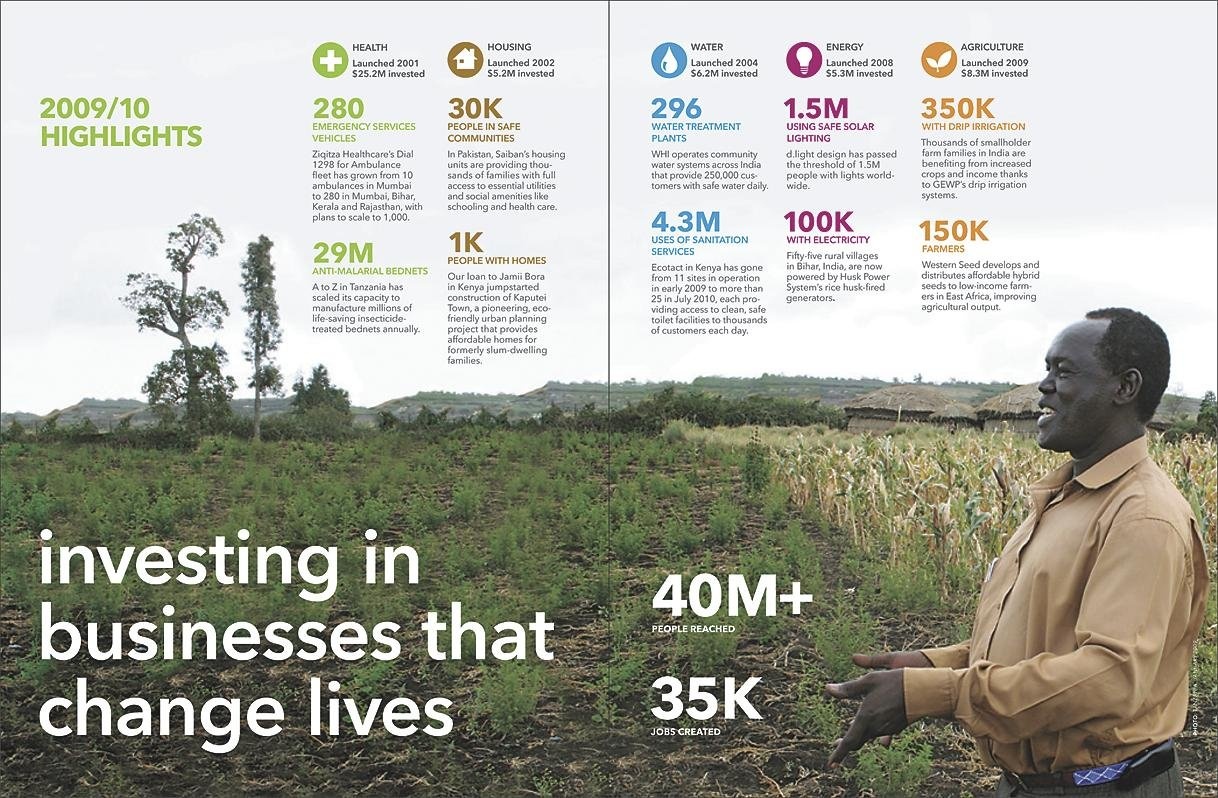
The New York organization raises money, which it then invests in companies that provide health care, housing, water, and other critical services to poor people in developing countries. Among the enterprises Acumen has invested in: a chain of small drugstores in rural Kenya, an animal-husbandry business in Pakistan that seeks to increase the productivity of dairy cows, and a company that uses rice husks to generate electricity for rural villages in India.
Gifts from individuals make up roughly three-quarters of the organization’s donations, with most of the money coming in the form of large contributions. Of the more than 300 donors who have contributed $10,000 or more since Acumen’s founding in 2001, roughly 80 live outside the United States. Nearly 40 of those donors are of Pakistani descent, living either in Pakistan or in places like London or Dubai.
“The questions that we’re addressing are global questions, and we want as much as possible to be a global organization,” says Sasha Dichter, the organization’s director of business development. “We know that there’s great interest in these questions in Europe, in the Middle East, in India, Pakistan, and Kenya as much as there is in New York or in the Bay Area.”
Of the $5.5-million the organization raised from individuals in 2009, donors from outside the United States contributed $1.5-million. The group’s annual daylong meeting for donors, which was held here in November, drew participants from 12 countries.
‘Concentric Circles’
Acumen has always sought support overseas, but the number of donors from outside the United States has accelerated since 2006, when the organization began to set up offices in the countries where it works, says Mr. Dichter. The reason for starting the offices was so Acumen could better provide consulting and assistance to the companies it helps to finance, he says, but the advisory councils and, in some cases, formal boards set up in each country have also been important for fund raising.
“Any community is built out from the people who come in first,” says Mr. Dichter. “It is from those relationships that we work our way out in concentric circles.”
The opportunity to work with the group at the local level was a turning point in Ali Jehangir Siddiqui’s relationship with the organization.
A leading businessman in Pakistan, where he is a managing partner of a financial-services firm, Mr. Siddiqui made a small gift to Acumen about eight years ago when a friend in New York sent him an e-mail message about the organization.
But it wasn’t until Mr. Siddiqui helped the group start its Karachi office that he really got involved. He provided temporary office space at his company for almost a year while the group looked for a permanent location, and he also offered legal and tax advice about how Acumen should structure its Pakistan operations.
“When one gets involved with establishing a country office, then one learns a lot about the inner workings of an organization,” he says.
He joined the advisory council in Pakistan and later Acumen’s board of directors. To date, he has donated more than $1-million.
At times, he says, he asked himself whether he should be dedicating that time and energy to a homegrown Pakistani organization.
But, at the same time, he was struggling with the concern that traditional charity makes people more dependent on aid, rather than less.
Acumen, he says, won him over with its business-minded approach, which provides assistance and opportunity in a way that preserves people’s dignity.
He also is intrigued by the potential for taking business ideas that are successful in one country and applying them elsewhere. He points to Global Easy Water Products, a company in India that sells low-cost drip-irrigation systems to small farmers. Acumen made a $1-million equity investment in the company in 2008 and has since helped negotiate a deal to transfer the technology to a rural-development organization in Pakistan to start a business selling irrigation systems in the country’s arid regions.
Says Mr. Siddiqui, “The community of Acumen is building bridges between countries.”
Volunteer Chapters
While most of Acumen’s fund-raising energy has focused on building relationships with people who can give large sums, it has in the last two years worked with volunteers who have created local chapters to call attention to the organization’s work and hold fund-raising events.
The chapter system, which Acumen formalized in late 2009, is growing both in the United States and around the world, with volunteers often finding each other through a social network Acumen has built on its Web site. Internationally, volunteers have formed a countrywide chapter in Pakistan as well as city chapters in Dubai, London, Toronto, and Vancouver, and another chapter is starting to organize in Japan.
Dubai for Acumen, the longest-established overseas chapter, drew 300 people to its first event, which featured a presentation by an Acumen fellow who spent a year working at one of the businesses the group has financed in Pakistan. The gathering raised $15,000.
Rabia S. Qari, an American who works in Dubai as a consultant at the management-services giant Ernst & Young, heads the chapter. The group’s 45 volunteers include Americans, Europeans, and South Asians, reflecting Dubai’s large number of residents from outside the United Arab Emirates.
Acumen employees provide guidance to the chapters, and technology allows the volunteers to support one another.
Ms. Qari and other members of the chapter have sought advice from members of the New York chapter through Acumen’s community site as they plan their second event, a photography auction. Using Skype and e-mail, chapter members in Dubai have offered assistance to volunteers in London and Karachi as they start to plan activities.
Ms. Qari thinks the chapters are an important tool for spreading Acumen’s message and that in time they will be a valuable pipeline for big donors.
“The chapters are an excellent way to get people who can donate maybe $1,000 a year, to make them a part of this as well,” she says. “Hopefully going forward these are the same people we can cultivate into being longer-term and bigger partners for Acumen.”