A Seattle Charity Helps Poor Families Lay Claim to the Land They Farm

By NICOLE WALLACE
Features Editor
February 6, 2012 | Read Time: 2 minutes
For very poor, rural families in developing countries, gaining legal rights to the land they farm can be life-changing.
People can invest in the land, secure in the knowledge it won’t be taken away from them. Farmers can use the land as collateral for loans to buy livestock, equipment, or supplies to increase their yield. And, in some countries, land title can provide the vital proof of residence that people need to apply for government services, such as public schools or subsidized seeds.
For more than 40 years, Landesa, a Seattle nonprofit organization, has sought to combat poverty by working with governments around the world to help poor people gain secure land rights.
“As you get title to land, the value of that land goes up,” says Tim Hanstad, chief executive of Landesa. “So by providing a title to land, the government is essentially creating capital, and it’s capital that’s sorely needed.”
The organization’s research has found that plots of land as small as a tenth of an acre—roughly the size of a tennis court—can make a meaningful difference in a family’s income and the quality of their diet. Mr. Hanstad says such tiny plots make it more “financially and politically feasible” for cash-strapped governments to overhaul land policies than previous approaches that sought to take land from the rich and redistribute it to the poor.
While Landesa works primarily in China, India, and sub-Saharan Africa, it recently started programs in Afghanistan and Pakistan. The nonprofit’s revenue in 2011 totaled $8.2-million, almost three-quarters of which came from foundations.
Landesa, which until 2010 was known as the Rural Development Institute, changed its name to merge the words land and destiny. It is now looking to spread the word about the power of land rights to fight poverty with a campaign aimed at other aid groups.
“As a relatively small organization,” says Mr. Hanstad, “we can leverage the knowledge and the expertise that we’ve gained over the decades by trying to make much larger international-development actors smarter about land rights.”
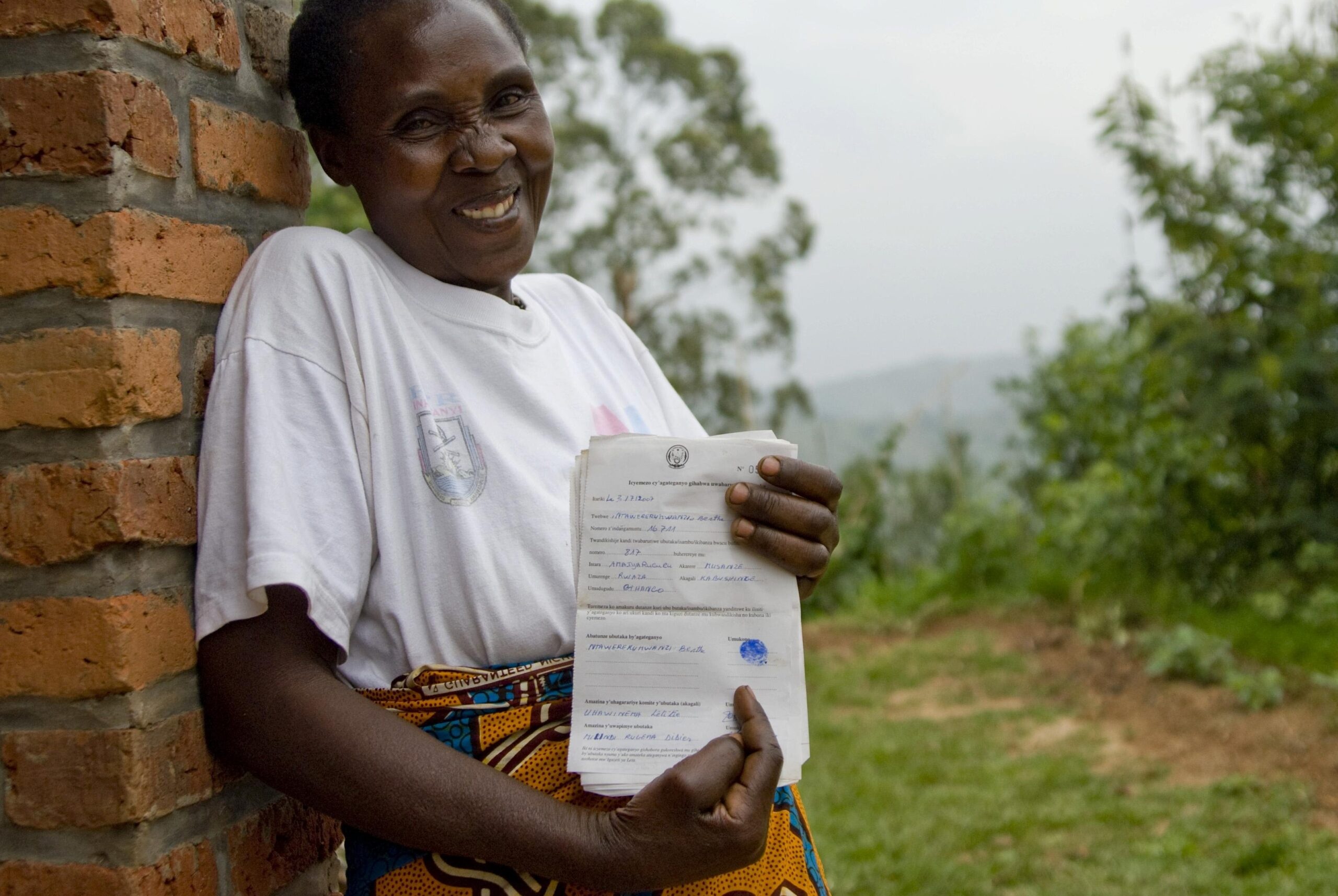
Here, a woman in Rwanda shows off the title to her land.